

Picture a garden centre on the ring road outside Leeds. Since the spring it has offered click and collect: you order compost, bedding plants or a new patio set on the website, then drive round to a bay beside the car park. A QR code on each collection slip leads to one question. In April, 88 per cent of replies are positive. Over the late May bank holiday that falls to 71. Nothing on the website had changed. Two of the yard staff were off sick, and customers stood in the drizzle for twenty minutes to collect a bag of multi-purpose compost.
The Customer Satisfaction Score is a metric for measuring how satisfied customers are with one specific experience, whether that’s a purchase, a delivery or a call to customer services. Shortly after that experience, people rate it from 1 (very dissatisfied) to 5 (very satisfied). Your CSAT is the percentage of them who picked 4 or 5. By the final section you’ll have calculated one yourself, you’ll know which bands to read it against and you’ll recognise the three situations in which it quietly misleads.
📌 Key points at a glance
- CSAT rates one experience on a five point scale, 1 to 5.
- Satisfied means a 4 or a 5, nothing else.
- CSAT = satisfied answers ÷ all answers × 100.
- Results range from 0 to 100 per cent.
- Best asked within hours of a purchase, delivery or support call.
Create a survey for free
With empirio.ai you can create a modern online survey in minutes — with hosting in the EU.
- AI-built survey
- Adjust by drag & drop
- Real-time analysis
What is the CSAT?
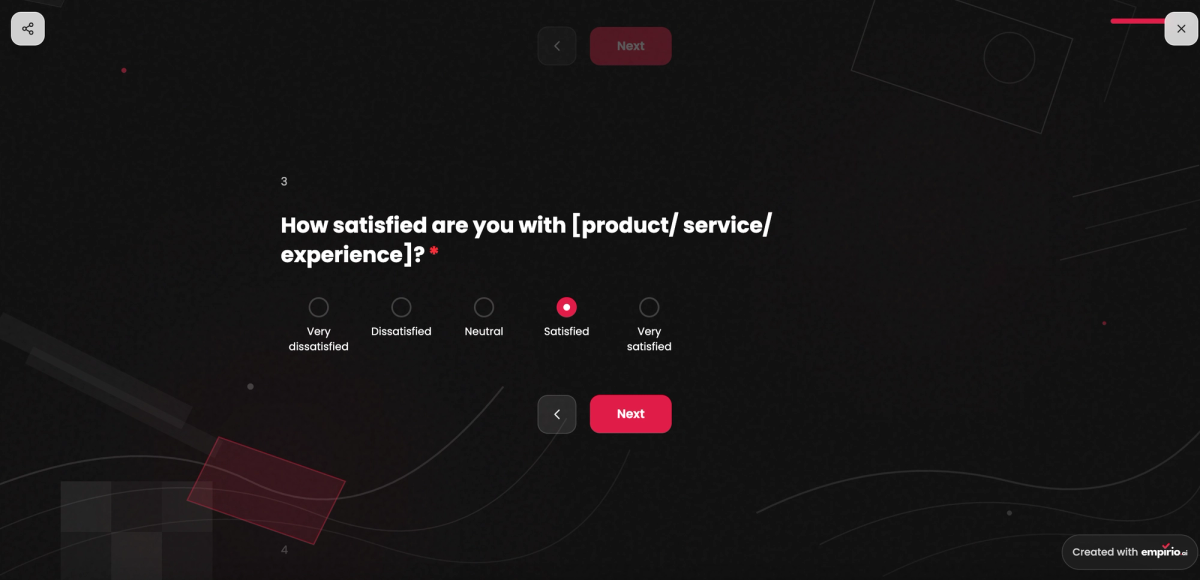
Behind the abbreviation CSAT, short for Customer Satisfaction Score, sits a single question put at a single touchpoint:
“Overall, how satisfied are you with our service?”
Five labelled answers are on offer, running from 1 (very dissatisfied) through dissatisfied, neutral and satisfied up to 5 (very satisfied).
Unlike the NPS, the CSAT has no author and no trademark behind it. Businesses were asking customers whether they were happy long before anyone gave the practice a name. Its reach is well documented, though. When the Corporate Executive Board studied service organisations for an article in the Harvard Business Review in 2010, roughly four in five of them relied on the CSAT as their primary measure of the customer experience.
Its strength is timing. The question isn’t about your brand, your prices or your reputation. It’s about this morning’s delivery, yesterday’s phone call, the collection bay on Saturday. That narrow focus is exactly what a team needs when it is trying to repair one stage of the journey and wants evidence within weeks rather than quarters.
The difference between “satisfied” and “loyal”
Happy today does not mean back tomorrow. The same research found that one in five customers who called themselves satisfied still planned to take their business elsewhere, and 28 per cent of those who were dissatisfied planned to stay put. So read the CSAT as a verdict on an experience, not as a forecast of loyalty.
Satisfied, neutral, dissatisfied: the answer steps
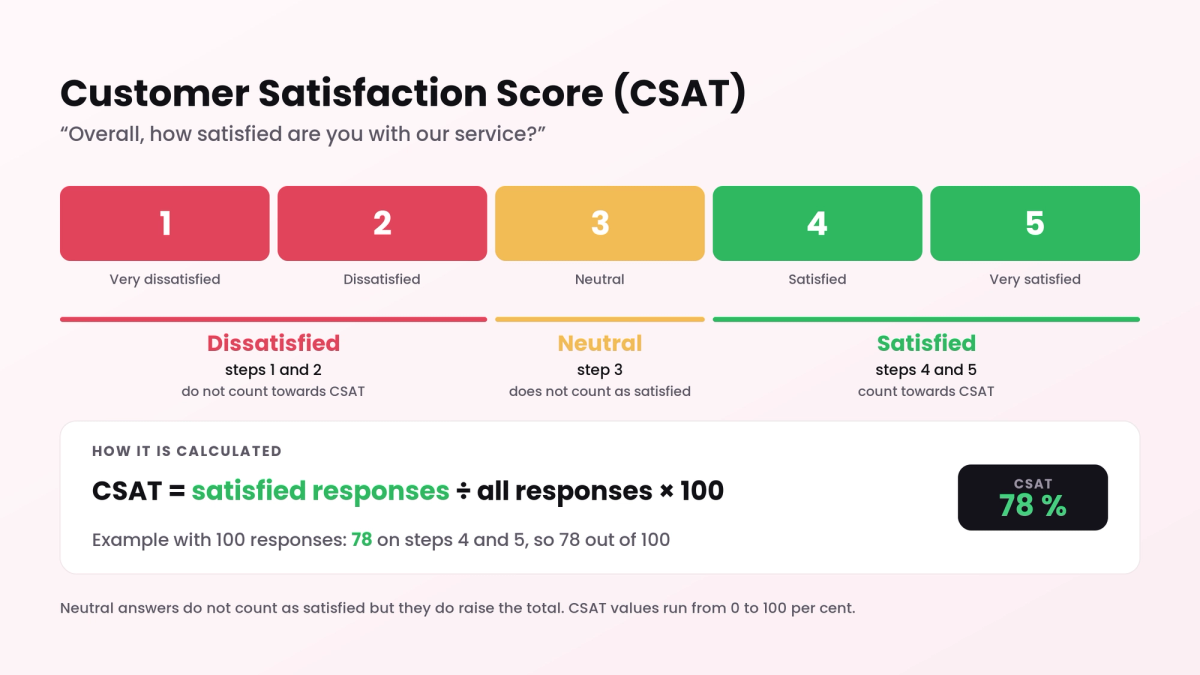
When you analyse the answers, the five steps collapse into three groups:
- Satisfied with 4 and 5: these, and only these, count towards the score.
- Neutral with 3: not counted as satisfied, yet included in the total, so every 3 pulls the result down.
- Dissatisfied with 1 and 2: the answers worth following up personally.
In market research this way of counting is known as top-two-box. The name gives it away: only the two top boxes score. A 3 earns nothing, because a lukewarm experience is not what you are aiming for. People who pick the middle rarely had a disaster, but nothing happened that they would mention over dinner either.
Variations are common. Some firms run seven steps, some use stars, some a row of faces. Any of these is fine as long as the rule about which answers count as satisfied is fixed before the first survey goes out and never touched again. Technically, each one is a rating scale whose points carry labels.
Tip
Satisfaction and effort are two separate things. The Customer Effort Score captures the second one: how much work the customer had to do. Asking both after a support case pays off. Someone whose parcel finally turned up after two chasing emails may give the driver a 4 for satisfaction and still mark the effort down hard.
Working out the CSAT: formula and worked example
The CSAT is the number of 4s and 5s divided by the number of all answers, times 100, which gives a percentage from 0 to 100.
- Count each step. Note how often 5, 4, 3, 2 and 1 were chosen.
- Combine the top two. Add the 4s and the 5s.
- Convert to a percentage. Divide by the grand total, then multiply by 100.
Got your counts? Work out your CSAT with our free calculator, which gives you the mean rating too.
Customer Satisfaction Score formula
CSAT = satisfied answers (steps 4 and 5) ÷ all answers × 100
Here is what 100 click and collect customers in Leeds said after picking up their orders:
| Step | Answers | Counts as satisfied |
|---|---|---|
| 5 very satisfied | 38 | yes |
| 4 satisfied | 40 | yes |
| 3 neutral | 11 | no |
| 2 dissatisfied | 7 | no |
| 1 very dissatisfied | 4 | no |
| Total | 100 | 78 satisfied |
The 38 fives and 40 fours add up to 78 satisfied customers out of 100, a CSAT of 78 per cent. Their average rating works out at 4.01.
Now imagine a second garden centre with the same 78 per cent but a different crowd: 31 fives, 47 fours, no threes or twos and 22 ones. Its average is only 3.65. Over a fifth of its customers were very dissatisfied, compared with 4 per cent in Leeds. The percentage misses that, the average and a glance at step 1 do not, so our calculator reports both.
Tip
Split the CSAT by touchpoint. Online ordering, collection, returns and customer services each deserve a score of their own. Averaged together, 94 per cent for the website and 63 per cent at the collection bay produce a comfortable figure that tells nobody where to act.
What is a good CSAT result?
A CSAT of 80 per cent can be excellent in one sector and mediocre in another. Ratings after a purchase tend to be kinder than ratings after a complaint, and hotel guests are harder to please than people waiting for a parcel. Our CSAT calculator therefore offers bands purely as a rough orientation, to help you read the number rather than to pass judgement on it:
- 85 to 100 per cent: very good. Nearly every customer walks away content.
- 75 to 84 per cent: good. Most are happy, though there is still something to gain.
- 60 to 74 per cent: room to improve. Between a quarter and two fifths of customers are not won over.
- 0 to 59 per cent: critical. Something fundamental is broken at this touchpoint.
CSAT results often look flattering. In Britain especially, people are reluctant to mark anyone down, so a polite “satisfied” regularly stands in for a shrug. That is why a slide of five points is worth taking seriously. The line over time at one touchpoint matters most: if satisfaction with collection slips three months running, something has changed, whatever band it still sits in.
Careful
A CSAT is not the UK Customer Satisfaction Index (UKCSI). The Institute of Customer Service has published that index twice a year since 2008. It scores organisations out of 100, based on customers’ ratings across a set of weighted measures. In July 2026 it stood at 78.3. Setting that beside your own 78 per cent might make you feel average, yet the two numbers are produced in entirely different ways. The American Customer Satisfaction Index, run from the University of Michigan since 1994, is likewise a modelled index built from several questions.
Create a survey for free
With empirio.ai you can create a modern online survey in minutes — with hosting in the EU.
- AI-built survey
- Adjust by drag & drop
- Real-time analysis
Putting the CSAT question into your questionnaire
No metric depends on timing quite as much as the CSAT. Ask while the experience is still fresh: on the card terminal once payment has gone through, by text a couple of hours after delivery, or in the email confirming that a ticket is closed. A week later, people are rating a blur of everything that has happened since.
Precise questions get precise answers. “How satisfied were you with the advice from our plant specialist today?” tells you far more than a vague “How satisfied are you with us?”. To cover several stages, repeat the satisfaction question for each one, as our CSAT survey template does. For the order of the questions around it, see our guide on how to create a questionnaire.
CSAT question checklist
- It names the experience being rated, not the company in general.
- Every one of the five points has a word label.
- Satisfied always sits on the same side of the scale.
- It goes out the same day whenever possible.
- The rule “4 and 5 count as satisfied” is agreed before launch.
- Low ratings (1 or 2) lead on to a question about the reason.
Tip
Let a 1 or 2 automatically trigger an open question, something like “What went wrong for you today?”. Happy customers skip straight past it, unhappy ones get a chance to explain. Thanks to the filter, everybody else still finishes in seconds, and your team gets reasons exactly where the score is poor.
Pros and cons of the CSAT
The CSAT is usually the first metric a business adopts, since it needs no introduction. The flip side of that familiarity is that people read more into it than it holds.
Where the CSAT is strong
- Everyone grasps a percentage of satisfied customers straight away.
- Each touchpoint can have its own score, so weak spots stand out.
- One quick question means more people bother to reply.
- Feedback arrives while there is still time to put things right.
- Shops, websites, training courses and events can all use it.
Where the CSAT is weak
- Being satisfied does not stop a customer from leaving.
- Courtesy pushes results upwards, so they often look better than reality.
- It rates a single moment and ignores the wider relationship.
- Every firm counts differently, which makes outside comparisons shaky.
- Counting only the top two boxes hides whether the rest were 1s or 3s.
Where the CSAT reaches its limits
Think of the CSAT as a photograph taken from one angle. It is accurate about what is in the frame and silent about everything outside it.
Three gaps matter most, particularly once the score starts appearing in targets or bonus schemes.
Loyalty is outside its view
According to the research in the Harvard Business Review, satisfaction and loyalty were only loosely connected. A customer can have a good experience with you and still move to a rival that is cheaper or on the way home. For intentions to return or to recommend, other metrics do a better job.
Silent customers never show up
Only people who reach a touchpoint can answer. If someone abandons their basket at checkout, or visits once and never returns, no satisfaction question ever finds them. A strong CSAT may simply mean that the disappointed customers have already left.
Other firms’ CSATs are not your CSAT
One company counts 4s and 5s on five points, another counts 6s and 7s on seven, a third only counts top marks. Each calls the result CSAT. Figures published elsewhere are therefore at most a vague reference and never a target.
The CSAT judges the moment, not the relationship.
CSAT, CES and NPS: where they differ
Three metrics dominate customer surveys, and each asks something different:
- The CSAT is about satisfaction with a specific experience, so it judges the moment.
- The CES (Customer Effort Score) is about how much work it took to get something done, so it judges the route.
- The NPS (Net Promoter Score) is about willingness to recommend you, so it judges the relationship.
Our comparison of NPS, CSAT and CES sets out when each fits best and how they work together.
Typical CSAT survey mistakes
A CSAT survey can be live in an afternoon and skewed by the end of the week. For the general principles, have a look at our 8 tips for creating the perfect online survey. The three errors below are the ones that crop up most with the CSAT.
Asking late, or asking vaguely
Send the question a fortnight after purchase and the answer covers the fortnight, not the purchase. An unanchored “How satisfied are you with us?” has the same problem. Tie the question to one experience and ask within hours.
Surveying only the tickets that were closed happily
Plenty of helpdesk tools trigger the CSAT only when an agent marks a case as resolved. Customers whose problem never got fixed are never asked, so the score climbs without the service improving at all. Survey every closed contact, the messy ones included.
Moving the goalposts
Five labelled points turn into emojis, top-two becomes top-one, or the neutral option quietly disappears. Each change shifts the result although customers feel exactly as they did before. Decide on the scale and the counting rule once, document both and pass the document on, so that next year’s figures can still be set against this year’s.
Conclusion
Few metrics are as quick to set up or as easy to explain as the CSAT, and few are as easy to over-interpret. Treat it as a close-up of one moment rather than a portrait of the relationship. Tie the question to a specific experience, send it promptly, count only the 4s and 5s, ask unhappy customers why and score each touchpoint separately. Then it will show you, week by week, exactly where your customers’ experience needs work!
What to read next
- Planning a bigger survey of your customers? Our guide to customer surveys
- Results in and want more out of them? How to analyse your questionnaire in five steps
Ready to measure satisfaction at every touchpoint?
empirio.ai is an online survey tool from Germany. You can set up your customer survey in minutes and share it by link or as a QR code on a receipt or collection slip. Our CSAT template already includes a satisfaction question for each stage.