
Shopping, dining out, or quickly sending an email on the smartphone: Our everyday activities shape not only our daily lives but also reflect the economic success of many service providers and companies. Whether there will be fewer retail stores in city centers in the future or whether all retail will take place in the digital world ultimately depends on customers' needs.
To survive in the modern business world, companies must regularly monitor customer satisfaction and respond appropriately to customer concerns. But how do companies know what needs their customers have or whether they are actually satisfied with the offered product or service? Well, the simplest way is to ask customers directly.
In this article, we show you how to conduct a customer survey and what role the Net Promoter Score can play.

Create a survey for free
With empirio.ai you can create a modern online survey in minutes — with hosting in the EU.
- AI-built survey
- Adjust by drag & drop
- Real-time analysis
Customer Survey: Definition & Goals
Particularly in the service and retail sectors, service quality and customer satisfaction are most frequently captured using quantitative and systematic surveys.
Typically, the following topics are the focus of a customer survey:
- The quality of the products or services offered
- The reliability and availability of the products or services
- The speed and efficiency with which customer inquiries or problems are processed
- The friendliness and helpfulness of customer service
- The transparency and honesty in dealing with customers
- The price-to-performance ratio of the products or services
For data collection, a standardized questionnaire is designed, which consists predominantly of closed questions with a Likert scale. This allows surveyed customers to give their subjective assessment regarding the service or existing offer.
Example:
On the shop page I could quickly find the product I was looking for. (Please select one answer.)
1. I completely disagree
2. I disagree
3. I neither agree nor disagree
4. I agree
5. I completely agree
Subsequently, the insights gained are used to improve the service offered. The results of a customer survey can, for example, lead to an expansion of the product or service offering or be used in training and employee development programs.
Net Promoter Score: Simplest Way to Measure Customer Satisfaction
The question of customer satisfaction is a very complex topic in which many different aspects must be considered. Fundamentally, however, it is true that satisfied customers both generally buy more and repeatedly return to the same company – and ideally even recommend the company to other customers.
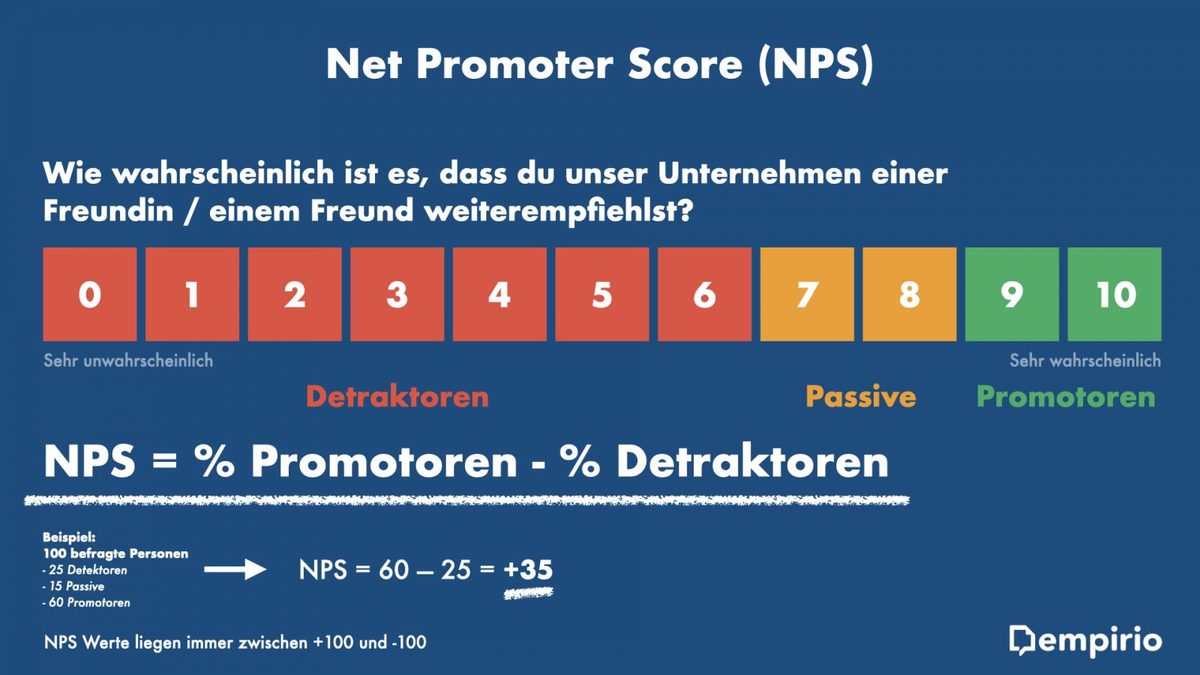
To measure this degree of customer loyalty and customer satisfaction objectively, American business expert Fred Reichheld proposes a simple method: Net Promoter Score. To determine this, customers must answer a simple question:
How likely would you be to recommend this company to your friends or colleagues?'' Please answer on a scale from 0 (absolutely unlikely) to 10 (extremely likely).
The question about recommendation, the results of which are used to calculate the NPS, can be asked as part of a comprehensive customer survey or can also be conducted separately (e.g., directly as a pop-up following the customer's online order). For evaluation of the survey, participants are divided into three categories based on their answer:
- Promoters or extremely satisfied customers (answer 9 or 10)
- Passives or passively satisfied customers (answer 7 or 8)
- Detractors or critics (answer 0 to 6)
In the calculation of the NPS all customers are considered as 100 percent and then the percentage share of promoters and detractors is derived from this. Then the number of detractors is subtracted from the promoters.
Example:
If the survey shows 60 percent promoters and 25 percent detractors, the NPS value is +35 (= 60-25). With your own figures you can calculate the NPS in the calculator.
In practice, companies can achieve NPS values of 50 percent and higher. However, average companies typically range from 5 to 10 percent. But negative NPS values are also not uncommon and indicate that customer satisfaction should be considered rather low.
As part of a larger customer survey, you can then specifically search for causes of existing dissatisfaction.
Conclusion: Recognize Customer Satisfaction Early – Thanks to the NPS
Due to the digital availability of offers, consumer expectations and needs are higher than ever before. Both customer and brand loyalty as well as a company's growth are directly linked to customer satisfaction. After all, without happy customers, no business can survive.
The simplest method for measuring customer satisfaction or dissatisfaction is the Net Promoter Score (NPS). The NPS can be used as a continuous monitoring tool for customer or employee feedback across industries and is also easy to calculate in a fun way. Using the value obtained, companies can very quickly determine whether there is a need for optimization in the service offered.
At the same time, the Net Promoter Score also has its limitations: Specific reasons for possible dissatisfaction cannot be determined with it. To find these out, an additional online survey with follow-up questions to customers is a good idea!
Surveying customers in several countries means the questionnaire belongs in their language. How that works is in Multilingual survey: how to set one up in four steps.