

The last question is answered and the “Submit” button has been clicked. What happens next? In many surveys, this is where a flat “Thank you for your participation” appears, or nothing at all.
Yet this is the one page of your survey that everyone who stays to the end is guaranteed to see. The catch: because the data is already in the system by then, it’s the last page to be written and the first to be forgotten.
The closing page of a survey needs a sentence of thanks for taking part and a note on what will happen to the results. Depending on the survey, you can add a way to get in touch with questions and a pointer to where people go next. Anything that needs contact details, such as a prize draw, also belongs here rather than among the questions.
📌 Key points at a glance
- Every closing page needs a thank-you and a note on the results.
- The thank-you only goes on the end page, after people have submitted.
- Ask for contact details for a prize draw only after submission.
- Two to four sentences are enough for the closing message.
- A promise about the results only counts if it has a date.
- In empirio.ai, you switch on the end page with a single click.
Create a survey for free
With empirio.ai you can create a modern online survey in minutes — with hosting in the EU.
- AI-built survey
- Adjust by drag & drop
- Real-time analysis
Why the last page matters more than you’d think
For the answers to this survey, the closing message genuinely makes no difference. For the next survey, it does. People who feel they’ve been given a proper send-off will click the link again next time.
That applies to more people than you might expect. Clubs survey their members every year, companies ask customers for feedback after every purchase and universities evaluate their modules every term. Your closing page lays the groundwork for a good turnout next time round.
There’s a practical reason too. Many respondents still have something to say after the last question, a query or a comment that didn’t fit into any answer box. Without a way to get in touch, that gets lost, even though these are often the most revealing responses of all.
In short, the closing page isn’t a polite formality but a handover. It says what happens now and who is looking after it.
What belongs on the closing page
The following five points cover almost every survey. You won’t always need all of them. Either way, the page needs no more than two to four sentences, because the real work is already done by this point.
- One sentence of thanks, specific and free of stock phrases.
- What happens to the results and when.
- If needed, a contact for questions. In an employee survey, people usually know who is responsible anyway.
- If there is one: how to enter the prize draw or claim the reward.
- If you like: where people go next, for example back to your website or to the internal dashboard.
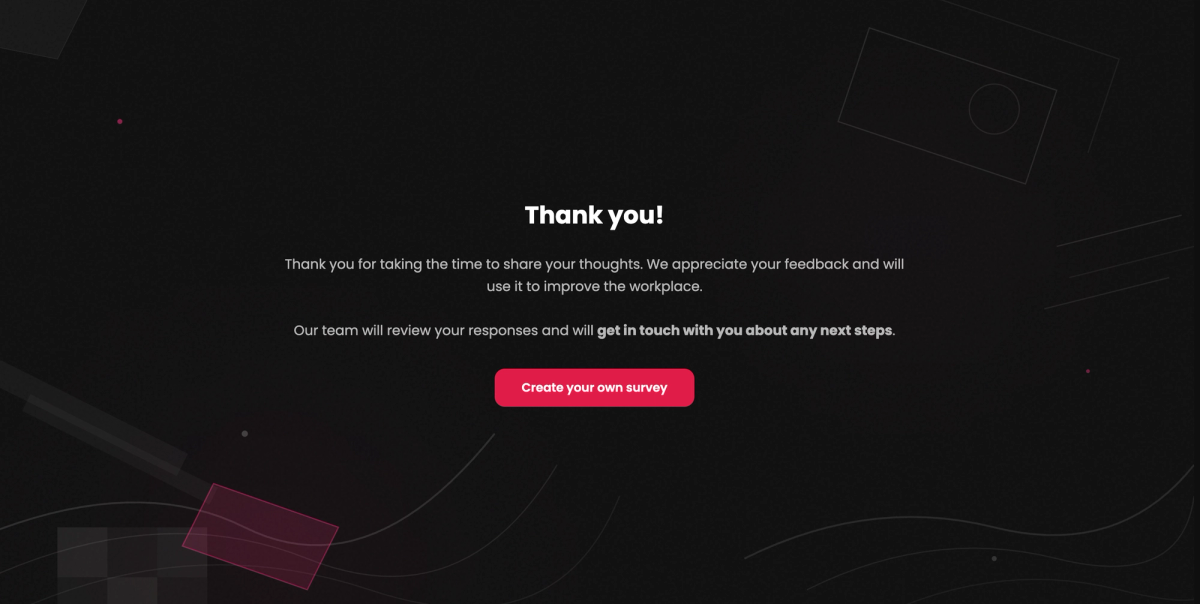
The end page of this employee survey says thank you and announces that the team will be in touch about the next steps. All that’s missing is a date. Only with a date does the friendly sentence become a promise that people can hold you to. A contact address isn’t needed here, because everyone already knows who is behind the survey.
The second point has the strongest effect, yet it’s the one most often left out. “We’ll publish the results in the members’ area in December” is a promise people can check. “We will carefully review your feedback” is not.
The privacy notice and consent don’t belong on the closing page. They come before the first question on your topic, as the overview of how to structure a survey shows. On the last page, a pointer to where people can read that information again is the most you need.
Four closing messages to adapt
These four examples cover the most common cases. You can use them word for word and just replace the details in square brackets.
All four have two things in common: the thanks comes in the first sentence and the promise about the results has a date. What differs is the tone and whether you need contact details at all.
Customer survey with a prize draw
In a customer survey with a prize draw, two things come together: the thank-you and the draw. It’s important that the email address is a separate, optional step and not simply question fifteen. Anyone who doesn’t want to enter should be able to leave the page without typing anything. Right alongside it goes a note that the address is stored separately from the answers.
Thank you for taking two minutes to do this! [Name] reads your feedback personally.
We’ll analyse all the responses at the beginning of [month].
If you’d like to enter the prize draw, follow the link below and add your email address there. It’s stored separately from your answers.
You’ll find suitable questions ready to use in our customer survey template.
Employee survey
In an employee survey, the closing page is read especially closely, because everyone wants to know whether anything will really change. A date and a setting, such as the staff meeting, are worth more here than any form of thanks. Keep that promise once and the next survey usually brings noticeably more candid answers.
Thank you for your time and for your honest answers!
We’ll present the results at the staff meeting on [date], together with the actions that follow from them. Individual answers won’t be shown.
If you have any questions about the survey, HR will be happy to help at [email address].
You’ll find a complete survey with an introduction, questions and end page in the employee satisfaction template.
Survey for your dissertation
In a survey for your dissertation, there’s one point the other messages leave out: deleting the data. Half a sentence is enough and it answers a question many people have at the back of their mind while filling in the survey. If you offer to send the results later, you’ll often be surprised how many people take you up on it.
Thank you so much for completing my survey! Your answers will help me with the analysis for my undergraduate dissertation on [topic].
Once I’ve submitted it in [month], I’ll delete all the data.
If you’d like to read the results, just drop me a line at [email address].
The dissertation questionnaire template shows what a rigorous questionnaire looks like from start to finish.
Club or group survey
In a club, people know each other, so the message can sound personal. Asking people to pass on the link also works here, because members can often reach others better than you can. In a customer survey, the same request tends to come across as pushy.
Thanks for taking part!
We’ll use your answers to set the dates for next year and present the results at the AGM on [date].
If you know someone who hasn’t voted yet, feel free to send them the link.
For a larger survey in your club, there’s the member survey template.
What none of the four messages contains is an apology for the length. Apologising for the effort at the end only confirms that the survey was too long. And that’s exactly what people will remember.
Prize draws and contact details without breaking anonymity
As soon as you need an email address for a prize draw, anonymity is at risk. If the field sits among the questions, the address ends up in the same record as the answers. The promise you made in the introduction no longer holds.
This isn’t a matter of interpretation. Recital 26 of the General Data Protection Regulation (GDPR) states that account should be taken of all the means reasonably likely to be used to identify a person. An address in the same record is exactly that kind of means.
The solution is simple: you ask for contact details only after submission, separately from the answers. By the time people reach the closing page, the questionnaire has already been sent, so no link between the address and the answers is ever created.
In practice, you set up a second, very short form for the prize draw and link to it from the closing page. That sounds like extra work, but it’s the safest way to keep both promises. What anonymous actually means is explained in our article on the anonymous survey.
Whether a prize draw is worth it at all and which incentives really make a difference is a separate question. There’s more on that in the article Finding survey participants.
Create a survey for free
With empirio.ai you can create a modern online survey in minutes — with hosting in the EU.
- AI-built survey
- Adjust by drag & drop
- Real-time analysis
Common mistakes at the end of a survey
Most of the following five mistakes don’t cost you data, but they do cost you trust. A lack of trust shows up in your response rate by the next survey, if not sooner. The first mistake, however, can even cost you entire responses.
These mistakes usually come down to a lack of time. The closing page is the last step before the survey goes out and by then patience has often run out.
The thank-you comes before the Submit button
The last page of questions already says “Thank you for taking part”, but the button to submit only comes after that. Many people assume the survey is over at this point and close the window without clicking “Submit”. Their response is then never completed. So save your thanks for the end page that appears after submission.
A promise about the results with no date
“We will keep you informed about the results” is a promise nobody has to keep, which is why hardly anyone does. Give a date and a place, even if both are only approximate. “In December in the members’ area” is enough and it’s a promise you can actually keep.
The prize draw is tied to the answers
The email field is the last question in the questionnaire, even though the introduction promised anonymity. The two simply don’t go together. So ask for the address only after submission and separately from the answers. If you don’t want to set that up, you’re better off dropping the prize draw and giving people another reason to take part, such as access to the results.
The thank-you is a stock phrase
“Thank you for participating in our survey” isn’t real thanks but a standard line. It appears in so many surveys that nobody properly reads it any more. A specific sentence has quite a different effect, for example: “Thanks for taking the ten minutes to do this.”
Nothing happens after clicking Submit
Without a closing page, an empty form is left on screen after the click or the survey jumps back to the start. Respondents then don’t know whether their answers have arrived. Some fill in the survey a second time and your analysis ends up with duplicate responses. So a confirmation at the end isn’t just polite but technically sensible too.
Setting up the end page in your survey
In most survey tools, the closing page isn’t a question but a page of its own after the questions. That matters, because a text-only question at the end can show up in your analysis as unanswered and distort the completion rate.
In empirio.ai, you switch on the end page in the editor with the toggle at the very bottom of the sidebar, directly below your last question. You then edit the heading and text directly in the preview and can add an image if you like.
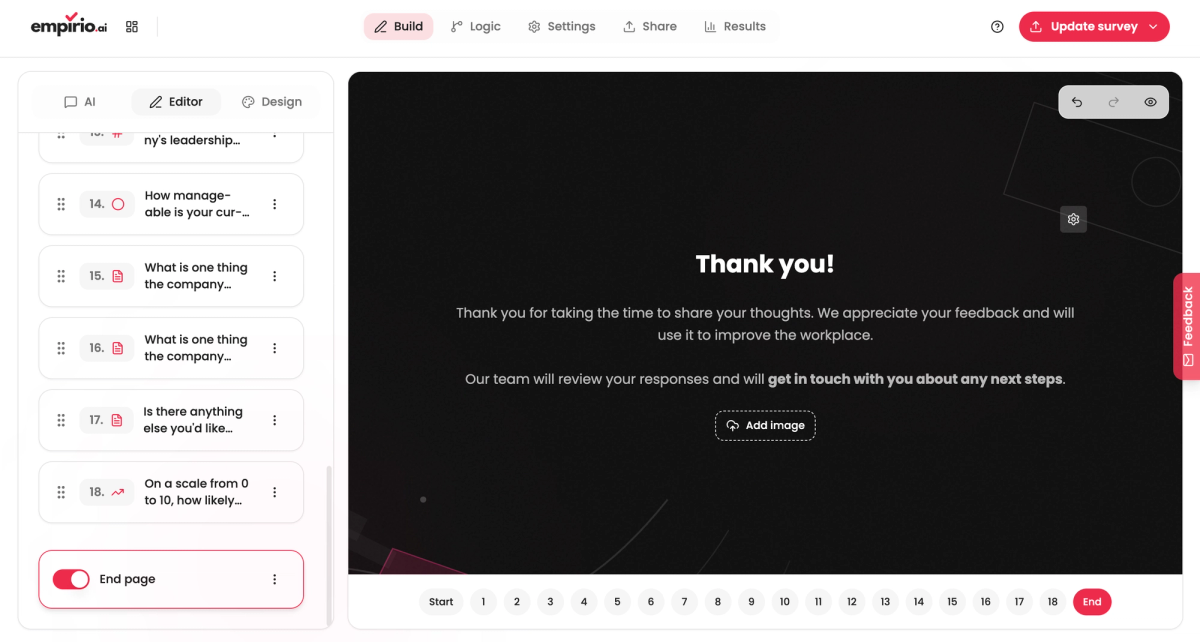
Make a point of using this end page for your thank-you rather than an ordinary page at the end of the questions. Ideally, write it straight after the introduction rather than leaving it until the very end. That way you still remember what you promised at the start and the two texts match.
Redirecting after the survey
From the end page, you can send respondents back to where they came from or on to wherever they need to go next. In a customer survey, that’s usually your website or online shop, in an employee survey the internal dashboard or intranet and in a prize draw the separate form for the email address.
What matters is that you announce the redirect. A sentence such as “The button below takes you back to our website” is enough. An unexpected redirect, on the other hand, looks like an error and leaves people wondering whether their answers arrived.
Note
In empirio.ai, the end page automatically follows the last question and only appears once the answers have been submitted. You can switch it off again at any time without touching the questions.
Conclusion
With the closing page, you make sure with very little effort that people take part again next time. All it takes is a few sentences: a specific thank-you, a promise about the results with a date and, where needed, an email address for questions.
Two points even affect the data itself. The thank-you belongs on the end page after submission, not on the last page of questions. And you ask for contact details for a prize draw only after submission, never in the questionnaire itself.
Where to go next
- Writing the text before the first question? Survey welcome message
- Want to see the whole process? How to structure a survey
- Reworking the questions themselves? Create a questionnaire
Want an end page without having to build it yourself?
In empirio.ai, the end page is part of the survey from the start. All you do is fill in the heading and text.