

Picture a local council asking residents about a proposed cycle lane. One version of the form offers a five point scale running from strongly support to strongly oppose, another version leaves a blank box under the words “What should the council know before it decides?”. Both forms ask about the same stretch of road, and yet the two piles of answers will look nothing alike.
Open questions let respondents answer freely, closed questions supply the choices in advance. Only the response format separates them: both forms demand the same mental work of understanding and remembering, and they part company at the final step, when an answer has to take its shape. By the end of this article you will know which form suits your research question and how to combine the two sensibly.
📌 The key points at a glance
- Closed questions supply the answers, open questions leave a text box.
- UK government guidance recommends at least a 5-point rating scale.
- GESIS distinguishes three response formats rather than two.
- Semi-open questions pair a set list with a field for anything else.
- Question form decides only the last of four mental steps.
Create a survey for free
With empirio.ai you can create a modern online survey in minutes — with hosting in the EU.
- AI-built survey
- Adjust by drag & drop
- Real-time analysis
Closed vs. open questions
Closed and open questions differ in exactly one respect: with a closed question the answer choices already stand in the questionnaire, with an open question respondents word the answer themselves. Everything else, from the analysis to the strength of your conclusions, follows from that single decision.
Closed questions produce quantitative data, meaning numbers you can count and compare. Open questions produce qualitative data, meaning text that has to be sorted before it can be counted. Rather than a question of effort, the choice is a question of what you want to learn: whoever needs to know how many needs categories, and whoever needs to know why needs the words of the respondents themselves.
Guidance written for UK government surveys draws the same line. The Questionnaire design guidance of the Government Analysis Function, owned by the Data Quality Hub at the Office for National Statistics and published on 14 March 2023, treats the response options as a design decision in their own right and sets separate rules for open questions, limited choice questions and multiple choice questions. Accessed for this article on 27 August 2026, the page carries a notice that it is under review and awaiting updates.
| Feature | Closed questions | Open questions |
|---|---|---|
| Response format | choices are given | free text field |
| Kind of data | quantitative | qualitative |
| Effort for respondents | low | high |
| Analysis | count the answers | code first, then count |
| New content | not possible | expressly possible |
| Typical risk | the list skews the result | drop-outs or empty fields |
Both forms appear in surveys of every kind, in person as much as in an online survey. The difference in the response format stays the same throughout, only the analysis usually costs less time online.
What is a closed question?
A closed question supplies the answer choices, and respondents select one or several of them. Your questionnaire settles in advance which answers are possible at all, and precisely there sit both the strength and the weakness of this form.
Underneath the familiar two-way split hides a distinction that matters a great deal in practice. Lenzner and Menold (2015) separate not two but three response formats in the German-language GESIS Survey Guidelines on question wording: open questions, closed questions with a rating scale and closed questions without one. Separate rules apply to each of the two closed forms.
Closed questions with a rating scale
A rating scale grades the answer choices along a single dimension, running for instance from very important to not at all important, and respondents place themselves somewhere on it. On the length of that scale the Government Analysis Function is precise: “A minimum of a 5-point Likert scale is recommended as one of the most reliable ways to measure degrees of opinions, perceptions, and behaviours. A 7-point Likert scale gives even more detailed answers for analysis.”
Where the middle of a scale sits matters just as much as the number of steps. Guidance from the same source states that the scale “ranges from one extreme to the other and should always include a neutral option in the middle of the scale”. Because the sequence itself carries meaning, the order of a rating scale stays fixed for every respondent.
Closed questions without a rating scale
A list without any internal grading covers cases such as degree subjects or political parties. UK government guidance splits that case in two, using limited choice question for a question with exactly one permitted answer (single-choice questions) and multiple choice question for one that allows several (multiple-choice questions). Since no natural order exists, the position in the list influences the choice, and randomising the order for each respondent evens that out.
Order still matters in one deliberate way. The same guidance advises you to “put response categories that are more socially desirable than others at the end of the list”, and it explains that placing them last helps to reduce bias.
Examples of closed questions
- What is your favourite city in the UK? Edinburgh, Cardiff, Bristol, York
- Have you ever been to York? Yes, no
- How would you rate your last holiday? From very good to very poor
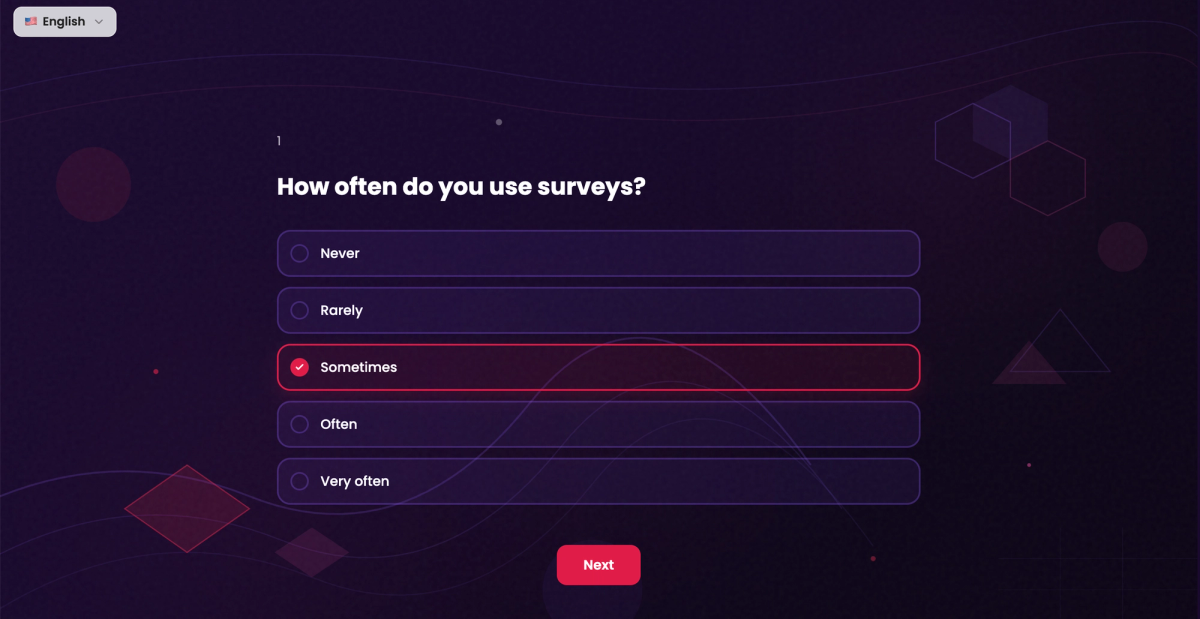
Answer categories have to be exhaustive and mutually exclusive, and the Government Analysis Function adds a practical limit on top: “find a balance in the number of categories”. Too many categories cause respondent burden, too few may not reflect where a respondent actually stands. How you build such categories and how many steps a scale can carry is set out at length in the article on closed questions.
What is an open question?
An open question offers no answer choices at all, only the question text and an empty field. Respondents answer in their own words, and those words are the result that no list of options could ever produce.
Open questions usually start with one of the classic question words, so with why, how, what or which. Yet the question word alone does not make a question open. What counts is whether the question can be answered with a plain yes or no: “Do you know why Edinburgh is such a popular place to visit?” invites a curt yes, while “Which reasons speak for Edinburgh?” does not.
On the question of when to reach for the format, the Government Analysis Function is unambiguous: “Open-ended questions are suitable for exploratory phases when there is not enough information to develop appropriate categories.” Whenever you cannot yet name the categories, in other words, a blank box is not laziness but the only honest option.
Examples of open questions
- Why is Edinburgh your favourite city?
- What do you dislike about Bristol?
- Which other cities have you travelled to?
- What would you like to tell us before you finish?
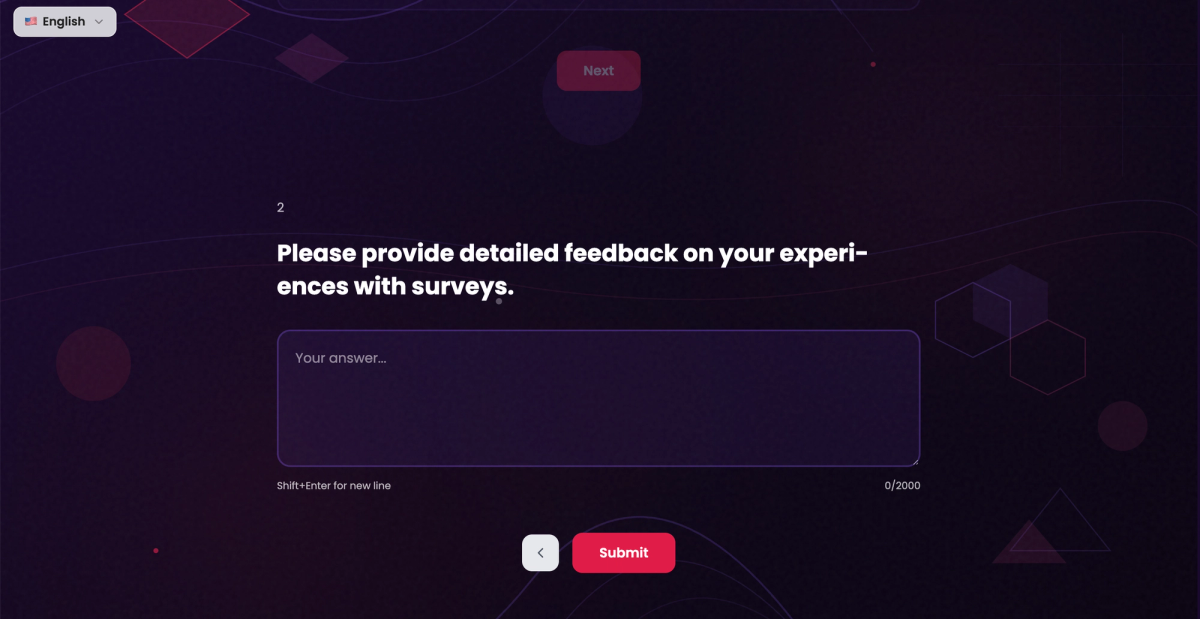
Free text costs your respondents time, which is why a questionnaire rarely carries more than a handful of open questions. How you code those answers afterwards and still arrive at numbers is shown in the article on open questions.
Semi-open questions: the hybrid of both
A semi-open question offers a list of answer choices and adds a free text field, usually labelled “other, please specify”. You get countable categories and still keep whatever escaped you while you were building the list.
In the literature the same form travels under several names, since semi-open, partly open and semi-closed all mean the same thing. Lenzner and Menold (2015) recommend the other category expressly for every case in which the possible answers cannot be listed in full, and with substantive questions that is the rule rather than the exception. UK government guidance arrives at the same place from another direction, because its own worked example of a response list ends with an other category.
Without that category two things can happen, and neither of them is good. When an obvious answer is missing, a question either stays unanswered, or something gets ticked at random. Annoying in the first case, dangerous in the second, because a random tick looks like a result in the analysis rather than like an error.
When the hybrid form pays off
Semi-open questions make sense whenever you know the subject area well but not completely. A question about how someone travels to work covers almost everything with six categories, from car and bus to train, tram, bicycle and on foot, but not the cargo bike and not the campervan. Equally, the form pays off at the end of a questionnaire, where one open question about anything remaining often yields the most usable pointers.
What you have to watch
The free text field belongs directly beside its category and not in a question of its own, otherwise nobody sees it. In the analysis you handle these answers separately: first you check whether several of them merge into a new category, then you count them alongside the given ones. Government guidance also advises you to “include a ‘Don’t Know’ or ‘Unsure’ option at the end of all your response categories, where appropriate”.
💡 Tip
Read the other answers once about 30 people have taken part. When the same thing turns up three times, you can still add the category to the list while the survey is running.
Create a survey for free
With empirio.ai you can create a modern online survey in minutes — with hosting in the EU.
- AI-built survey
- Adjust by drag & drop
- Real-time analysis
The wording of the questions matters
Question wording decides more about the quality of your data than the question form does, and a solid reason stands behind that: of the four mental steps a respondent goes through, the question form touches only the last one.
Lenzner and Menold (2015) describe this response process after Tourangeau as four tasks in the German-language GESIS Survey Guidelines: understanding the question, retrieving the relevant information, forming a judgement from it and expressing that judgement in the given format. Whether you ask openly or with fixed choices takes effect only at the fourth stage. The first three hang entirely on the question text, and there arise the errors that no amount of later work can repair.
What every question has to satisfy, whatever its form
- One issue per question, never two stimuli at once.
- No jargon, technical terms or abbreviations in the question text.
- No vague words such as often or recently.
- No double negatives, and ideally no negation at all.
- No leading questions, both alternatives spelled out.
- Short active sentences instead of passives and nominalisations.
An example from the same source shows how quickly this goes wrong. The statement that the state must ensure a decent living in illness, hardship, unemployment and old age carries four issues at once. Anyone who supports three of them and rejects the fourth cannot answer the question, and anyone who answers regardless produces a number that nobody can interpret afterwards.
⚠️ Watch out
Plain language is not a nicety in a UK survey. The Government Analysis Function puts the target plainly: “Remember the average reading age in the UK is 9 years old.” Read every question aloud before you send it, and rewrite anything a nine-year-old would stumble over.
No answer list in the world can rescue a badly worded question.
Final decision
Which question form you take is decided by the kind of statement you want to make at the end. Do you need shares, comparisons and charts, then the road runs through closed questions. Do you need reasons, phrasings and new aspects, then you need open ones.
For the typical standardised survey one weighting has proved itself: mostly closed questions for the measurable content, plus a few open ones at the points where the why interests you. Such a mixture keeps the analysis workload manageable without giving up the explanations your respondents can offer.
| Your goal | Suitable question form | The reason behind it |
|---|---|---|
| Report shares and comparisons | closed | countable straight off, with no rework |
| Understand the reason behind an answer | open, as a follow-up | a list of choices does not know the reason |
| Explore an unfamiliar subject area | open | categories cannot be formed yet |
| Ask about an almost complete list | semi-open | catches the cases you overlooked |
| Reach many respondents quickly | closed | lowest effort for the respondents |
| Collect quotable statements | open | only original wording can be quoted |
Which further question forms you will meet in a questionnaire, from the matrix to the ranking, is sorted out in the overview of question types in surveys.
Conclusion
Choosing between open and closed questions is not a matter of taste but an anticipation of the analysis: whatever you fix as a category up front you can count later, and whatever you leave open you have to sort out later. Yet neither of the two forms decides on its own how good your data turns out.
Question wording does, and that is the same work in both cases. Whichever form you settle on, the Government Analysis Function guidance gives you a workable benchmark for a UK audience: one issue per question, a rating scale of at least five points with a neutral middle, an other category wherever the list may fall short, and language a nine-year-old could follow.
Where to go next
- Want to build answer categories properly? Closed-Ended Questions: Definition, Types, Pros and Cons
- Need to analyse free-text answers? Open-Ended Questions: Definition, Examples, Pros and Cons
- Looking for further question forms? Question Types and Answers in Questionnaires
- Building your questionnaire right now? Questionnaire Design: How to Create a Questionnaire
The UK rules quoted here come from the Questionnaire design guidance of the Government Analysis Function, published on 14 March 2023 and accessed on 27 August 2026, and the German-language rules on question wording are published in full by Lenzner and Menold (2015).
Want to try both question forms side by side?
With empirio.ai, an online survey tool from Germany, you can put free text fields, answer lists and rating scales into the same questionnaire and watch the results come in live. Create a survey for free