

Picture two module evaluation forms side by side. On the first, “Which year of your course are you in?” lets you tick five boxes at once. On the second it lets you tick exactly one, and only the second form leaves you with a distribution that goes straight into a pie chart.
A single choice question is a closed question that offers several set answer options and lets each respondent pick exactly one of them. Every option rules the others out, so each person leaves exactly one value per question and the analysis stays unambiguous. By the end of this article you will know which level of measurement your question creates, how many answer options are sensible and what changes once the same question sits on an exam paper.
📌 The key points at a glance
- Single choice questions allow exactly one answer from several set options.
- The answer options set the level of measurement, not the format.
- Answer categories must not overlap and must fit everyone.
- UK medical exams call the same format a single best answer.
- Negative marking is allowed here only if candidates are told beforehand.
Create a survey for free
With empirio.ai you can create a modern online survey in minutes — with hosting in the EU.
- AI-built survey
- Adjust by drag & drop
- Real-time analysis
What are single choice questions? The definition
A single choice question is a form of closed question in which the respondent picks exactly one category from a set list. The shortest version offers only two options and is called a dichotomous question.
Question: Do you have a part-time job alongside your course? Answers: “Yes” or “No”
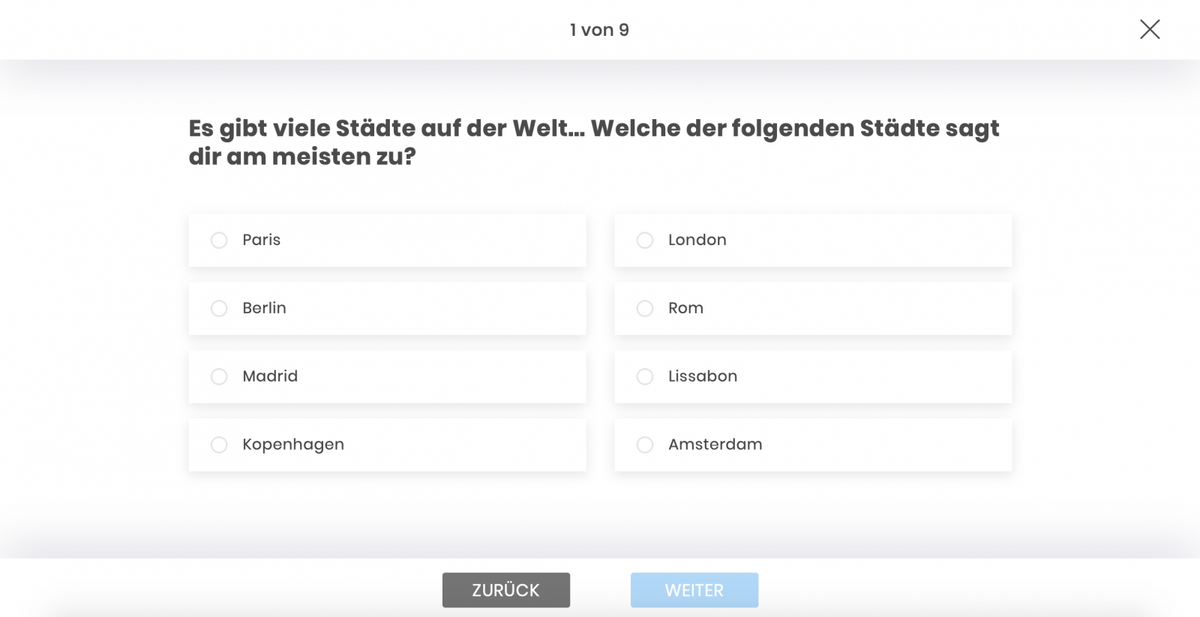
What separates the format from a multiple selection is the number of ticks allowed. Survey software usually renders single choice as a radio button, and as a drop-down list once the option list runs long: tick a second option and the first one clears itself. Because the categories rule each other out in substance, the shares of the valid answers add up to 100 per cent at the analysis stage. The Government Analysis Function makes the same point from the respondent side in its questionnaire design guidance, noting that “round circles suggest respondents should choose one response option only”.
That clarity is also why the format survives in high stakes assessment, where an ambiguous tick would be indefensible.
Two names for one format
Survey methodology and assessment practice in the UK use different words for the same thing. The Government Analysis Function calls it a limited choice question, defined as one that lets “respondents choose only one response category”. Medical schools and the General Medical Council call it a single best answer, usually shortened to SBA. Survey tools mostly say single choice, and all three describe one question with one permitted tick.
Where single choice questions are used
Single choice questions belong wherever exactly one value applies per person: one degree subject, one region, one age band, one employment status. The format therefore carries almost every demographic block at the foot of a questionnaire.
The second big use is the routing question. “Have you taken part in an online survey in the past twelve months?” decides what a respondent sees next, and the routing only works if exactly one answer is possible. When creating a questionnaire, settling the routing questions first saves a lot of rework later.
Third, every single item of a rating scale is technically a single choice question. The options there carry a rank order, with each step standing above the one below it:
How useful did you find the library induction session?
- Very useful
- Useful
- Neither useful nor not useful
- Not very useful
- Not at all useful
Balanced wording of that kind is what the questionnaire design guidance of the Government Analysis Function (2023) recommends, along with at least five scale points and a neutral option in the middle.
Which level of measurement do single choice questions have?
The level of measurement of a single choice question is set by the answer options. Options that sit side by side as equals produce a nominal scale. Options that carry a visible rank order produce an ordinal scale, and options that are counted quantities with a true zero, such as the number of children or the year of study, reach metric level.
The distinction is no label. It decides what you may calculate afterwards. A mean across regions is meaningless, however willingly the software prints one, while counts and a mode describe the same data properly.
| Answer options | Level of measurement | What you can sensibly report |
|---|---|---|
| Degree subject, region, yes or no | Nominal scale | Counts, percentages, mode, cross-tabulation |
| Never, rarely, sometimes, often, always | Ordinal scale | Median, quartiles, rank correlation |
| Age bands, number of children, year of study | Banded metric quantity | Median and quartiles, a mean only from class midpoints |
Yes or no answers deserve a footnote of their own. Code them as 0 and 1 and the mean comes out as the exact proportion of yes votes, which is the one calculation nominal data still supports.
The contested case: rating steps and the gaps between them
The argument starts at the second row, as soon as someone wants to average the steps. Ranked options tell you that “often” outranks “sometimes”. Whether the gap between those two words matches the gap between “sometimes” and “rarely” is an assumption you bring to the data, and the question itself never supplies it. The Government Analysis Function guidance describes such response sets as scalar and sets out how many points to offer, while saying nothing about the steps being equal. Where published work does treat rating data as interval data, the case rests on the summed score across several items of a Likert scale; a mean over one single item stays open to challenge. For an undergraduate dissertation the consequence is small but firm: state that decision in your methods chapter and give your reason.
The question type never decides the analysis. The order inside the answer options does.
Single choice or multiple choice: which fits when?
Single choice fits when the answer options rule each other out, and multiple choice fits when several answers can be true at once. The test is quick: if you can picture one person for whom two options are both correct, single choice is the wrong format.
The price of the decision shows up in the analysis. With single choice the shares of the valid answers add up to 100 per cent; with multiple choice they climb well past that mark, because one respondent contributes several ticks. Put both in one chart and you are comparing two different quantities.
| Question | Format that fits |
|---|---|
| Which year of your course are you in? | Single choice |
| Which languages do you speak at home? | Multiple choice |
| How satisfied are you with your personal tutor? | Single choice on a rating scale |
| What was missing from induction week? | Open question |
Questionnaires come unstuck most often on the last of those four questions. Where the possible answers are not yet known, any list of options is guesswork dressed as data. An open question is the honest choice, and its answers give you the categories for the next round of fieldwork.
Create a survey for free
With empirio.ai you can create a modern online survey in minutes — with hosting in the EU.
- AI-built survey
- Adjust by drag & drop
- Real-time analysis
Single choice questions in exams and assessments
Single choice items in UK assessment usually travel under a different name: medical schools, the General Medical Council and most question banks call them single best answer questions, built from a short scenario, a question and a set of options of which exactly one is correct. The wrong options are called distractors.
A survey uses the shape to measure an opinion and an exam to measure knowledge. A survey option may stay a little vague and still be analysed, an exam option may not: a candidate who can defend a second answer has a case for the board of examiners.
What the format looks like in a UK exam
PLAB 1, the applied knowledge test the General Medical Council runs for internationally qualified doctors, is the clearest published example. The GMC describes it as “180 multiple choice questions which you must answer within three hours”, where the candidate chooses “the right answer out of the five possible answers given”. Five options, one key, no partial credit: see the GMC guidance on the PLAB 1 exam.
Marking: one mark or none
One option is the key and every other is wrong, so the mark scheme gives the full mark for the right tick and zero for anything else. Partial credit belongs to formats that permit more than one selection: guidance from the University of Manchester on Blackboard tests lists partial credit for multiple answer questions, while the plain multiple choice type takes a single answer and is marked automatically.
Negative marking is allowed in the UK, on conditions
Negative marking, where a wrong tick costs marks, is permitted in UK higher education but hedged about. The University of Bristol sets the conditions out in section 20 of its regulations and code of practice for taught programmes: it “may be employed in subjects where it is essential that the student should not guess the right answer”, and if it is used, “this must be with the full knowledge of the student”, with an appropriate rubric on the cover of the paper and a chance to practise the format first, as set out in the Bristol regulations on marking criteria and scales. Whether it applies to your module sits with your institution and its board of examiners, so check the programme handbook. Read this article as background; the binding source is your own institution’s regulations.
Guessing and how many options to offer
The chance of a blind guess landing follows from the number of options: one in five with five, one in four with four, one in two on a true or false item. No UK-wide minimum exists, and inventing a fifth option only to lengthen the list makes an item worse. The University of Bath advises that all distractors should be plausible, mutually exclusive and free of clues to the key, and warns against “all of the above” style options in its guide to writing effective multiple choice questions. Research summarised by the University of Sussex suggests three well built options often work as well as five, since an implausible distractor eliminates itself and quietly raises the guessing rate you were trying to lower.
Writing the answer options: what matters
Answer categories for a single choice question have to meet three conditions: no two options may overlap, the list must fit every respondent and each option must be precise enough that two people who behave the same way tick the same box. The Government Analysis Function puts the first condition plainly, advising designers to “avoid any overlap between categories” and offering age bands of 16 to 25, 26 to 44, 45 to 64 and 65 and over as the pattern.
Precision is the condition most often missed. “Often” and “occasionally” do not formally overlap, yet two people with identical habits will split between them. Concrete quantities fix it: “at least twice a week” instead of “often”. The same guidance also warns against letting the list run away, since too many categories add burden while too few fail to reflect where the respondent actually stands.
A checklist for your answer list
- No two options apply to the same person.
- Every respondent can find an option that fits.
- A residual option with a free text box, where one is needed.
- Quantities and time periods are stated concretely.
- The order is a deliberate choice, either ranked or deliberately varied.
- No technical term sits unexplained in an option.
Where to put the awkward option
Some answers are easier to admit to than others, and the position of an option in the list nudges the result. The Government Analysis Function recommends putting response categories that are more socially desirable than others at the end of the list, which takes a little of the pull off them. Two further habits from the same guidance are worth copying: keep one Likert scale in the same order everywhere in a questionnaire, and add a “Prefer not to say” option to anything sensitive.
Ordered options bring two more decisions: the middle category and the escape hatch. The guidance recommends a scale of at least five points that always includes a neutral option in the middle, and a “Don’t know” or “Unsure” category at the end of the response list where it applies, so that people without a view are not pushed into inventing one. What to do with the answers afterwards is covered in the article on evaluating a questionnaire.
Common mistakes with single choice questions
Most trouble with single choice questions surfaces in the analysis, long after the fieldwork has closed. A distribution turns up that nobody can explain, and the cause sits three weeks back in the wording of a single option.
Four patterns come round again and again. All four cost the same thing: the clarity that made you choose the format in the first place.
Categories that overlap
Age bands of 18 to 25, 25 to 34 and 35 to 50 give anyone aged exactly 25 two correct answers, so they pick one on instinct. The counts at every boundary quietly become useless and nobody notices. Set the edges cleanly instead: 18 to 24, 25 to 34, 35 to 49.
A list with an answer missing
Where the fitting option is absent, respondents either tick something arbitrary or drop out. Both spoil the result, and only the drop-out is visible in the data. A residual category with a free text box catches the case, and adds the labels you had not thought of to your next questionnaire.
Single choice where several answers apply
“Which social platform do you use?” forces a decision that does not exist in real life, so the answer measures which platform came to mind first. Multiple choice is the right format there, and the wider distinction is set out in the comparison of open and closed questions.
A compulsory question with no way out
A required question without a fitting option produces wrong data rather than missing data. Anyone who does not want to answer should be able to say so, otherwise the top row gets ticked and the rest of the questionnaire is clicked through on autopilot.
Careful with demographic questions
The finer you slice age, department and job grade, the easier a single person is to recognise, even with no name anywhere on the form. In a cohort of thirty, three single choice questions can be enough. Under UK GDPR, as the Information Commissioner’s Office explains in its guidance on what counts as personal data, someone counts as identifiable if they can be identified “directly or indirectly”. Ask demographic questions only as finely as your analysis genuinely needs and merge small groups.
Conclusion
Single choice questions are the least showy format in a questionnaire and, for that reason, the most dependable. Their quality is decided in the answer list: no overlaps, no gaps, concrete wording and a list short enough that nobody reads only the top three lines. Anyone putting the format into an exam paper checks first that exactly one answer can be defended.
Where to go next
- Want the full map of question formats? Question types in surveys explained
- Need to allow several answers? Multiple choice questions explained
- Starting your questionnaire right now? Create a questionnaire step by step
Want to try your single choice questions out straight away?
With empirio.ai, a survey tool from Germany, you can create your questionnaire free of charge and analyse the answers without any extra software. Start for free