

Every ten years, everyone in England and Wales has to answer a survey whether they want to or not. When you run your own survey for a dissertation, the opposite applies: anyone can stop halfway through without giving a reason.
A survey is a data collection method in which people give information about their opinions, attitudes, knowledge or behaviour, either in writing or in conversation. It is chosen whenever the subject of the research cannot be observed and is only accessible through language, such as motives or values. By the end you will know which type of survey fits your research question and how to spot that the method is the wrong one.
📌 The key points at a glance
- A survey collects data through language, not through observation.
- Standardised, semi-standardised, non-standardised: three levels, three routes.
- Quantitative and standardised are not the same thing.
- The UK census is compulsory, ONS household surveys are voluntary.
- Answers can be biased even when everyone is honest.
Create a survey for free
With empirio.ai you can create a modern online survey in minutes — with hosting in the EU.
- AI-built survey
- Adjust by drag & drop
- Real-time analysis
Survey: definition and how it differs from other methods
A survey is a planned and purposeful communication process in which a researcher asks questions and a respondent answers them, so that the answers can be turned into data in a systematic way. Across the social sciences, business studies and psychology, the survey is the most widely used data collection method there is.
So why ask instead of simply watching? The rule of thumb in empirical research is that a survey is the right choice whenever the thing you care about cannot be observed and only becomes accessible through language. Opinions, attitudes, values and emotions all fall into that category. If you want to know how often someone visits the university canteen, count. If you want to know why they avoid it, ask.
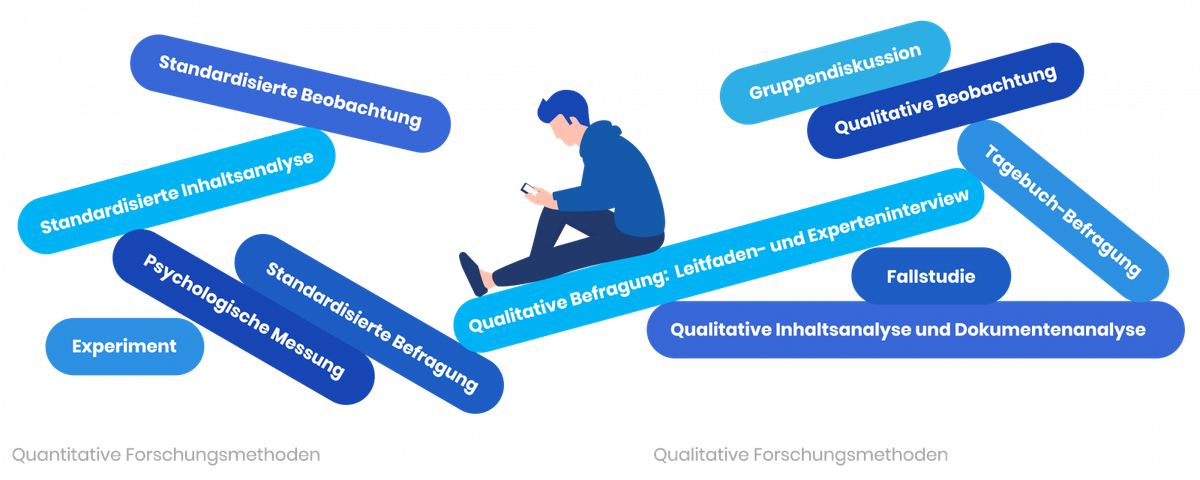
Alongside the survey there are three other routes to data. Which one fits is not decided by effort or budget, but by where the information you are after actually sits.
| Method | What it captures | Where it runs out |
|---|---|---|
| Survey | opinions, attitudes, motives, reported behaviour | anything respondents do not know or will not say |
| Observation | actual behaviour in a real situation | the reasons and intentions behind that behaviour |
| Experiment | the effect of one deliberately changed condition | everyday realism, because conditions are artificial |
| Content analysis | features of existing texts, images or videos | anything that was never recorded |
The table also makes the single biggest caveat visible: a survey produces self-reports, not measurements. People misremember, guess, or rate themselves more kindly than the facts allow. Subjective judgements and objective facts are therefore not interchangeable, however carefully the questionnaire is written.
A survey does not measure what people do. It records what people say about it.
Types of survey: quantitative and qualitative
Surveys fall into two broad types: the quantitative survey, which asks many people the same questions and is analysed statistically, and the qualitative survey, which lets a small number of people speak at length. The difference is not the number of participants alone, it is what the study is trying to find out.
A quantitative survey tests assumptions that already exist. A qualitative survey looks for patterns nobody has put into words yet. If you already have a hypothesis, count. If you do not, listen. The two combine well, for instance when a handful of interviews supply the wording for a later questionnaire.
Quantitative survey: measuring and comparing
The quantitative survey uses one identical questionnaire for everyone, online, on paper, by telephone or face to face. Most of it consists of closed questions with fixed answer options. Because conditions stay the same for every respondent, the answers can be added up, split into groups and compared with one another. How a quantitative survey is built in detail is covered in its own article.
What a quantitative survey delivers
- It produces numbers that can be tested statistically.
- It reaches large groups at a reasonable cost.
- It keeps the survey situation constant for everyone.
- It allows comparison across several points in time.
Qualitative survey: understanding and reconstructing
The qualitative survey runs as a conversation, usually a semi-structured, expert or narrative interview, often with a single-figure number of participants. The questions are open, and the respondent helps decide which points to expand on. That is precisely where the value sits: what someone chooses to stress or leave out is itself a finding. Analysing those conversations is covered in the article on the qualitative survey.
What a qualitative survey delivers
- It opens up topics with no established theory behind them.
- It allows follow-up questions during the conversation.
- It makes reasoning and contradictions visible.
- It works with few, deliberately chosen cases.
Level of standardisation: standardised, semi-structured or open
The level of standardisation describes how far the wording and order of the questions are fixed in advance. Methodology distinguishes three levels, and the choice belongs to the research design, not to the interviewer sitting in the room.
| Level | How the questions run | What the level is good for |
|---|---|---|
| Standardised | wording, order and answer options are identical for everyone | testing hypotheses, statistical analysis |
| Semi-structured | a topic guide fixes themes and order, the phrasing stays free | interviewing experts, reaching known points quickly |
| Non-standardised | only the topic is fixed, the conversation takes its own course | building theory, exploring unmapped ground |
You will often read that standardised is simply another word for quantitative. That is not quite right. The level of standardisation and the question of numbers versus text are two separate axes. The semi-structured interview is the clearest example: it follows a fixed topic guide and still analyses text rather than numbers.
The practical value of the distinction shows up when you write the instrument. A standardised questionnaire has to be finished before the first invitation goes out, because any later change destroys comparability. A topic guide may still grow between the second and the third interview, as long as the change is documented in the methodology chapter. Supervisors and viva panels ask about exactly that. Further guidance sits in the article on objectivity, reliability and validity.
Kinds of survey: by mode, number of topics and frequency
Kinds of survey differ in three respects above all: the route the questions travel, how many topics one questionnaire covers, and how often the same study is repeated. On top of that sits the distinction between direct and indirect questioning.
The three classifications do not compete, they stack. One study can be telephone-based, single-topic and set up as a panel at the same time. For a methodology chapter that means naming all three axes, otherwise the design of the survey stays unclear to the reader.
Survey modes: face to face, postal, telephone, online
A face-to-face survey is the classic interview in person, a postal survey uses a paper questionnaire sent by mail, a telephone survey runs as a call, and an online survey travels as a link in a browser. Four things decide which mode fits. A face-to-face interview tolerates long questionnaires but costs the most. Telephone and internet deliver results quickly, post and personal interviews take longer. Images or video as stimuli work well in person and online, and not at all on the phone. Strengths and limits of the digital route are covered in the article on the online survey.
💡 Tip
Offer two routes when one group would otherwise drop out. If you launch online and also make paper questionnaires available, people without reliable internet access stay in the sample, and you avoid having to explain the gap in your methodology chapter later.
Kinds of survey by topics and frequency: omnibus, panel and wave
A single-topic survey covers exactly one subject, while an omnibus survey bundles several clients into one questionnaire and splits the cost between them. By frequency, market research separates the one-off survey from the repeated survey, and repetition itself splits in two: a panel survey asks the same people every time, a wave survey asks different people each round. The difference matters, because only a panel shows change within individual people. A wave shows change in the average.
Create a survey for free
With empirio.ai you can create a modern online survey in minutes — with hosting in the EU.
- AI-built survey
- Adjust by drag & drop
- Real-time analysis
Is taking part in a survey voluntary in the UK?
Taking part in a survey in the UK is usually voluntary, but not always. Two exceptions carry a legal duty: the census, and most business surveys run by the Office for National Statistics. Everything else, including ONS household surveys, is a request rather than an obligation.
The Office for National Statistics states that the Census Act 1920 makes answering the census questions mandatory for everyone in England and Wales, and that failing to complete a census questionnaire is a criminal offence punishable by a fine of up to 1,000 pounds and a criminal record. Three questions are exempt from that penalty: religion, sexual orientation and gender identity. The last census took place on 21 March 2021, and in July 2025 the government commissioned a further mandatory whole-population census for 2031.
⚠️ Careful
Household surveys are a different matter. For the Labour Force Survey the Office for National Statistics writes that no-one has to take part if they do not want to, and its Respondent Charter promises to be honest about participation being voluntary. Business surveys reverse that again: under the Statistics of Trade Act 1947 most are legally required, with fines of up to 2,500 pounds for non-compliance and no exemption or appeal process (as at August 2026).
For your own survey none of this applies. A study for a dissertation, a charity or a company is always voluntary, and that belongs in the invitation text. Alongside it goes an explanation of what data you store and for how long, since UK GDPR requires transparency before collection begins. The article on data protection in surveys covers the detail.
Source: Office for National Statistics, Census legislation and policy (accessed 23 August 2026).
Common mistakes in surveys
The most common mistakes in a survey are not made during analysis. They are made much earlier, while the questions are being written and the method is being chosen. The core problem has a name: validity. A survey may simply not be measuring what it set out to measure.
Four patterns come up again and again. All four are avoidable, but only before the invitations go out.
Social desirability shifts the answers
People answer the way they believe will look good. On questions about exercise, alcohol, charitable giving or environmental behaviour, the answers therefore come out consistently more flattering than the actual behaviour. Anonymity reduces the effect noticeably, because no answer can be traced back to a person. A staff survey whose results a line manager could read individually mostly measures caution.
Questions about the past meet patchy memory
Questions about the past assume that respondents remember correctly. For rare events that works, for everyday ones it rarely does. Ask how often someone exercised over the past year and you get an estimate, not a number. Short reference periods and fixed anchors make the answer more reliable, for example over the past seven days rather than normally.
Question order and answer options steer the result
The order of the questions and the choice of answer options shape responses systematically. A question about overall satisfaction reads differently after five questions about problems. If the option that actually applies is missing from a list, respondents pick the nearest one and the analysis shows a result nobody ever meant. The article on creating a questionnaire goes into this in detail.
The survey was the wrong method
Some questions cannot sensibly be asked at all. If you want to know how long visitors stand in front of an exhibit, measure rather than ask, because nobody knows that number about themselves. Unconscious processes and heavily automated behaviour are equally out of reach for a survey. Observation, an experiment or existing data will give the sounder answer.
Conclusion
A survey is strong when the subject is opinions, reasons and judgements, and weak everywhere something can be measured directly. Before you write the first question, settle two things in this order: whether a survey is the right method at all, and how much standardisation your research question can carry. Everything else, from mode to analysis, follows from those two answers.
Where to go next
- Still choosing between the two types? Qualitative and quantitative surveys compared
- Ready to write the questionnaire? Creating a questionnaire: structure and examples
- Planning to run it online? Online survey: advantages and drawbacks
- Wondering how many participants you need? Representative survey: criteria and limits
- Working on a dissertation? Empirical research: methods and process
Want to run your survey, not just plan it?
With empirio.ai, an online survey tool from Germany, you build the questionnaire, send it out and analyse the answers in one place. The free plan includes 50 responses a month, hosted in the EU.