

Two sentences, side by side. Sentence one: “Social media makes people lonely.” Sentence two: “The more time undergraduates spend on social media each day, the lonelier they rate themselves.”
Only the second sentence can be checked against data. To write a hypothesis, turn your research question into a reasoned prediction about how at least two variables relate, phrase it as a single testable statement, and check that some measurable result could genuinely prove it wrong. Falsifiability of that kind is what separates a hypothesis from an opinion. By the end of this article you will know how to write a hypothesis that stands up to your supervisor.
📌 The key points at a glance
- A hypothesis links at least two variables in a testable statement.
- If-then and correlational sentences are the two basic forms.
- Two or three hypotheses usually suffice for an undergraduate dissertation.
- Not every dissertation needs hypotheses; qualitative projects often generate them.
- Statistics can support or reject a hypothesis, but never prove it.
Create a survey for free
With empirio.ai you can create a modern online survey in minutes — with hosting in the EU.
- AI-built survey
- Adjust by drag & drop
- Real-time analysis
What is a hypothesis?
A hypothesis is a reasoned, provisional statement about how at least two variables relate, phrased so that empirical data can support it or help to reject it. A hypothesis always reaches beyond the single case.
Sheffield Hallam University sets out the same idea in its library guidance on hypothesis testing for dissertations and research projects: a hypothesis is a predictive statement that can be tested through the collection of data, and the analysis then either supports the hypothesis or helps to reject it. Note how carefully that is worded. Nothing in it says proved.
The word itself comes from Greek, where “hypóthesis” means something like supposition or groundwork. Three terms circulate almost interchangeably in student writing, although each claims something different.
| Term | What it claims | Example |
|---|---|---|
| Thesis statement | a pointed, arguable claim | Social media is reshaping how students socialise |
| Hypothesis | a relationship between two variables | The longer the daily use, the higher the loneliness score |
| Assumption | something taken for granted, not tested | Respondents estimate their screen time realistically |
The distinction matters less in the abstract than it does at your desk. Whoever argues a thesis statement builds a case; whoever tests a hypothesis collects data and runs the numbers. Which term your discipline expects is something we have unpicked in our piece on research question, thesis and hypothesis.
One British wrinkle is worth naming, because it catches out students who read American guides. At UK universities, “dissertation” normally means the undergraduate or taught-postgraduate research project, while “thesis” is reserved for doctoral work defended in a viva voce. American usage runs the other way round.
A thesis statement you can argue about. A hypothesis you can measure.
How to write a hypothesis: the four steps
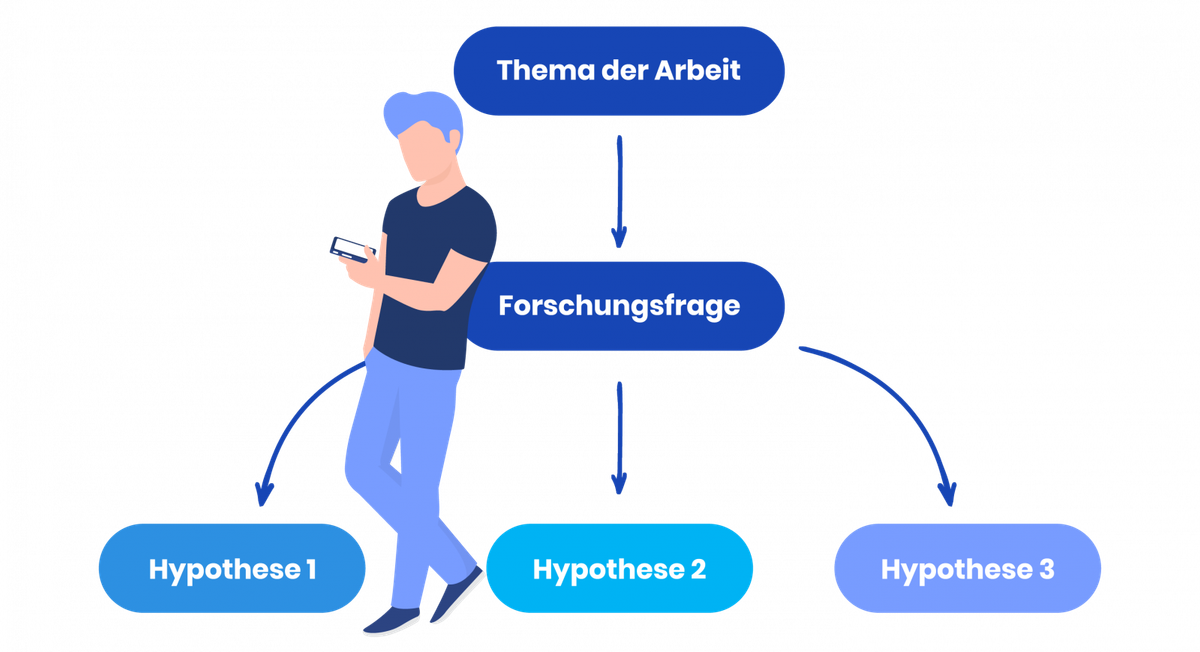
Writing a hypothesis takes four steps: narrow the research question until it can be measured, read the literature and choose a theory, name your variables and make them measurable, then phrase the prediction and check that something could disprove it.
The order matters more than it looks. Whoever starts with the sentence usually produces elegant wording about things that turn out to be unmeasurable. A workable hypothesis grows backwards instead: first the suspected relationship, then the variables, then the language.
As a running example, take an undergraduate dissertation on the link between social media use and loneliness among students at a UK university. The example runs through all four steps, so that a broad interest can be seen turning into a statement somebody could actually test.
Step 1: Narrow the research question until it can be measured
At the start sits a question that is still far too wide. “How does social media affect young people?” cannot be surveyed, because neither “affect” nor “young people” is defined. Narrow the subject, the group and the timeframe until the question fits into one sentence: “Is daily time spent on social media associated with self-rated loneliness among undergraduates?” Only a question of that shape yields a prediction.
Step 2: Read the literature and choose a theory
A hypothesis comes from reading, not from instinct. Work through the literature and look for a model that has already explained your subject once, because that is exactly what your supervisor will ask about: why you expect this particular relationship. Cultivation theory, developed by George Gerbner and his team around the idea of the “mean world syndrome”, is one candidate here. Whether you derive a hypothesis from theory or build it from observation decides whether you are working deductively or inductively.
Step 3: Name your variables and make them measurable
Every hypothesis needs at least two variables, and both have to be collectable. Name the one you suspect does the influencing (the independent variable) and the one you expect to shift as a result (the dependent variable). Daily use is the independent variable in our example, self-rated loneliness the dependent one. For loneliness, an established British measure such as the items used by the Office for National Statistics in its wellbeing surveys beats an item you invent yourself, because your marker can then check it.
Step 4: Phrase the statement and read it back
Language comes last. Put both variables into one conditional statement and commit to a direction: “The more time undergraduates spend on social media each day, the higher their self-rated loneliness.” Read the sentence back afterwards with one question in mind: which measurable result would knock it over? If one comes to mind, you have a hypothesis. If none does, you have an opinion.
One British step follows straight on and catches people out. Most UK departments require ethical approval before any data are collected, and the application asks for your hypotheses, your variables and your instrument. Sheffield Hallam University lists ethical approval as a stage of its own when planning a research project, alongside developing research questions. Settling the hypothesis first therefore saves a round trip through the ethics committee.
Types of hypothesis: if-then, correlational and one-tailed
If-then and correlational hypotheses are the two basic forms: an if-then hypothesis links two states, so that if condition X holds, outcome Y follows, while a correlational hypothesis links two quantities that rise or fall together.
Which form you choose depends on how your variables are measured. Where they arrive as a yes-no attribute or as groups, the if-then sentence fits. Where they arrive as a number or a scale, the correlational sentence fits better, because it carries the gradation with it. Both forms are equally respectable, and neither counts as more scientific than the other.
| Type of hypothesis | How to recognise it | Example |
|---|---|---|
| Correlational hypothesis | two attributes rise or fall together | The longer the daily use, the higher the loneliness score |
| If-then hypothesis | one state brings on another | If daily use exceeds three hours, stress levels rise |
| Difference hypothesis | two groups are compared | First-year students use social media longer than finalists |
Cutting across that list is a second distinction, and British guidance names it differently from most German and American textbooks. Sheffield Hallam University classifies hypotheses as one-tailed or two-tailed rather than directional or non-directional, so those are the words your marking criteria are likely to use.
One-tailed and two-tailed hypotheses
A one-tailed hypothesis specifies the direction of the predicted association. Sheffield Hallam University gives the example that the higher an individual’s educational level, the more books they will read in a one-year period. A two-tailed hypothesis claims only that an association exists, without naming a direction. One-tailed hypotheses say more because they risk more, and they are the norm once the literature points one way.
Association is not cause
Something slips regularly in undergraduate dissertations at this point. A correlational hypothesis claims an association, not a cause. Sheffield Hallam University is careful about exactly this: the guidance speaks throughout of an association or a difference between variables, never of one variable causing another. For a genuine causal claim you need a causal research design, and a one-off online survey does not deliver one.
What makes a good hypothesis?
A good hypothesis meets five criteria: reaching beyond the single case, naming at least two measurable variables, taking the form of a conditional statement, contradicting none of your other hypotheses, and being open to refutation by data.
Of those five, the last carries the most weight and is the one most often garbled. Falsifiable does not mean “you can confirm or disconfirm it”. Falsifiable means a conceivable measurement result has to exist that would knock the hypothesis over. Karl Popper introduced the criterion in “The Logic of Scientific Discovery” to separate scientific from non-scientific statements.
The test takes under a minute. Ask of every hypothesis: which result would I have to see in my data before giving this statement up? Where nothing comes to mind, a conviction has been written rather than a hypothesis. Sentences such as “Social media influences people” fail on exactly that count, because no finding could speak against them.
British guidance adds a second filter worth running alongside. The University of Westminster recommends the FINER criteria from Hulley et al. (2007) for checking the strength of a research question or hypothesis: feasible, interesting, novel, ethical and relevant. Feasibility and ethics do real work in an undergraduate dissertation, where the time budget is one term and the ethics committee has the last word.
Checklist before you submit your hypotheses
- Your statement holds beyond your single case.
- Both variables are measurable with your instrument.
- The sentence takes a conditional or comparative form.
- Your hypotheses do not contradict one another.
- One conceivable result would refute the hypothesis.
💡 Tip
Our reading tip for the methodology chapter: Creswell, John W. and Creswell, J. David (2018): Research Design. Qualitative, Quantitative and Mixed Methods Approaches. Sage, London. The University of Westminster lists the book among its core dissertation resources, and the chapters on quantitative design are where the derivation of your hypotheses can be cited.
Create a survey for free
With empirio.ai you can create a modern online survey in minutes — with hosting in the EU.
- AI-built survey
- Adjust by drag & drop
- Real-time analysis
Research question or hypothesis: which does your dissertation need?
Not every dissertation needs hypotheses: a hypothesis suits explanatory, mostly quantitative work, while exploratory and qualitative projects are usually better served by a precisely framed research question.
Reassurance of that kind is rare in study guides and common in university guidance. The University of Westminster puts it plainly in its guide to devising a dissertation approach: normally a dissertation will have a research question or a hypothesis, not both. Mixed-methods projects are the exception, where a hypothesis carries the quantitative part and a research question the qualitative part.
A second case gets overlooked more often still. Qualitative research frequently generates hypotheses rather than testing them: no prediction at the start, one at the end. Whoever runs twelve semi-structured interviews to understand how undergraduates experience their own screen time writes the hypothesis into the findings chapter, not the methodology, as our overview of qualitative and quantitative research methods sets out.
| Type of project | Hypotheses needed? | What carries it instead |
|---|---|---|
| Quantitative survey with a theory base | yes, usually two or three | derivation from the literature |
| Exploratory interview study | usually not | a precise research question and topic guide |
| Literature-based dissertation | no | a thesis statement and a coherent argument |
No table replaces a conversation with your supervisor. What counts as normal practice differs sharply between psychology, English and business studies, and the binding word comes from your module handbook and your marking criteria.
⚠️ Warning
Settle the hypothesis question in your first supervision meeting, not three weeks before the deadline. Turning a dissertation from exploratory to hypothesis-testing after the fact normally means collecting your data again, and in most UK departments a fresh ethics application as well.
How many hypotheses, and where do they go?
Two or three hypotheses are a workable guide for an undergraduate dissertation, and a master’s dissertation may carry a few more. Binding guidance comes from your module handbook and your supervisor, never from a rule of thumb.
Fit matters more than count in any case. Every hypothesis has to follow from the research question, and every one needs its own result at the end. Whoever sets out six hypotheses and collects data for four of them produces gaps in the findings chapter that any marker spots immediately.
Sheffield Hallam University adds a rule that keeps the number honest: where several predictor variables are in play, write several simple hypotheses instead of one complicated one, on the principle of one predictor and one outcome variable per statement. Complexity in a single sentence tends to hide an analysis you cannot actually run.
Where hypotheses sit in a UK dissertation
No universal rule governs placement, but two patterns are established. Which one fits depends on when your hypotheses came into being. Derived from the literature, they belong after the literature review. Fixed from the outset of your thinking, they may come earlier. Both patterns turn up in marked dissertations across British departments.
Option 1, derived from the literature
- Introduction with the research question
- Literature review and theoretical framework
- Methodology, with the hypotheses
Option 2, fixed from the outset
- Introduction with the research question
- A short chapter of its own for the hypotheses
- Literature review and theoretical framework
- Methodology
Both options are common and both are accepted. More important than the order is that your argument stays traceable: whoever marks your dissertation has to be able to see, at any point, where a prediction came from. How that fits into the overall structure is laid out in our guide to writing an empirical dissertation.

Testing a hypothesis: support, reject or leave open?
A hypothesis can be statistically supported or rejected, but not proved. A significance test tells you how well your data fit an assumed model, not whether your own prediction is true.
The reason lies in how the procedure is built. What gets tested is not your own prediction but the null hypothesis, the assumption that the expected relationship does not exist. Sheffield Hallam University describes the pairing precisely: the alternative hypothesis cannot be tested directly and is accepted by rejecting the null hypothesis. Nothing is proved by that move, because a later study with different data can reach a different conclusion.
The American Statistical Association set the point out in six principles in 2016: a p-value measures the compatibility of data with a statistical model, not the probability that the hypothesis under study is true. The principles are available as a PDF from the American Statistical Association.
For your findings chapter that means, concretely:
✓ “The association between daily use and self-rated loneliness is statistically significant.”
✕ “Hypothesis 1 is proved.”
→ Better: “The data support hypothesis 1. A conclusion about cause and effect is not possible with this design.”
The step many people skip: operationalisation
Between a finished hypothesis and the analysis sits a step that decides the quality of the whole dissertation. Operationalisation (= translating a concept into a concrete measurement rule) turns “loneliness” into a scale with several items and “daily use” into a question about minutes per day. Only afterwards is it clear whether your hypothesis can be tested at all. Building a sound instrument from it is covered under questionnaire design, and the yardsticks for good measurement sit under objectivity, reliability and validity.
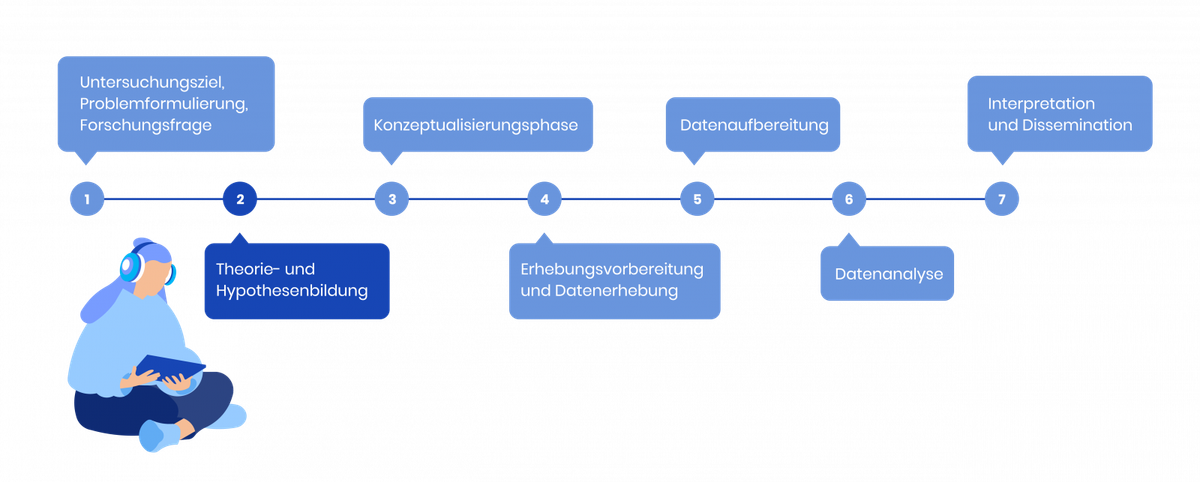
Keeping to that order spares you the least pleasant experience in the whole research process: finding out, once data collection has closed, that your data do not fit your hypothesis.
Common mistakes when writing a hypothesis
Most trouble with hypotheses arises in the wording, not in the arithmetic. Four mistakes recur so regularly that a quick check is worth the time before your hypotheses reach your supervisor.
All four share one feature: before data collection they take minutes to fix, and afterwards almost nothing can be done about them. Bad news and good news in the same sentence.
Mistake 1: The hypothesis only restates the research question
From the question “Is daily use associated with self-rated loneliness?” students readily produce the hypothesis “Daily use is associated with self-rated loneliness.” Same statement, full stop at the end. A hypothesis does more than reverse a question: a hypothesis commits to a direction and therefore claims something that could turn out to be wrong.
Mistake 2: Only one variable appears
Sentences such as “Undergraduates use social media frequently” contain exactly one attribute. Description is possible on that basis, testing is not, because no relationship is claimed. Count the variables in each hypothesis. Where only one turns up, a descriptive question has been written, and a descriptive question belongs in the findings chapter rather than the hypothesis section.
Mistake 3: An association is turned into a cause
“Social media causes loneliness” claims a direction of effect that a one-off survey cannot support. Equally plausible would be that lonely people spend more time on social media. Write the claim as an association for as long as your design carries no causal statement, and name the restriction in your chapter on the limitations of the study.
Mistake 4: The hypotheses contradict each other
With three or more hypotheses, two of them easily end up claiming opposite things, because they come from different theories. Read your hypotheses through in one go at the end. Where two contradict each other, either decide between them or make the contradiction the subject of your dissertation, which can be a genuinely interesting move.
Sources and further reading
The following sources carry the statements in this article and work equally well as references for your own methodology chapter.
- Sheffield Hallam University, Library Skills: Dissertations and research projects: Hypothesis testing. Compiled by Kirsty Hemsworth, last updated 23 January 2026.
- University of Westminster, Library Guides: Dissertations 1: Getting Started. Devising an Approach and Method. Compiled by Laura Niada.
- Popper, Karl R. (2002): The Logic of Scientific Discovery. Routledge Classics, London. Foundational for the criterion of falsifiability.
- American Statistical Association (2016): Statement on Statistical Significance and P-Values.
- Creswell, John W. and Creswell, J. David (2018): Research Design. Qualitative, Quantitative and Mixed Methods Approaches. Sage, London.
- Hulley, Stephen B. and others (2007): Designing Clinical Research. Lippincott Williams and Wilkins. Source of the FINER criteria.
Conclusion
A hypothesis is not an ornament in the methodology chapter but the place where your dissertation makes itself vulnerable, and that is precisely its purpose. Whoever derives two or three predictions cleanly from the literature, makes both variables measurable and then writes honestly about what the data support and what they do not has the hardest part behind them. And no cause for alarm: a hypothesis that fails to hold up is a finding, not a mistake.
What to do next
- Still unsure about your research question? How to formulate a research question and research objective
- Want to see the whole sequence? Empirical research process: phases, steps and example
- Planning a survey for your dissertation? Survey for a bachelor’s or master’s dissertation
Your hypotheses are ready, but the data are missing?
With empirio.ai, an online survey tool from Germany, you can build the matching questionnaire free of charge, share it as a link and see your responses analysed straight away.