

Two sentences. Sentence one: “Social media makes people lonely.” Sentence two: “The more time undergraduates spend on social media each day, the lonelier they rate themselves.”
Each sentence claims something about the same subject, yet only the second one can be checked against data. How to write a hypothesis, then, comes down to four moves: you turn your research question into a reasoned guess about how at least two variables relate, you phrase it as an if-then or a the-more-the-more sentence, and you check that some measurement could knock it down. Falsifiability is what makes a hypothesis scientific. By the end you will have two or three hypotheses your advisor can sign off on.
📌 The short version
- A hypothesis links at least two variables in one testable claim.
- If-then and the-more-the-more are the two basic forms.
- Two or three hypotheses are enough for most undergraduate theses.
- Research with human participants usually needs IRB approval before data collection.
- Statistics can support a hypothesis, never prove it.
Create a survey for free
With empirio.ai you can create a modern online survey in minutes — free to start.
- AI-built survey
- Adjust by drag & drop
- Real-time analysis
What is a hypothesis?
A hypothesis is a reasoned guess about how at least two variables relate, phrased so that empirical data could support the pattern or knock it down, and stated in a way that reaches beyond the single case you happen to be looking at.
The Writing Center at Penn State Berks puts the standard just as plainly in its handout on hypothesis writing: hypotheses are not opinions or predictions, but reasonable expectations based on factual information, written as clear and testable statements. Worth keeping open while you draft is the one-page version on how to write a proper hypothesis. The word itself comes from Greek, where “hypóthesis” means something close to supposition or foundation.
Three terms turn up almost interchangeably in student writing, although each one does a different job. A thesis statement takes a debatable position and argues it. A hypothesis claims a relationship and tests it. An assumption is something you accept in order to get started at all.
| Term | What it claims | Example |
|---|---|---|
| Thesis statement | a debatable position you defend | Social media reshapes how students spend their time |
| Hypothesis | a relationship between two variables | The more daily use, the higher the loneliness score |
| Assumption | something you take for granted | Respondents estimate their screen time realistically |
Mixing up the first two is the most common source of trouble in a proposal. Whoever defends a thesis statement argues; whoever tests a hypothesis collects data and runs numbers. Which term your own department expects is worth settling early, and we pulled the three apart in our piece on research question, thesis and hypothesis.
A thesis statement invites an argument. A hypothesis invites a measurement.
How to write a hypothesis: formulating one in four steps
Writing a hypothesis takes four steps, and formulating the sentence is the last of them: narrow your research question until it becomes measurable, read the literature and pick a theory to build on, name the two variables you will collect, and only then formulate the if-then or the-more-the-more sentence you plan to test.
The order matters more than it looks. Whoever starts with the sentence usually produces elegant phrasing about things that cannot be measured afterwards. Rather, a workable hypothesis grows from the back: first the suspected relationship, then the variables, then the language.
As a running example, picture a senior capstone project on social media use and loneliness among undergraduates. The example carries through all four steps, so you can watch a broad interest turn into a claim that survives contact with data.
Step 1: Narrow the research question until it can be measured
At the beginning sits a question that is still far too wide. “How does social media affect young people?” cannot be collected, because neither “affect” nor “young people” is defined anywhere. Narrow the subject, the group and the time frame until the question fits into one line: “Is daily social media use related to self-rated loneliness among undergraduates?” Only a question that tight can produce a hypothesis at all.
Step 2: Read the literature and choose a theory
A hypothesis comes out of the literature, not out of your gut. Look for a model that has already explained your subject once, because that is exactly what your advisor will ask about in the first meeting. For the capstone example, cultivation theory by George Gerbner at the Annenberg School fits well, the line of work that gave us the term “mean world syndrome”.
National survey data helps you argue that the question is worth asking. Pew Research Center found that 36 percent of U.S. teens use at least one of five major platforms almost constantly (Pew Research Center 2025, n = 1,458 teens ages 13 to 17, surveyed September 25 to October 9, 2025). Note that the figure covers teens rather than undergraduates, so it frames the problem instead of proving it. Whether you derive a hypothesis from theory or build it up from observations decides whether you work deductively or inductively.
Step 3: Name your variables and make them measurable
Every hypothesis needs at least two variables, and both have to be collectable. Name first what you suspect as the driver (the independent variable) and what should change along with it (the dependent variable). For the capstone example, daily use is the independent variable and self-rated loneliness the dependent one. Then check, very concretely, which question in your questionnaire captures each variable. Finding none means the variable is still too abstract.
Step 4: Formulate the conditional sentence and stress-test it
Only now comes the language. Put both variables into an if-then or a the-more-the-more sentence and commit to a direction: “The more time undergraduates spend on social media each day, the higher their self-rated loneliness.” Then read the sentence once with a single question in mind: which result would knock it down? Finding such a result means you have a hypothesis. Finding none means you have an opinion.
Three sentence patterns cover almost everything that shows up in a thesis or a capstone project. Drop your own variables into the brackets and read the result out loud:
- The higher [variable A] among [target group], the higher [variable B]. Example: the more time undergraduates spend on social media each day, the higher their self-rated loneliness.
- If [condition] holds, then [outcome] among [target group]. Example: if undergraduates spend more than three hours a day on social media, they report trouble falling asleep more often.
- [Group 1] scores higher on [attribute] than [group 2]. Example: first-year students spend more time on social media than seniors.
Three wordings fail that stress test with striking regularity. “Social media could have an influence” hedges instead of claiming anything. “Social media has a harmful influence” carries a judgment that no questionnaire measures. And “There is a relationship between A and B” is accurate, yet it commits to no direction and gives away most of what the sentence could have said.
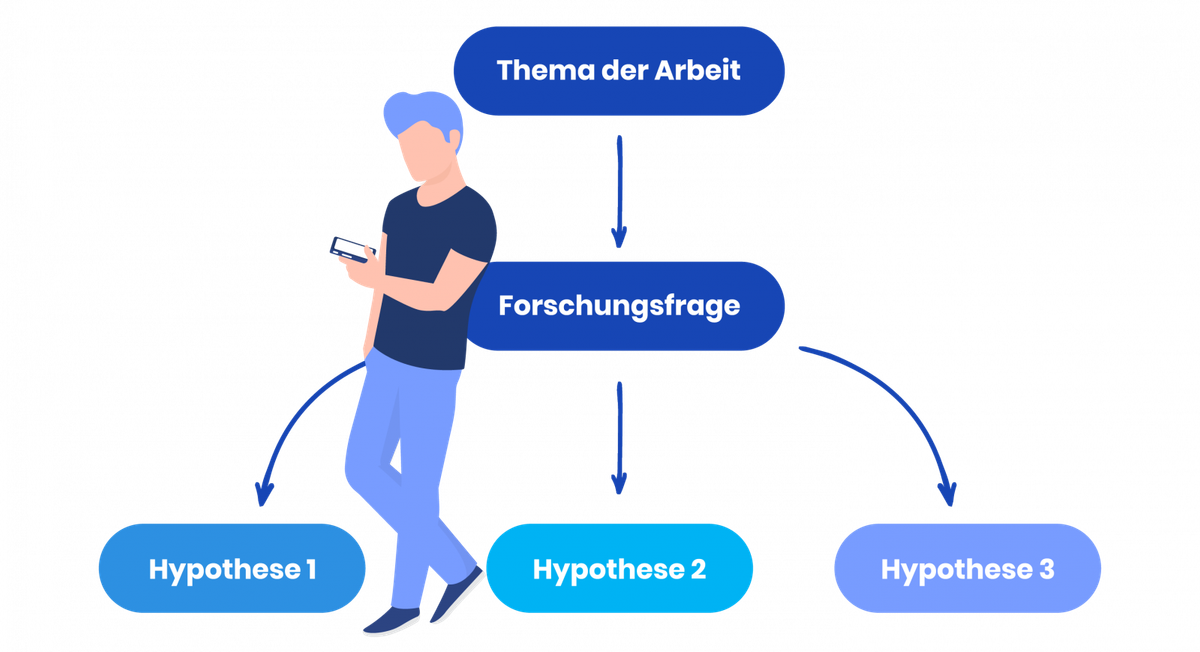
Anyone who walks this path once notices the side effect in the methods chapter at the latest. The justification for your hypotheses is already written, because it came out of the literature instead of being hunted down after the fact.
If-then, the-more-the-more and other types of hypotheses
If-then and the-more-the-more hypotheses are the two basic forms: the if-then version links two states, so when condition X holds, outcome Y follows, while the-more-the-more version links two quantities that rise or fall together across the people you survey, such as hours of use and a loneliness score.
Which form fits depends on how your variables are measured. Yes-no attributes and group memberships call for the if-then sentence. Numbers and rating scales call for the-more-the-more sentence, because it carries the gradation with it. Both forms count as equally scientific, and no committee prefers one over the other on principle.
| Type of hypothesis | How to spot it | Example |
|---|---|---|
| The-more-the-more hypothesis | two attributes rise or fall together | The longer the daily use, the higher the loneliness score |
| If-then hypothesis | one state pulls another one after it | If use exceeds three hours, stress ratings go up |
| Difference hypothesis | two groups are compared | First-year students use social media longer than seniors |
Correlational and difference hypotheses
A correlational hypothesis claims that two attributes vary together, rising or falling with one another. A difference hypothesis claims that two or more groups differ on one attribute. Methods instructors ask about that split more often than about any other, because it decides what happens to your numbers later on.
Which of the two you need follows from your research question rather than from taste. Wanting to know whether daily use and self-rated loneliness go together gives you a correlational hypothesis, and a correlation in the analysis. Wanting to know whether first-year students spend more time on social media than seniors gives you a difference hypothesis, and a comparison between two groups. The choice therefore reaches straight into your statistics, because each pattern calls for a different procedure.
Directional and non-directional hypotheses
A directional hypothesis commits to the direction of the relationship, while a non-directional one claims only that some relationship or difference exists. “The more daily use, the higher the loneliness score” is directional, “daily use and loneliness are related” is non-directional.
Directional hypotheses say more because they risk more: they rule out one of the two possible directions in advance, which also means they can fail more visibly. They are the norm as soon as the literature points one way. Where the literature points nowhere in particular, the non-directional version is the more honest choice, and your advisor will probably ask which of the two you picked and why.
A relationship is not a cause
One point slips in student work with striking regularity. A the-more-the-more hypothesis claims a relationship, not a cause. Both variables can move together because a third one drives them, or because the arrow runs the other way around. For a genuine causal statement you need a causal research design, and a one-shot online survey does not deliver one.
What makes a good hypothesis
A good hypothesis meets five criteria: it reaches beyond a single case, names at least two measurable variables, takes the form of a conditional sentence, sits without contradiction next to your other hypotheses, and could be knocked down by data.
Of these five, the last one carries the most weight, and gets misquoted the most often. Falsifiable does not mean “you can confirm or refute it”. Falsifiable means there has to be a conceivable measurement result that would topple the claim. Karl Popper introduced the criterion in “The Logic of Scientific Discovery” in order to separate scientific statements from unscientific ones.
The test itself takes less than a minute. Ask of every hypothesis: which result would I have to see in my data before I give this claim up? Finding no such result means you wrote down a conviction rather than a hypothesis. Sentences like “Social media influences people” fail exactly here, because nothing at all can speak against them.
Checklist before you hand your hypotheses to your advisor
- Your claim holds beyond your own single case.
- Both variables can be measured with your instrument.
- The sentence has an if-then or a the-more-the-more shape.
- Your hypotheses do not contradict one another.
- You can name a result that would refute the claim.
Tip
Our reading tip for the methods chapter: the Penn State Berks Writing Center handout sets out the PICOT frame, which asks you to state population, interest, comparison, outcome and time in a single sentence. Working through those five slots is the fastest way to notice that one of your variables is still missing.
Create a survey for free
With empirio.ai you can create a modern online survey in minutes — free to start.
- AI-built survey
- Adjust by drag & drop
- Real-time analysis
How many hypotheses do you need, and where do they go?
Two or three hypotheses are a workable number for an undergraduate thesis or capstone project, and a master’s thesis can carry a few more. Binding, however, are the guidelines of your graduate school and whatever your advisor asks of you.
Fit matters more than count anyway. Every hypothesis has to follow from the research question, and every one needs its own result at the end. Whoever states six hypotheses but collects data for only four leaves gaps in the results chapter, and gaps in a results chapter are the first thing a committee notices.
Where hypotheses belong in a thesis
No universal rule governs the placement, but two patterns are well established, and which one fits depends on when your hypotheses came into being. Derived from the literature, they belong behind the literature review. Fixed from the very start of your thinking, they may come earlier and stand on their own.
Option 1, derived from the literature
- Introduction with the research question
- Literature review and theory
- Methods, with the hypotheses
Option 2, fixed from the start
- Introduction with the research question
- Separate chapter with the hypotheses
- Literature review and theory
- Methods
Both options are common and both get accepted. More important than the order is that your argument stays traceable, because whoever grades the work has to see at every point where a claim came from. How that fits into the overall structure is laid out in our guide to writing an empirical paper.

Do you even need a hypothesis?
No, not every thesis needs a hypothesis. Hypotheses belong to a testing, mostly quantitative approach, and purely exploratory or qualitative projects work without them, as long as the research question is sharp enough to carry the analysis on its own.
Relief of that kind rarely shows up in study guides. Qualitative work in particular is often hypothesis-generating instead of hypothesis-testing: no guess at the beginning, one guess at the end. Whoever runs twelve interviews to understand how undergraduates experience their own screen time writes the hypothesis into the results chapter, not into the methods chapter. Our overview of qualitative and quantitative research methods walks through the difference.
| Type of project | Hypotheses needed? | What carries the work instead |
|---|---|---|
| Quantitative survey with theory | yes, usually two or three | derivation from the literature |
| Exploratory interview study | usually not | a precise question and a good interview guide |
| Literature review without new data | no | a thesis statement and a clear argument |
The table does not replace a conversation. What counts as normal practice differs sharply between psychology, English literature and business, and the binding word comes from your department and from your graduate school guidelines.
Warning
Settle the hypothesis question in your first advising meeting, not three weeks before the deadline. Turning a project from exploratory into hypothesis-testing after the fact usually means collecting all of your data a second time.
Get IRB approval before you collect data
In the United States, a study with human participants normally needs approval from an Institutional Review Board before the first response is collected, and a thesis or dissertation project counts as research in almost every case, even when nothing is ever published.
The requirement comes from federal regulation and is applied by every institution through its own board. The Office of Research at the University of California, Irvine states it directly in its guidance on whether you need IRB review: thesis or dissertation projects involving human subjects conducted to meet the requirement of a graduate degree are usually considered generalizable, and therefore require IRB review and approval. Surveys, interviews and focus groups appear there as textbook examples of a systematic investigation.
IRB timing: when to submit and what counts as low risk
Timing is the part students get wrong. Research activities may begin once the approval is finalized, and recruitment already counts as a research activity, so posting your survey link in a group chat before the decision arrives is too early. Not every project needs a full committee review, though: many low-risk student surveys qualify for exempt review, and classroom exercises that exist only to fulfill a course requirement are often not research at all.
Even professional survey research runs through this step. Pew Research Center notes that its 2025 study of teens, social media and AI chatbots was reviewed and approved by an external institutional review board before fieldwork began. Which category your own project falls into is decided by your institution and not by you, so write to the IRB office while your hypotheses are still taking shape. Guidance on a website, this article included, does not replace that determination.
Testing a hypothesis: supported, rejected, never proven
A hypothesis can be statistically supported or rejected, but never proven. A significance test tells you how well your data fit an assumed model, and not whether your own guess about the world happens to be true, because the test is aimed at the null hypothesis rather than at your own claim.
The American Statistical Association put the point on record in 2016 in six principles: a p-value measures the compatibility of data with a statistical model, not the probability that the hypothesis under study is true. The six principles are available as a PDF from the American Statistical Association.
For your results chapter, that means:
✓ “The relationship between daily use and self-rated loneliness is statistically significant.”
✕ “Hypothesis 1 is proven.”
→ Better: “The data support Hypothesis 1. A causal conclusion is not possible with this design.”
Null hypothesis and alternative hypothesis: what a significance test actually tests
The null hypothesis (H0) says that the suspected relationship or difference does not exist. The alternative hypothesis (H1) is your own guess, the sentence you wrote into your methods chapter. A significance test always goes after the null hypothesis and never after the alternative one.
That reversal reads as a detour the first time through, and it has a reason. A claim about every case can never be fully established, only knocked down. So the test works out how likely your data would be if the relationship did not exist at all. Should that come out unlikely enough, you reject the null hypothesis and keep your alternative for the time being. Proven is still the wrong word, because a later study with different data can land somewhere else entirely.
Tip
Comparing two groups on a yes/no question, say the share who agree among students with and without a part-time job? You can run the test right in our calculator and calculate statistical significance. It runs a chi-square test and reports the effect size next to the p-value, so you can see how far apart the groups really are.
For your own thesis, two things follow. The hypothesis section carries the alternative hypothesis, the sentence with the direction in it. The null hypothesis usually stays unwritten, since every test contains it as the counter-assumption. Where your advisor asks for both, write the pair underneath one another and number them H0 and H1.
The step most people skip: operationalization
Between a finished hypothesis and the analysis sits one step that decides the quality of the whole project. Operationalization (= translating a concept into a concrete measurement rule) turns “loneliness” into a scale with several statements and “daily use” into a question about minutes per day. Only afterwards is it clear whether a hypothesis can be tested at all. How to build a clean instrument is covered in our guide to creating a questionnaire, and what good measurement means is explained under objectivity, reliability and validity.
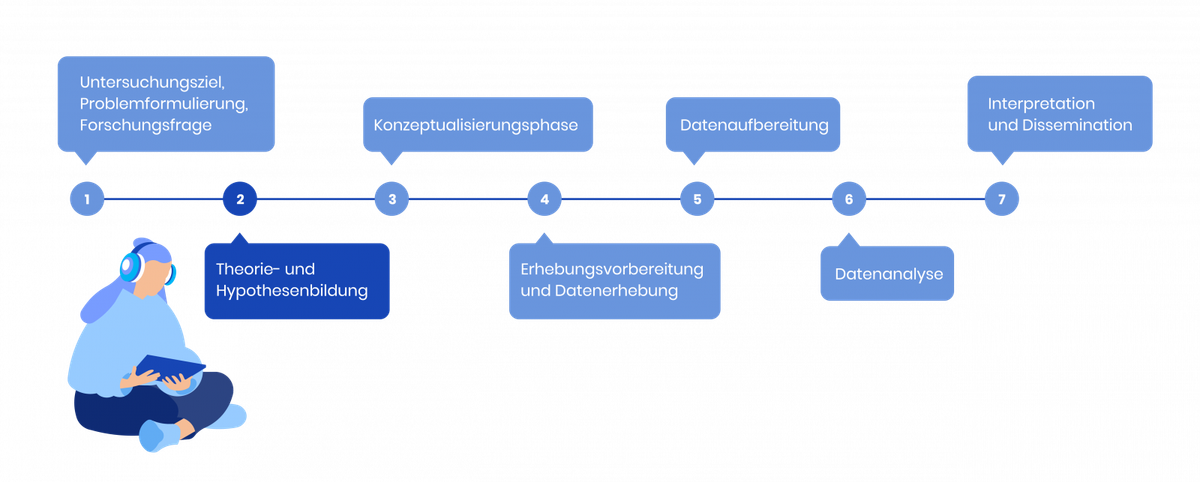
Following that order spares you the least pleasant experience in the whole research process, which is finishing data collection and discovering that the numbers say nothing about your hypothesis.
Common mistakes when writing a hypothesis
Most trouble with hypotheses starts in the wording, not in the statistics. Four mistakes show up so regularly in undergraduate and graduate theses that a short check before you hand your draft to your advisor pays for itself several times over.
What the four have in common is convenient: each one takes minutes to repair before data collection and is nearly impossible to repair afterwards. Bad news and good news in a single sentence.
Mistake 1: The hypothesis only repeats the research question
Out of the question “Is daily use related to self-rated loneliness?” students happily make the hypothesis “Daily use is related to self-rated loneliness.” Same statement, different punctuation. A hypothesis does more than rearrange a question: it commits to a direction and therefore claims something that could turn out to be wrong.
Mistake 2: Only one variable appears
Sentences such as “Undergraduates use social media a lot” contain exactly one attribute. Descriptive work is possible with that, testing is not, because no relationship is claimed. Count the variables in every hypothesis you write. Finding only one means you formulated a descriptive question, and a descriptive question belongs in the results chapter rather than the hypothesis section.
Mistake 3: A relationship gets turned into a cause
“Social media causes loneliness” asserts a direction of effect that a one-shot survey cannot establish. Equally plausible is that lonely people spend more time on social media in the first place. Write the claim as a relationship as long as your design cannot carry a causal statement, and name that limit in your chapter on limitations.
Mistake 4: The hypotheses contradict each other
With three or more hypotheses it happens easily that two of them claim opposite things, because each came from a different theory. Read your hypotheses through once in a row at the end. Should two of them clash, either decide between them or make the contradiction itself the subject of your work, which can be the more interesting project.
Conclusion
A hypothesis is not decoration in the methods chapter. Rather, it is the place where your work becomes attackable, and that is precisely its job. Whoever derives two or three claims cleanly from the literature, makes both variables measurable and then writes honestly what the data support and what they do not has the hardest part behind them. And a hypothesis that fails is a finding, not a failure!
What comes next
- Still unsure about your research question? How to formulate a research question and research objective
- Want to see the whole process in order? Empirical research process: seven steps with an example
- Planning a survey for your thesis? Survey for a bachelor’s or master’s thesis
Your hypotheses are set, now you need the data?
With empirio.ai, an online survey tool from Germany, you build the matching questionnaire for free, share it as a link and see the responses already analyzed.