

Your questionnaire is done and you’re ready to send it out. All that’s missing are the few lines in front of it: the text everyone reads before they see the first question.
Those lines decide how many people start at all. They aren’t a preface or a polite formality. They’re the point where someone decides to take part or close the tab. The catch: most welcome messages are too long and too vague at the same time.
Depending on the survey, a survey welcome message covers up to six things: a short greeting, who is asking, what it’s about, how long it takes, what happens to the answers (including a note that taking part is voluntary) and one sentence on why it’s worth people’s time. Three to five sentences are enough for all of that.
📌 The key points at a glance
- Three to five sentences are enough for a welcome message.
- The purpose goes in the first two sentences.
- The time you announce is a promise, not an estimate.
- Only promise anonymity if your tool actually delivers it.
- The privacy notice and consent go on a separate page right after it.
- In empirio.ai, you turn on the welcome page with one click.
Create a survey for free
With empirio.ai you can create a modern online survey in minutes — free to start.
- AI-built survey
- Adjust by drag & drop
- Real-time analysis
What is a survey welcome message and how is it different from the invitation?
A welcome message is the text that appears in a survey before the first question. It has exactly one job: turning an opened link into a started survey. Anything that doesn’t serve that job can go.
Whoever clicks the link has three questions in mind at that moment. Who wants this from me? How long will it take? And can I answer honestly without it coming back to bite me? If the text answers those three questions, it has done its job.
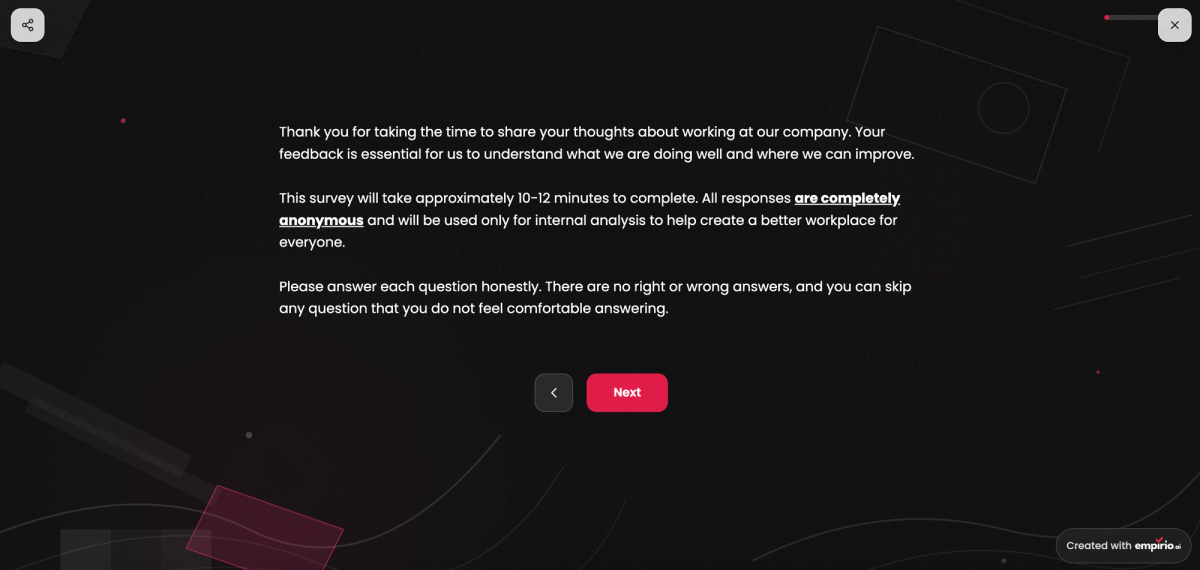
In this employee survey, the introduction answers all three: the person’s own company is asking, it takes ten to twelve minutes to fill out and the answers are analyzed anonymously.
Order matters here. The purpose belongs in the first two sentences, because people who only find out what it’s about in the third sentence often don’t read the third sentence. An opening like “As part of an internal needs assessment, we would like to …” still reveals nothing after two sentences. “We’re rethinking next year’s club meetings and want to know which day works for you” says it right away.
Not to be confused with the invitation
The welcome message sits inside the survey itself. The invitation comes first and gets people to click the survey link in the first place. How people find their way to your survey determines how much the invitation can already explain:
- By email or text message: The invitation has room for the sender, purpose, length and deadline. The welcome message can then be shorter, since much of it is already known.
- Within an online process: for example after checkout in an online store, in a customer account or through a prompt on your website. Here the invitation is often just one sentence and a button, so the welcome message has to deliver the key details itself.
- By QR code: on a flyer, a bulletin board or a restaurant table. Next to the code there’s usually just one line, so the welcome message carries almost everything.
The rule of thumb: the less the invitation explains, the more the welcome message has to cover, and vice versa.
Here’s an example. You create a survey and post the link in a group chat. In your message, you explain what it’s about and why it matters that everyone takes part. Then you don’t need a detailed welcome message in the survey itself. A short sentence on the length is enough or you can jump straight into the questions. That way everyone gets to the point quickly.
It’s a different story if the link can travel without your message, for instance because it gets forwarded. In that case the core details (who is asking, what it’s about and how long it takes) still belong at the start of the survey.
6 details that belong in a survey welcome message
What exactly goes into your welcome message depends on what kind of survey you’re running and how people get to it. A quick poll in a group chat needs little more than the length. An employee survey, on the other hand, has to spell out who gets to see the answers.
The three questions participants ask themselves lead to six details at most. Pick the ones your survey needs. More details don’t make the text more trustworthy, they just make it longer.
- A greeting, one sentence, without titles or filler.
- Who is asking, with the name of the person or organization.
- What it’s about, in one sentence and without jargon.
- How long it takes, as a number of minutes.
- What happens to the answers and that taking part is voluntary.
- Why taking part is worth it, concrete and without exaggeration.
Two of these carry the most weight. The length, because it decides whether people drop out. And what happens to the answers, because that determines how honestly people respond.
A privacy notice is something different from the sentence “Your answers will be analyzed anonymously.” As soon as a club, a university or a company is asking, you also need a privacy notice and consent. They don’t belong in the welcome message but on a separate page right after it, which puts them before the first content question. More on that below.
Four welcome messages you can adapt
The four examples below cover the cases people ask about most often. Each one is as short as it can be. You can use them word for word and just replace the details in brackets.
What all four have in common: no formal titles, no long run-up before the actual point and a number for the length. What differs is the reason to take part. It depends on who benefits from the results.
Customer survey
In a customer survey, brevity counts most, because someone who just bought something doesn’t want a second chore. Two minutes is the upper limit. Say explicitly that it’s anonymous, because otherwise hardly anyone writes down criticism, and criticism is exactly why you’re running the survey. Everything else can wait.
Hi,
We’re [company name] and we want to know what’s working for you and what isn’t. The survey has ten questions and takes about two minutes.
Your answers are analyzed anonymously, so individual responses can’t be traced back to anyone.
Thanks for taking the time!
Start now
You’ll find a ready-made survey for this in our customer survey template.
Note
With a customer survey in particular, you might even skip the welcome message altogether. If your invitation email or a prompt on your website has already set the scene, people know who’s asking and what it’s about. Then the survey can start right with the first question. That saves a click and works especially well for short surveys, for example right after a purchase. If you collect personal data, you still need the privacy notice.
Employee survey
In an employee survey, the tricky part isn’t length but trust. The text has to say who sees the answers and how big a group has to be before results are reported. Without those two details, part of the team will play it safe and give neutral answers. The survey then tells you nothing in exactly the areas you cared about.
Hi,
We’re reaching out from HR because we want to know how satisfied you are with your day-to-day work and where things get stuck. The survey takes about ten minutes and is voluntary.
Your answers are analyzed anonymously and your manager won’t see individual responses. Results are only reported for groups of five or more people.
We’ll share the results with everyone and decide on next steps together.
Start now
The right questions for the main part are already built into the employee satisfaction template.
Thesis survey
In a survey for your thesis, a single person is asking. It’s fine if the text shows that. Naming your university and topic builds trust and mentioning that you’ll delete the data after you submit takes away the worry that it will sit around somewhere. Adding your own email address at the end costs nothing and feels more trustworthy than any reassurance.
Hi,
I’m writing my thesis on [topic] at [university] and I’d really value your input. The survey has 18 questions and takes about four minutes.
I’ll analyze all answers anonymously and delete them once my thesis is submitted.
If you have any questions, you can reach me at [email address].
Start now
To see what a methodologically sound version of the rest of your questionnaire looks like, check out the thesis questionnaire template.
Club or group survey
Here the reason to take part lies with the respondents themselves. That’s exactly what belongs in the text. People who know they’re helping decide their own meeting schedule have a better reason to click than someone who’s just offered a gift card. It also helps to say when and where the results will be presented, because that turns your promise into something people can check.
Hi everyone,
We’re rethinking our monthly meetings for next year and don’t want to decide over your heads. Twelve questions, about three minutes.
We’ll present the results at the annual meeting. The more of you take part, the more likely the new schedule works for most people.
Start now
For a bigger survey in your club, there’s the member survey template.
The biggest difference among the four texts lies in the reason to take part. In the customer survey, it’s the prospect that criticism gets heard and something improves. In the club survey, it’s having a say in your own meeting schedule. Miss that reason and you end up with a polite sentence that moves no one.
How long a survey welcome message should be
Three to five sentences, short enough that the text fits on a phone screen without scrolling. That’s not a question of style. A text that fills half a phone screen doesn’t get read, it gets skipped, and the length and the anonymity note get skipped along with it.
If you have more to say, this isn’t the place for it. Detailed explanations of the topic or key terms belong on a separate page after the welcome. Details on how the data is processed go in the privacy notice.
A test that always works: read the text out loud. If it takes you longer than twenty seconds, it’s too long. And if you stumble over a sentence while reading it aloud, rewrite that sentence instead of defending it.
Create a survey for free
With empirio.ai you can create a modern online survey in minutes — free to start.
- AI-built survey
- Adjust by drag & drop
- Real-time analysis
Common mistakes in survey welcome messages
The following five mistakes come up again and again. Most of them are quick to fix before you send the link.
What they have in common is that they don’t come from carelessness but from good intentions. If you play down the length, it’s because you don’t want to scare anyone off. That’s exactly why these mistakes rarely stand out when you proofread your own text.
The length is guessed instead of measured
“Only takes two minutes” is simply wrong with 30 questions. People then drop out halfway through the questionnaire. Fill it out once yourself, time it and add another 50 percent. You know your own questionnaire, so you read faster than anyone else, which makes you the worst benchmark for how long it takes.
Shaving the number doesn’t help either. Mirta Galesic and Michael Bosnjak showed that announcing a longer completion time leads to fewer starts and fewer completed questionnaires (Galesic and Bosnjak 2009, Public Opinion Quarterly). The takeaway is a shorter questionnaire, not a nicer number in the text.
Also put the number of questions in the text, not just the minutes. “Twelve questions, about three minutes” can be checked, “won’t take long” can’t. The number feels more binding because it either holds up while people fill out the survey or it doesn’t.
Anonymity is promised but not delivered
The text says “completely anonymous,” while the tool stores IP addresses in the background and the questionnaire asks for department and age. Check your settings before you use that word. What anonymous really means is covered in our article on anonymous surveys.
The text explains the method instead of the purpose
“As part of a quantitative study using a standardized questionnaire” tells participants nothing. They want to know what’s being decided, not which method you’re using. That sentence usually comes from the methods section of a paper, where it belongs. In the welcome message, it eats up half of people’s attention and gives them zero information.
There’s no reason to take part
Without a reason, all that’s left is politeness. For a survey, that’s rarely enough. The reason doesn’t have to be a prize drawing. “We’ll present the results at the annual meeting” works better with club members than a gift card, because taking part then visibly changes something. An outside incentive can’t replace that.
The welcome and the questions address people differently
If your welcome message sounds casual and friendly but the questions read like a government form, it feels as if two different people wrote them. Pick one tone and stick with it, including in the answer options and on the last page. The break happens most often when questions are copied from an older survey without being read again.
How to add the welcome message to your survey
In most survey tools, the welcome message isn’t a question but a separate page before the questions. That matters, because a text question with no answer option can show up as an unanswered question in your results and skew your completion rate.
In empirio.ai, you turn on this start page in the editor with the welcome page toggle at the top of the sidebar. Then you edit the heading and text right in the preview and can add an image if you like. The start button is already included.
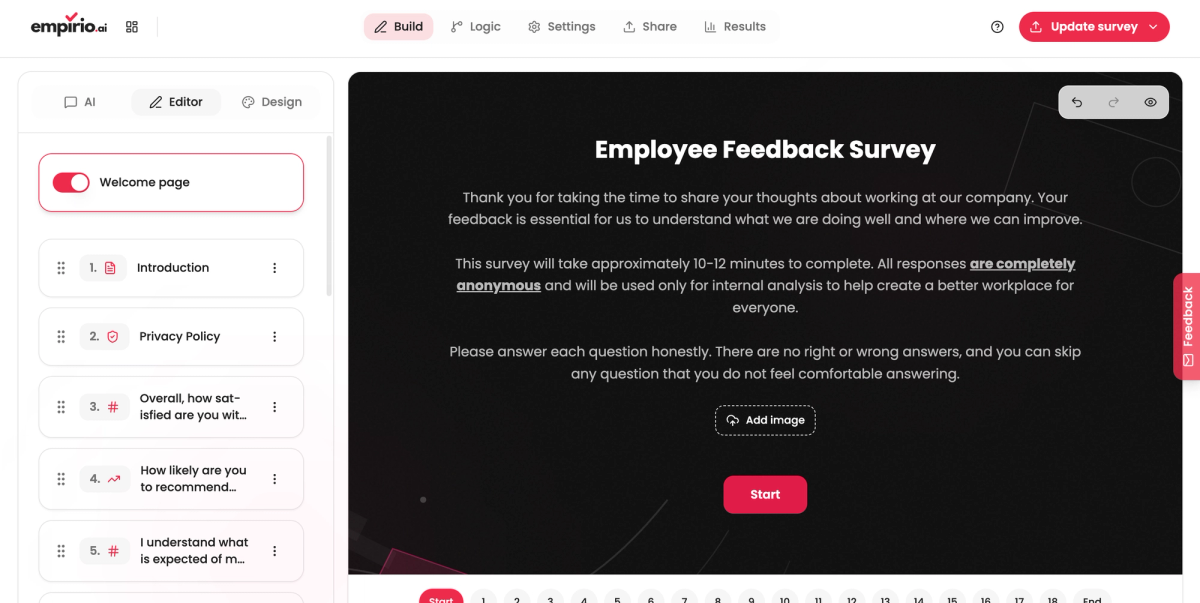
Two more steps come after that. Open the preview on your phone and check that the text is visible without scrolling. Then read it aloud to someone who doesn’t know the topic and ask them what the survey is about.
Note
In empirio.ai, the welcome page automatically appears before the first question. You can turn it off again at any time without touching your questions. You add the privacy and consent statement right after it as a separate page, ready-made and with one click.
What else belongs in the introduction besides the welcome
The welcome message is the biggest part of the introduction, but not the only one. Depending on the survey, two more things belong at the start, each on its own page after the welcome:
- Privacy notice and consent (if needed): As soon as a club, a university or a company is asking, you explain what happens to the data and get consent with a checkbox. Both come before the first content question.
- More background (optional): If the topic needs more context, explain after the welcome what exactly it’s about and how you define key terms. In an employee survey, that might be: “By manager, we mean your direct team lead, not senior leadership.”
That keeps the welcome short while every respondent still has the same information before answering. How the start page, privacy page and background fit together is covered in our article on how to structure a survey.
Conclusion
A good welcome message is shorter than you think and more concrete than you dare. Three to five sentences, a number for the length, one honest sentence about the answers and a reason that matters to your respondents rather than to you. Anything beyond that costs you participants.
If you’re not sure whether a sentence still belongs, cut it and test the text on someone who doesn’t know the topic. If they understand what it’s about within twenty seconds, your text is done.
Where to go next
- Want to know what comes after the introduction? How to structure a survey
- Still need the text for your privacy notice? Data privacy in surveys
- Need the text for the last page? End of Survey Message: Thank-You Note and Closing Text
- Still looking for participants? How to find survey participants
Welcome page, questions and closing all in one go?
In empirio.ai, the welcome page and the end page are part of every survey. All you do is fill in the text.