

The research question is set, the literature review is drafted, and then the faculty advisor asks the one thing that stalls a thesis for weeks: how exactly are you going to study that?
Research methods are the systematic procedures you use to collect and analyze data in an empirical project. Whether you choose qualitative or quantitative research methods is decided by your research question and not by preference: qualitative and quantitative research methods differ in what they are built to deliver, so a question about measuring and generalizing points to quantitative work, and a question about understanding a thinly researched phenomenon points to qualitative work. By the end of this guide you can defend that choice in three sentences.
📌 Key points at a glance
- Every choice of method is two choices: collection and analysis.
- Qualitative methods understand a phenomenon, quantitative methods measure it.
- The research question decides the method, never the reverse.
- Deduction tests an existing theory, induction builds a new one.
- Mixed methods combines both routes inside one study.
Create a survey for free
With empirio.ai you can create a modern online survey in minutes — free to start.
- AI-built survey
- Adjust by drag & drop
- Real-time analysis
What are research methods?
A research method is a rule governed and openly documented procedure for producing and analyzing data. Rule governed means the rules are fixed before the data arrives and every departure is written down.
Design comes before the label in American methods teaching. USC Libraries describes research design as the overall strategy that ties a study together, and stresses that the research problem determines the design rather than the reverse. Reading your own methods section as a design makes the order of your decisions much easier to defend.
Openness is the half of the definition your committee reads. Ten conversations with friends turn into an interview study only once you state how the participants were selected and how the material was coded.
Method, methodology and the methods section
Three similar words, three different meanings, and a standard question in a proposal defense. A method is the single procedure, for example the semi structured interview. Methodology asks why a procedure produces valid knowledge at all. Your methods section describes and justifies the procedures you used.
What a usable methods section looks like
A simple test helps: hand the section to a classmate and ask whether they could run the study from it. Every point where that reader has to ask you something is a missing sentence.
A method is worth exactly as much as its description is reproducible.
The difference between qualitative and quantitative research methods
The difference between qualitative and quantitative research methods lies in the goal of the inquiry and not in the amount of data. Quantitative procedures measure fixed variables across many cases and test whether a suspected relationship holds statistically. Qualitative procedures reconstruct, across few cases, how people interpret something and why they act as they do.
Almost everything else follows from that goal: the form of the questions, the size and selection of the sample, and the type of analysis.
| Feature | Qualitative | Quantitative |
|---|---|---|
| Goal | understanding and reconstructing | measuring and testing |
| Typical question | How do students experience finals week? | How many students study in the evening? |
| Number of cases | few, purposively selected | many, ideally randomly drawn |
| Collection | open, adjustable during the conversation | standardized, identical for everyone |
| Material | text, image, sound | numbers and codes |
| Analysis | interpretive, building categories | statistical |
| Result | types, patterns, new hypotheses | estimates and tested hypotheses |
One misunderstanding survives almost every study guide: that quantitative automatically means representative. Representativeness is decided by the selection procedure, not by the number of respondents. A survey with 800 answers from your own campus is quantitative, cleanly analyzable and still not representative of college students in the United States. How a defensible selection is built is set out in the guide to the sample and its size.
Collection and analysis: two decisions, not one
A choice of method always consists of two decisions: how you obtain your data and how you analyze it. Collection methods produce material, analysis methods order and interpret it, and both can be combined fairly freely.
A third level often lands in the same pot: the research design. Design fixes the time frame, the number of groups and the arrangement in which anything is collected at all.
| Level | What you decide | Examples |
|---|---|---|
| Collection | how the material comes about | survey, observation, experiment, document set |
| Analysis | how material becomes a finding | content analysis, coding, frequencies, regression |
| Design | how both steps are arranged | case study, cross-sectional, longitudinal, cohort |
Why the split matters in your methods section
Study guides often list the semi structured interview next to thematic analysis as though the two were alternatives. Alternatives they are not. The interview produces transcripts, and thematic analysis is one of several ways of analyzing them. Treating both as one thing costs you a justification, and that gap is what a committee asks about. Which procedures are available is set out in the guide to analysis methods in empirical research.
Secondary analysis: check what your school already pays for
Not every empirical project collects its own data. Secondary analysis works with material that others collected and counts as a full empirical route, but access in the United States runs through institutional membership. Part of the holdings at ICPSR at the University of Michigan is free to download, while the rest is members-only and reserved for institutions that fund the archive.
Membership therefore belongs in your planning. ICPSR states that individuals at nonmember institutions can ask for members-only data and that it typically charges around 825 dollars per dataset as an administration fee. Checking your library's membership in week one costs ten minutes. How a collection of your own runs instead is set out in the guide to data collection.
Deductive and inductive approaches: finding the right answering strategy
Deductive and inductive describe the direction in which you move between theory and data. Deductive work starts from an existing theory, derives a hypothesis from it and tests that hypothesis against your data. Inductive work starts from the observations and builds toward a theory of your own.
A look at the literature is worth having before the qualitative or quantitative decision. Are there robust theories your study can attach itself to, or is the field too thin for that?
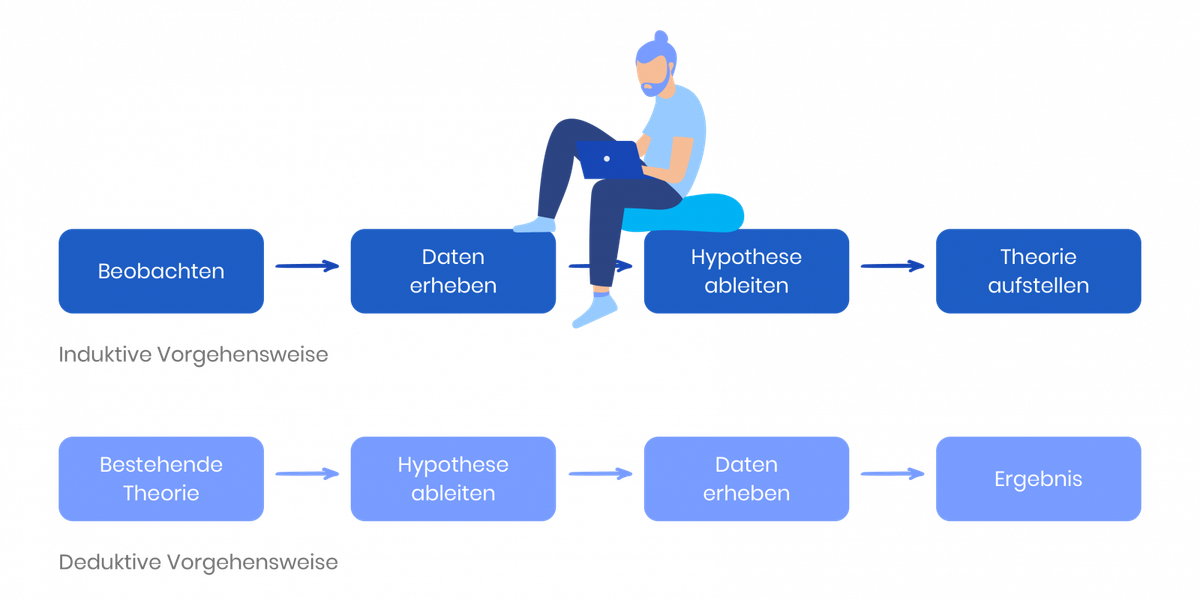
Deductive: testing an existing theory
Deductive work begins with a search for a theory that can answer your research question. From it you derive a hypothesis and test that hypothesis on a concrete case, so the aim is to confirm or refute an existing explanation. In undergraduate and master's projects the route is usually quantitative.
An example shows the derivation. Suppose your public health capstone looks at commuting time and reported stress among community college students. If the studies you read report that long commutes reduce sleep, and that short sleep raises reported stress, your hypothesis becomes: the longer the commute, the higher the reported stress.
Inductive: building a theory of your own
Inductive work either lacks a theoretical basis or deliberately avoids looking for answers in the literature first. Instead you observe as openly as possible, find a pattern and develop your own explanation, which makes the approach exploratory. On the same topic that means interviewing commuting students and formulating an assumption somebody else can test.
The pairing of induction with qualitative work and deduction with quantitative work is a rule of thumb. Qualitative content analysis can build categories from the material or apply categories derived from theory, and exploratory quantitative studies run without a prior hypothesis. More on that sits in the guide to deductive and inductive research.
Create a survey for free
With empirio.ai you can create a modern online survey in minutes — free to start.
- AI-built survey
- Adjust by drag & drop
- Real-time analysis
Qualitative research methods: features and examples
Qualitative research methods capture a phenomenon openly and interpretively across few, purposively selected cases. The view of the person taking part and the reasons they give stand at the center, so the aim is understanding rather than measurement.
- Goal: reconstruct subjective perception and the reasons behind a behavior rather than establish frequencies.
- Field of use: thinly researched topics and pilot work from which a questionnaire is later built.
- Procedure: open conversations with a few people or with specialists, followed by transcription and systematic coding.
- Example: semi structured interviews with eight high school seniors about why they use one particular platform.
How many cases are enough arrives before every qualitative project. No universally valid number exists, but reference points do: a systematic review by Hennink and Kaiser (2022) in Social Science and Medicine found saturation within 9 to 17 interviews for narrowly defined objectives and relatively homogenous groups, and within 4 to 8 focus group discussions. Saturation means the point at which further conversations produce no new themes. The derivation sits in the guide to qualitative research.
Purposive selection makes those numbers work. Eight interviews with people in comparable situations can reach saturation, while eight spread across four states will not.
Quantitative research methods: features and examples
Quantitative research methods measure fixed variables in standardized form across as many cases as possible and analyze the data statistically. Standardized means every participant receives the same questions with the same answer options. Only on that condition can the cases be compared at all.
- Goal: test relationships between variables and carry the finding from the sample to the population.
- Field of use: topics with existing theory and missing robust numbers for a larger group.
- Procedure: derive a hypothesis from theory, collect in standardized form, then test the hypothesis statistically.
- Example: standardized online survey of 600 high school seniors about the platform they use most often.
For student projects quantitative research is often the faster route, because an online survey delivers many answers quickly and parts of the analysis can be automated. The effort moves forward instead: a badly built questionnaire cannot be repaired later, whereas an interview guide can still be adjusted mid conversation.
Measurement quality decides what the numbers are worth. Every item has to capture what your hypothesis is about, and a pilot with ten people exposes ambiguous wording. Building the instrument is covered in the guide to creating a questionnaire.
Mixed methods: both approaches in one study
Mixed methods describes the combination of qualitative and quantitative steps inside one study. Integration is what separates mixed methods from simply running two studies and reporting them next to each other.
Fetters, Curry and Creswell set out three basic designs in Health Services Research: exploratory sequential, explanatory sequential and convergent. At the level of methods they name four ways of joining the strands, and naming yours makes the combination reviewable.
| Approach | What happens | Typical use |
|---|---|---|
| Connecting | one dataset links to the other through sampling | interviewing selected survey respondents |
| Building | one dataset shapes the other instrument | writing survey items from interviews |
| Merging | both datasets brought together for analysis | comparing findings on one topic |
| Embedding | collection and analysis link at several points | a qualitative strand inside a trial |
All four approaches come from Fetters, Curry and Creswell (2013) on achieving integration, which also treats narrative, data transformation and joint displays as ways of integrating at the reporting stage.
Feasibility decides the rest. Within one semester a small qualitative pilot of four or five conversations is realistic, a full convergent design usually is not. Settling which strand carries your research question keeps the write up focused.
Methods of empirical research at a glance
The overview below sorts the common empirical research methods by what they deliver and where they sit in the research process. A method is neither good nor bad in itself, it either fits your question or it does not.
American methods guides rarely stop at three boxes. USC Libraries runs a catalog of eighteen design types, from action research and case study through cohort, cross-sectional and longitudinal to systematic review, and mixed-method sits in that list as one entry rather than as a third category.
| Method | What it delivers | Role in the process |
|---|---|---|
| Standardized survey | comparable numbers across many cases | quantitative collection |
| Qualitative interview | detailed accounts from single people | qualitative collection |
| Focus group | opinions negotiated within a group | qualitative collection |
| Structured observation | frequencies of defined behaviors | quantitative collection |
| Experiment | effect of one deliberately changed condition | quantitative collection |
| Diary study | courses of events over several days | collection, both directions |
| Content analysis | ordered categories from text or sound | analysis, both directions |
| Statistical analysis | estimates, relationships, significance tests | analysis, quantitative |
Case study is missing from the table on purpose. Case study is a design, not a collection procedure: inside one you can interview, observe and analyze documents.
💡 Tip
Copy two rows out of the table: one collection method and one analysis method. That pair is the core of your methods section.
When is which method appropriate?
Which method is appropriate is decided by the form of your research question. Questions about frequency and relationship call for a standardized procedure, questions about experience for an open one.
Inside quantitative work a second fork follows immediately, and skipping it produces overstated conclusions.
Descriptive or experimental
Quantitative designs split into descriptive and experimental. USC Libraries puts the distinction plainly: a descriptive study establishes associations while an experimental study establishes causality, with subjects usually measured once in the first case and before and after a treatment in the second.
Consequences for your wording are immediate. A campus survey run once can report that two variables move together, and the sentence stops there. Only a design that changes a condition on purpose supports the verb cause.
Matching the question to the method
Each form of question has a procedure that fits and a limitation that comes with it. The limitation is no reason to drop the method, it is the sentence that belongs in your limitations section.
| If your question is | Then this fits | The catch |
|---|---|---|
| How many or how often? | standardized survey | nobody can query a misunderstanding |
| How do people experience this? | semi structured or expert interview | the interviewer shapes the answers |
| Does A really affect B? | experiment | the laboratory shortens everyday life |
| What is in existing material? | document set plus content analysis | the selection decides the finding |
| How does one case hang together? | case study design, usually with interviews | generalization is mostly impossible |
What are the advantages and disadvantages of quantitative research methods?
Quantitative research methods deliver comparable, testable numbers and scale well, but they say nothing about why somebody answered as they did. Advantage and disadvantage hang on the same feature: standardization.
What quantitative methods achieve
- Variables can be measured precisely and compared between groups.
- Statistical relationships become testable instead of merely asserted.
- Objectivity and reliability can be checked with established coefficients.
- Five hundred answers cost barely more time than fifty.
What you accept in return
- The questionnaire is fixed, spontaneous follow up disappears.
- Misunderstandings on single items go unnoticed.
- Reasons and interpretations stay invisible in the numbers.
- A relationship in survey data is not yet a cause.
- Without a clean sample the finding stays with the respondents.
The penultimate line is often shortened into the claim that quantitative work cannot study causes. Wrong, as it happens: the experiment tests causes and is quantitative throughout. A one time survey, by contrast, cannot separate cause from effect.
What are the advantages and disadvantages of qualitative research methods?
Qualitative research methods make reasons, interpretations and unexpected aspects visible, at the price of poorly comparable cases and a laborious analysis. Openness produces both sides.
What qualitative methods achieve
- Data collection adapts to new leads during the conversation.
- Unexpected aspects reach the record in the first place.
- Reasons and interpretations of the participants become traceable.
- Single cases generate new hypotheses that others can test.
Where it gets uncomfortable
- Cases are comparable with one another only to a limited degree.
- Transcription and coding consume a great deal of time.
- Result quality depends heavily on the interviewing.
- Statistical projection onto a population is not possible.
- Without a documented procedure the analysis looks arbitrary.
The fourth point stems from purposive case selection, not from the method. Out of it grows the charge that qualitative work is not objective. Objectivity, reliability and validity come from quantitative test theory and fit open procedures only in part. Qualitative work applies standards of its own, set out in the guide to quality criteria of empirical research.
Building research methods into your thesis
In a quantitative thesis the choice of method belongs in the research design chapter, directly after the hypotheses. In a qualitative thesis the sharpened research question stands there instead, because no hypothesis is tested.
Vocabulary in the United States differs from British usage. Thesis normally names the final project of a bachelor's or master's degree, dissertation is reserved almost entirely for doctoral work, and many programs award a capstone project instead. Your faculty advisor and, in graduate programs, a thesis committee sign off on the design before fieldwork starts.
Where the method sits in the structure
The outline below shows the usual build of an empirical thesis.
- Introduction. Research question and why the topic matters.
- Literature review. State of research and theoretical framework.
- Research design. Hypotheses, method, sample, variables, instrument.
- Data collection. Fieldwork, time frame, response rate.
- Results. Procedures and findings.
- Discussion. Interpretation and limitations of your approach.
- Conclusion. Answer to the research question and open questions.
How to defend the choice in three sentences
Defending the method is the part many theses skip and almost every advisor asks for. First, what your research question demands. Second, which procedure delivers exactly that. Third, which limitation you accept. An example: the question asks how often a behavior occurs in a larger group; a standardized survey records that comparably; the reasons behind it stay outside what the design shows.
IRB review: does your project need it?
Human subjects research at an American institution normally goes to an Institutional Review Board before any data is collected. The Common Rule defines research as a systematic investigation designed to develop or contribute to generalizable knowledge in 45 CFR 46.102(l), and defines a human subject in section 46.102(e)(1) as a living individual about whom an investigator obtains data through interaction or identifiable private information.
Both definitions have to be met, which is where student projects differ. Harvard's Committee on the Use of Human Subjects notes that class projects run to teach methods often need no IRB review, because the intent is training rather than generalizable knowledge, and that publishing alone does not turn an activity into research. Once the data is meant to support conclusions beyond the course, review applies. Rules differ by institution, so your IRB office decides. The wider process sits in the guide to the fundamentals of empirical research. This guide does not replace legal advice.
⚠️ Important
Program requirements and your advisor outrank every guide. Some departments prescribe one procedure or rule another out. Settle that before the first collection, because standardized material cannot be turned back into open material later.
Further reading
The four sources below were checked on September 8, 2026 and each points at the body that produced it.
American sources come first on purpose. Data access, review requirements and degree vocabulary differ between countries, and your methods section is judged against the rules of your own institution.
- USC Libraries, Organizing Your Social Sciences Research Paper: Types of Research Designs. The catalog of eighteen designs and the rule that the research problem determines the design. Read the guide
- USC Libraries: Quantitative Methods. The split between descriptive and experimental designs and what each one may claim. Read the guide
- ICPSR, University of Michigan: Non-member Data Access Policy. Which holdings are free, which are members-only and what nonmember access costs. Read the policy
- Fetters, Curry and Creswell (2013): Achieving Integration in Mixed Methods Designs. Health Services Research 48(6pt2), pages 2134 to 2156. Read the article
Federal regulations change without a new edition number, so cite the Common Rule from the eCFR with an access date.
Conclusion
The choice between qualitative and quantitative research methods follows from your research question and is not a matter of principle. Measuring and generalizing leads to quantitative work, understanding and reconstructing leads to qualitative work. Keep the second decision in view: collection and analysis are separate steps, and both belong in your methods section with a reason attached.
A thesis is judged on the fit between question, method and claim. A modest design carried out cleanly beats an ambitious one nobody could repeat.
Where to go next
- The whole sequence from idea to finding: the empirical research process
- Research question still unsettled: research question, thesis and hypothesis
- Method fixed, questionnaire missing: creating a questionnaire
- The overview of the whole field: fundamentals of empirical research
Method settled and the data still missing?
With empirio.ai, an online survey tool from Germany, you build a standardized survey, share it by link or QR code and analyze the answers right away. The free plan includes 50 responses a month and the data is stored in the EU.