

The people team at a SaaS company in Austin gets its first eNPS results back on a Thursday afternoon. Customer support comes in at −14. Engineering sits at +33. The head of support wants to know how worried she should be, and the CTO wants to know whether he can stop worrying. Neither number answers that by itself.
The Employee Net Promoter Score is a metric for measuring how attached employees are to their employer. You ask your people how likely they are to recommend the company as a place to work, on a scale from 0 (not at all likely) to 10 (extremely likely), split the answers into promoters, passives and detractors and subtract the detractor share from the promoter share. The result is a number between −100 and +100. We'll show you how to ask the question without putting anonymity at risk, how to run the numbers on a real example and when the score hides more than it reveals.
📌 Key takeaways
- The eNPS rates employer recommendation on a scale from 0 to 10.
- Promoters pick 9 or 10, detractors pick anything from 0 to 6.
- eNPS = % promoters − % detractors, passives (neutrals) are left out.
- The score runs from −100 (negative) to +100 (positive).
- Bain lists Apple among the companies that adopted the eNPS question.
Create a survey for free
With empirio.ai you can create a modern online survey in minutes — free to start.
- AI-built survey
- Adjust by drag & drop
- Real-time analysis
What is the eNPS?
The Employee Net Promoter Score, eNPS for short, takes the Net Promoter Score and points it at your own workforce. Everything hinges on a single question:
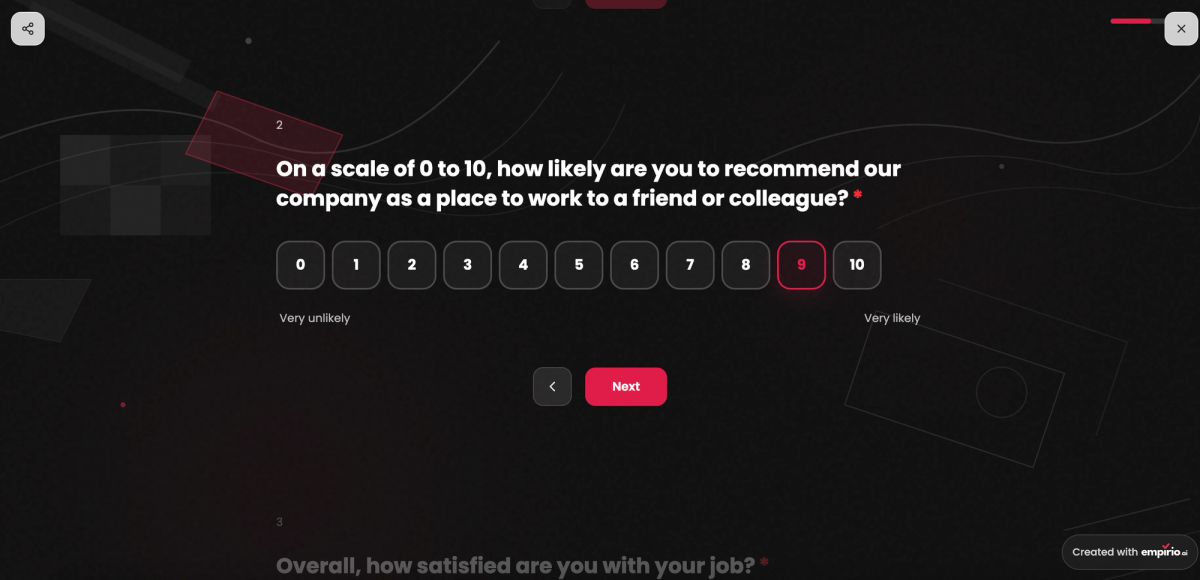
“On a scale from 0 to 10, how likely are you to recommend our company as a place to work?”
People answer from 0 (not at all likely) to 10 (extremely likely), and only the two ends of the scale carry a label.
The concept started at Bain & Company, the consulting firm where Fred Reichheld developed the original NPS. On its page about the Employee Net Promoter System, Bain names Apple as one of the adopters that settled on one central question about recommending the company as a place to work, and it calls the eNPS an emerging science. Two remarks on that page are worth keeping in mind before your first round. Employee scores can land substantially lower than customer scores, because people hold their own company to a higher standard. And while Bain found the recommendation question to be the best predictor of retention, it suggests a second statement along the lines of “My job inspires me” if you also want to know how much energy people bring to work.
“Net Promoter” and “NPS” are registered trademarks of Bain & Company, NICE Systems and Fred Reichheld. Running an eNPS survey inside your own company doesn't require anyone's permission. A license only becomes relevant if you put the marks to commercial use, for instance in the name of a product you sell.
The difference between “recommendation” and “employee satisfaction”
Satisfaction asks how someone feels about their pay, their team or the work itself. The eNPS question asks whether they would put their own name behind a tip to a friend who is job hunting. That is a much higher bar. Plenty of people are happy to keep their badge and would still hesitate before telling a former classmate to apply.
Promoters, passives (neutrals) and detractors: the three groups
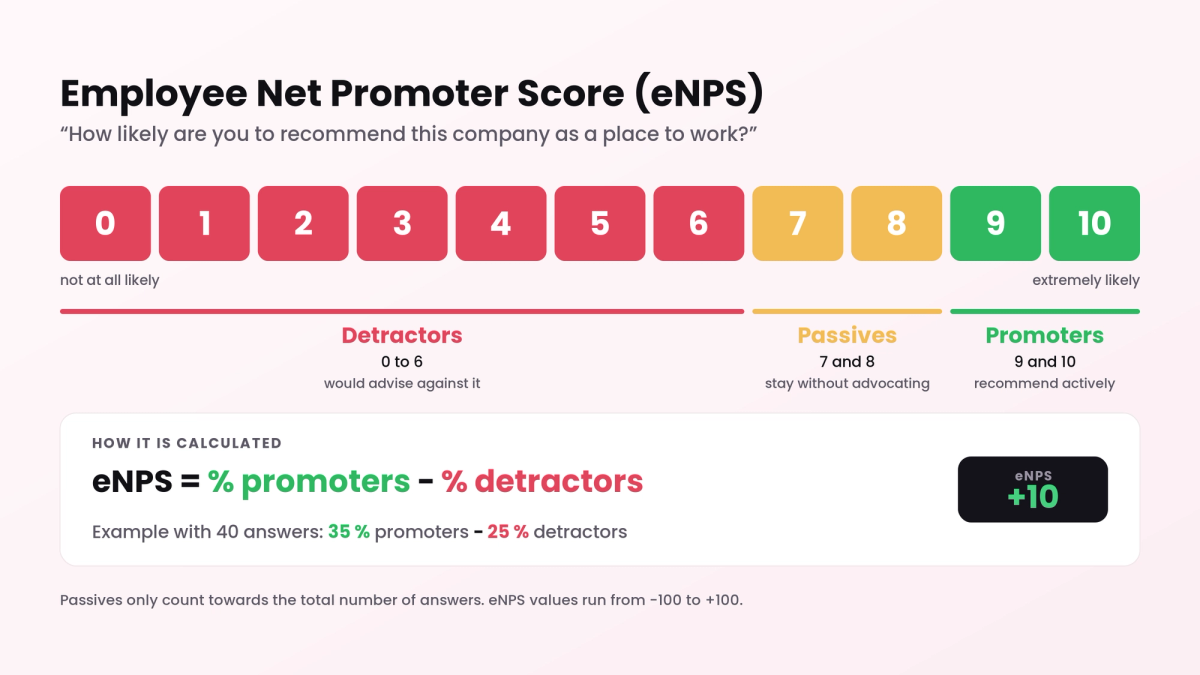
When you analyze the results, you sort the eleven possible answers into three groups. The cutoffs are exactly the ones used for customers:
- Promoters at 9 and 10: would tell a friend to apply without being asked and are the people most likely to send a referral your way.
- Passives (neutrals) at 7 and 8: comfortable enough to stay for now, though a message from a recruiter could change that.
- Detractors at 0 to 6: would steer a friend elsewhere, and some of them have quietly updated their résumé already.
The bar at 9 can feel harsh inside a company. A 7 from a coworker often just means “it's fine,” and that is precisely the attitude the eNPS wants to separate from real conviction. So a big block of passives isn't reassuring. It's a group of people whose loyalty has a price tag, and the next offer might meet it.
Technically, the answer format is a rating scale with eleven steps. The eNPS still ignores the average and works with shares instead, because an average of 7.3 can't tell you how many people are genuinely on your side.
Tip
Put the same question to customers and you get the NPS for customers, which asks whether someone would recommend your product, your service or your company. The groups and the math stay the same. Who answers, and how you read the result, do not.
Calculating the eNPS: formula and a worked example
To calculate the eNPS, you take the percentage of promoters and subtract the percentage of detractors. Passives only show up in the total count, never in the subtraction itself. What you end up with is a whole number, written without a percent sign.
- Tally the answers. How many people chose 9 or 10, how many 7 or 8 and how many anything from 0 through 6?
- Convert the counts to percentages. Divide each group by the total number of responses, then multiply by 100.
- Subtract. Promoter percentage minus detractor percentage is your eNPS.
Once you have the three counts, you can work out your eNPS with our free calculator, which also shows you the shares and the band your score falls into.
The Employee Net Promoter Score formula
eNPS = % promoters − % detractors
Share of a group = responses in that group ÷ all responses × 100
Here is what that looks like for the Austin company's full survey, which collected 120 responses across all teams:
| Group | Responses | Share |
|---|---|---|
| Promoters (9 to 10) | 48 | 40 percent |
| Passives (7 to 8) | 42 | 35 percent |
| Detractors (0 to 6) | 30 | 25 percent |
| Total | 120 | 100 percent |
40 percent promoters minus 25 percent detractors gives an eNPS of +15. The 42 passives are not part of the subtraction. They do sit in the denominator, though, which keeps both percentages smaller than they would be without them.
Now picture a second company that also collects 120 responses: 69 promoters, zero passives and 51 detractors. That works out to 57.5 percent minus 42.5 percent, and once again the result is +15. One +15 describes a workforce that is mostly settled, the other a workforce split into two camps. That's why you should never share an eNPS without the three shares and the number of responses right next to it.
Tip
Only break the eNPS down by team, office or manager once every group has at least five responses. Below that, people can work out from the numbers who said what, and in the next round nobody will be candid anymore.
What counts as a good eNPS score?
There is no fixed line above which an eNPS counts as good. Industry, company size and the local job market all move the score. On top of that, employees see the company from the inside and grade it harder than customers do, so eNPS results usually sit below customer NPS results. For orientation, the eNPS calculator on our site sorts scores into five bands. They help you read a number, they don't set a standard:
- −100 to −21: critical. Far more people would warn a friend off than recommend you. Stop measuring and start listening.
- −20 to −1: room to improve. Criticism has the upper hand, and the open answers usually show why.
- 0 to +19: solid. Promoters and detractors roughly cancel each other out.
- +20 to +39: good. Supporters clearly outnumber critics.
- +40 to +100: very good. A large share of your people would actively vouch for you as an employer.
So the +15 from the example is a respectable result for a workforce, not a weak one. What tells you more than any band is the direction. If support climbs from −14 to −2 over two quarters, that says more than a lone +25 you can't compare with anything. The same goes for looking inside the company: support at −14 and engineering at +33 tells you exactly where your first conversation should happen.
Careful
Most eNPS industry benchmarks you find online come from HR software vendors and are based on data from their own customers. How those samples were put together is rarely explained. The yardstick that counts is your own previous score.
And if your score is bad? A negative eNPS is not a verdict on you as a manager. It's a to-do list. Read the open answers first. Three or four themes usually keep coming up. Tackle those where people can see it, then measure again in three months.
Create a survey for free
With empirio.ai you can create a modern online survey in minutes — free to start.
- AI-built survey
- Adjust by drag & drop
- Real-time analysis
Asking the eNPS question the right way
The eNPS question only produces comparable scores if the wording, the scale and the rhythm stay the same every time. Tweak the phrasing from one round to the next and you end up measuring something new each time.
Where the question sits affects the answer. After twelve detailed items about parking, PTO rules and the coffee machine, people have exactly those details on their mind instead of the big picture. So either let the question stand alone in a short pulse survey or put it at the very end of a full employee survey. Our pulse survey template gives you a ready starting point with five questions, among them the eNPS question, three core work engagement statements and an open prompt.
Anonymity and the legal ground rules in the US
With the eNPS, anonymity is not a nice extra. It's the precondition. Only ask for the demographic details you really plan to report on, and tell people in advance how large a group has to be before any result becomes visible. How to set up an anonymous survey properly is covered step by step in our guide.
In the US, no works council has to approve an employee survey. Two sets of rules still deserve a look. The first is the National Labor Relations Act. Its Section 7 protects the right of most private-sector employees to talk with each other about pay and working conditions and to act together on them. According to the NLRB page on Sections 7 and 8(a)(1), employers must not coercively question workers about union activity, and asking for grievances during a union organizing campaign can read as an implied promise of benefits. The same page adds that an employer who regularly asked for employee grievances before a campaign may continue that practice unchanged. One more reason to set your eNPS rhythm early and stick to it. The second is privacy law. Texas's own privacy statute leaves employment data out, but if your company falls under California's CCPA, employees who live there have had rights over their personal information since January 1, 2023, including a notice at collection and the right to know, correct and delete. Whether that applies to you is a question for your legal team.
Your eNPS question checklist
- The wording is identical every round and includes “as a place to work.”
- The scale runs from 0 to 10, with labels only at the two ends.
- An open question about the main reason sits right below it.
- The question stands alone in a pulse or closes out the full survey.
- No demographic field is narrow enough to single anyone out.
- The rhythm is set and announced before the first round.
Tip
Put an open question right under the scale, something like “What is the biggest reason behind the number you picked?” It matters even more here than with a customer NPS: the survey is anonymous, so you can't go back to anyone afterward and ask. Whatever the questionnaire doesn't collect, you will never hear.
As for timing, Bain notes that monthly is the most common rhythm for eNPS feedback. Other companies go quarterly or twice a year. The frequency matters less than sticking to it. Three rounds at even intervals give you a trend, three rounds whenever someone remembers give you three random numbers.
Pros and cons of the eNPS
HR teams like the eNPS because it costs little to run and everyone gets it right away. Some executives distrust it for exactly the same reason. Both camps have a point.
What speaks for the eNPS
- One rating plus one open question takes under a minute, which your people will appreciate.
- Run as a pulse every four to twelve weeks, it flags early when morale drops after a reorg.
- With enough responses, you can put teams and offices side by side.
- Because it follows the logic of the customer NPS, employee and customer loyalty fit into one report.
- Nobody on the leadership team needs the number explained.
What speaks against the eNPS
- Small teams make it jumpy: with 15 responses, each person is worth almost 7 points, and one detractor turning into a promoter moves the score by more than 13.
- As soon as people doubt the anonymity, the answers get suspiciously friendly.
- Passives vanish from the result, even though that's where a good part of your flight risk sits.
- The number names no cause. Without the open question, it stays silent.
- Benchmarks from the internet invite comparisons that mean nothing.
What the eNPS does not tell you
The eNPS works like a mood gauge, not a diagnostic tool. Confuse it with a full employee survey and you will expect answers it simply can't give.
Three limits are worth knowing before the score lands on a slide at the next company meeting.
It doesn't explain why
Pay, leadership, on-call duty or the return-to-office policy: the eNPS only tells you that something is dragging down people's willingness to recommend you. The what lives in the open answers or in a deeper survey. If you want to measure employee satisfaction without betting everything on one number, our separate guide shows you how.
It needs volume to carry weight
As a rule of thumb, the score becomes usable at around 20 responses and stable at around 50. In a team of eight, an honest conversation over coffee tells you more than any metric. When you report by department, stick to at least five responses per group, or your statistics turn into a way of unmasking people.
It measures intent, not behavior
Bain calls the recommendation question the best predictor of retention. Even so, someone who gives a 9 hasn't referred anyone yet, and someone who gives a 5 isn't necessarily about to quit. Timing plays a part too: right after merit increases land, the score looks friendlier than in the week a reorg gets announced.
The score is the smoke alarm. The open answers show you where the fire is.
How the eNPS compares with other metrics
The eNPS isn't the only number companies use to keep track of how their people are doing. These are its closest neighbors:
- The NPS uses the same question format, scale and formula, but it asks customers. Its scores tend to run higher, and you can follow up on criticism because customer responses don't have to be anonymous.
- Employee satisfaction is usually measured with a set of questions about the work itself, leadership and working conditions, and it shows exactly where things are rubbing. The eNPS rolls all of that into one recommendation.
- Work engagement asks about energy and dedication in daily work, in other words how much drive someone puts into their own job. A high eNPS and low engagement can go together, for example in a secure but monotonous role.
Typical mistakes in eNPS surveys
Most eNPS surveys don't fail on the math. They fail on everything around it. For survey basics in general, see our 8 tips for creating the perfect online survey. Three mistakes come up with the eNPS in particular.
The question turns into a satisfaction question
“How satisfied are you with us as an employer?” sounds like a harmless variation, but it measures something else. Take out the idea of recommending and it's no longer an eNPS. The same goes for trimming the scale to 1 to 10: from then on, the score no longer lines up with any earlier round.
Small groups get reported on their own
A department with three responses in the report isn't a statistic. It's a name tag. Once someone realizes their answer can be traced back to them, they answer cautiously next time, or not at all. That damage carries over into every round that follows.
The results end up in a drawer
Survey people and then go quiet, and next time far fewer of them will bother to answer. Address the two or three biggest themes from the open answers within a few weeks, even if you don't have a fix yet. Showing people they were heard is often worth more than the fix itself.
Conclusion
The eNPS is the simplest metric you can collect about your workforce, and that is both its strength and its limit. One question, one number, one trend line: enough to notice early when something starts to tip, not enough to know why. Ask the question the same way every time, put the open question right under it, measure on a fixed schedule and compare yourself only with yourself. Do that, and the eNPS stops being a report card and turns into an early warning system that buys you time before the resignations start.
What to read next
- Answers are in and you want to analyze them properly? How to evaluate a questionnaire in five steps
- Curious what else surveys are good for? Survey use cases at a glance
Ready to measure the eNPS on your team?
With empirio.ai, an online survey tool from Germany, you can create your employee survey in a few minutes, keep it anonymous and get an analysis that works out the score for you. The employee satisfaction template already includes the eNPS question.