

Two surveys, the same question. One offers five rating options, the other asks it as an open question with an empty text box underneath. What ends up in the data differs far more than most people expect.
Open questions, usually called open-ended questions, are questions in a survey or interview that come without any answer categories: the respondent puts the answer into their own words and types it into a free-text box or says it to an interviewer, with no list steering them in a particular direction. We will show you when that extra effort pays off and how you still end up with data you can analyze.
📌 The key points at a glance
- Open-ended questions give respondents no answer categories.
- Open and closed questions produce different content on the same topic.
- In a Pew study, 43 percent named answers outside the list.
- A larger text box produces longer answers.
- Analysis needs a coding frame, not just reading.
Create a survey for free
With empirio.ai you can create a modern online survey in minutes — free to start.
- AI-built survey
- Adjust by drag & drop
- Real-time analysis
What are open-ended questions?
An open-ended question is a survey question with no answer options attached. The respondent answers in their own words, either out loud to an interviewer or in writing in a free-text box.
According to the GESIS Survey Guidelines by Cornelia Züll (2015), that absence of options is the defining feature: no steering through predefined answer categories takes place. How detailed the answer turns out then depends on how the question is worded and how the answer box is designed.
Open-ended questions do not only capture text. “How many hours a week do you work alongside school?” is also an open question, because it offers no ranges to choose from. In everyday use the term still tends to mean the text version, because that is the one that creates the work.
| Question form | What is given | Example |
|---|---|---|
| Open-ended question | nothing, just a text box | What was missing from the session for you? |
| Closed-ended question | all answer categories | Was the session too long? Yes or no |
| Semi-open question | categories plus a text box | Other, please specify: ______ |
The semi-open question is the most common compromise in everyday survey work, because it keeps the fast analysis and still allows unexpected answers. All three forms and their subtypes are set out in our overview of question types in a questionnaire. If what you actually need is to decide between the two main forms, the direct comparison of open and closed questions is the better place to start.
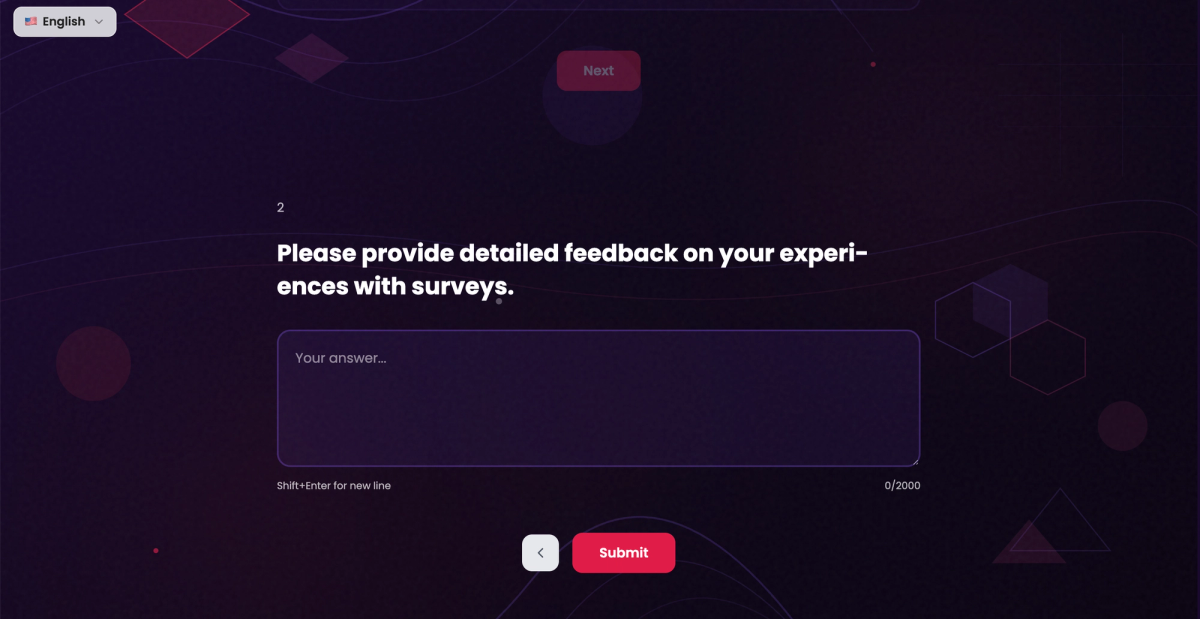
Open-ended questions: examples for surveys and interviews
Good examples of open-ended questions almost always start with a question word and still make clear what they are driving at. “What”, “how” and “which” produce usable answers, while “why” demands a justification that not everybody has on hand.
The examples below come from three typical situations. As you read them, notice that each question covers exactly one topic and signals how long the answer should be.
In a thesis or capstone survey
- What made you choose this major?
- What support would you have wanted in your first semester?
- What do you associate with the term sustainability?
In a feedback survey after an event
- What did you like most about the workshop?
- What should we do differently next time?
- Which topic was missing for you?
In a qualitative interview
- Tell me how a typical working day goes for you.
- How did you arrive at that decision at the time?
Survey tools label this question form differently. Sometimes it sits in the menu as Short answer and Paragraph, sometimes as free text, comment box or text entry. For how to fit the questions into a sensible order, see our guide to creating a questionnaire.
When open-ended questions make sense
Open-ended questions pay off whenever you do not yet know the possible answers or deliberately do not want to supply them. The GESIS Survey Guidelines list five situations in which they beat closed-ended questions.
The decision should follow from the research question, not from personal preference and not from how much work the analysis will be. Züll (2015) warns about exactly that, and the warning is fair: in practice the open question usually gets dropped because nobody wants to do the coding.
- Testing knowledge. People who can guess will guess. Without options, lucky hits go down, while don’t-know answers go up.
- Narrowing a topic. When it is unclear which answers even occur, this is how you find out.
- Too many possible answers. Occupation, age or place of residence cannot sensibly be offered as a list.
- Avoiding a steer. A list of options shows the researcher’s assumptions, not the respondent’s.
- Probing in a pretest. Why was that scale point chosen? Only an open follow-up answers that.
The Pew Research Center adds a sixth use that is easy to overlook: running a pilot with open-ended questions to find out which answers are most common, and building the closed-ended answer list from those results. That way the categories come from the public rather than from the research team.
Open-ended questions are also strongest in the early stage of a study. In exploratory research nobody knows in advance which categories will emerge. That is precisely what they are built for.
Pros and cons of open-ended questions
The biggest advantage of open-ended questions is the range of content they capture, the biggest drawback is the effort of analysis. The two are connected: whatever you gain in variety, you have to sort back into categories afterward.
How large the difference really is shows up in an experiment by the Pew Research Center after the 2008 presidential election. The same question about the most important voting issue was asked once openly and once with five given options. In the closed-ended version, 58 percent named the economy, in the open-ended version only 35 percent. And 43 percent of those asked the open-ended version named something that did not appear on the list at all, compared with 8 percent who volunteered an off-list answer in the closed version.
What open-ended questions deliver
- They capture answers nobody thought of in advance.
- They avoid the bias built into predefined categories.
- They let respondents use their own words.
- They suit knowledge questions, because guessing gets harder.
What you accept in return
- Analysis requires a coding frame of your own.
- Answers vary in length and are sometimes unclear.
- More respondents skip the question or write “don’t know”.
- Completion time rises, and with it the drop-out rate.
One widespread objection does not hold up, though. You often read that open-ended questions favor articulate people. Research points the other way: in principle almost all respondents are able to answer open questions (Geer 1988). What matters more than fluency is how interesting the respondent finds the topic. For the other side of the ledger, see our article on closed questions, which are quick to analyze and lose content in exchange.
Create a survey for free
With empirio.ai you can create a modern online survey in minutes — free to start.
- AI-built survey
- Adjust by drag & drop
- Real-time analysis
How to word and place open-ended questions
Open-ended questions have to be worded more precisely than closed-ended ones, not more loosely. That sounds contradictory but follows directly from the situation: without answer options, the respondent has no clue what the question is aiming at.
Schuman and Presser asked the same topics both ways and concluded in 1981 that open questions need to be more clearly focused than closed ones. The GESIS Survey Guidelines pick up that finding. Four rules follow for everyday use, plus one about placement that is specific to open-ended questions.
One topic per open-ended question, or nobody answers in full
A question that asks about positive and negative aspects at once nearly always gets half an answer. Züll (2015) therefore recommends splitting such questions: one asking what went well, a second asking what was missing. The survey gets longer, the data gets more complete.
Say in the question how detailed the answer should be
A keyword, a sentence or a short paragraph? Respondents cannot guess, and the answers vary accordingly. A short addition such as “please answer in one or two sentences” costs nothing and makes the later coding considerably easier.
The size of the text box steers the length of the answer
This is the trick almost nobody uses: in self-administered surveys, the detail of the answers is measurably linked to the size of the answer box. Dillman, Smyth and Christian (2009) report this connection, and Züll, Menold and Körber confirmed it for web surveys in 2014. A large box signals that more is expected here.
Put open-ended questions before the related closed-ended ones
Placement changes the answers, and open-ended questions are the clearest case. The Pew Research Center reports that when closed-ended questions on a topic come first, respondents are much more likely to repeat concepts from those earlier questions in the open answer. Pew therefore places its open-ended questions about national problems near the beginning of the questionnaire.
💡 Tip
Size the box to match the answer you want, and state the expected length in the question as well. The two together work better than any plea for detailed answers.
Use open-ended questions sparingly
A few well-placed open questions achieve more than many that nobody fills in. Dillman, Smyth and Christian (2009) explicitly recommend sparing use so respondents are not overloaded. A note about what the answers will be used for adds further motivation.
How to analyze open-ended questions
You analyze open-ended questions by coding the answers against a coding frame defined in advance and then treating those codes like any other variable. The method is called quantitative content analysis and is the classic approach to free-text answers.
The decisive step is the coding frame. It grows from two directions: from theory, meaning what is already known about the topic, and from the data itself, by reading a sample of the answers and deriving further categories from them. In practice both routes are almost always combined.
- Build the coding frame. Each category gets a number, a definition and an anchor example, an answer that illustrates it particularly well.
- Test-code a sample. Try it on a small part first, then revise the frame.
- Code all answers. A spreadsheet works, as do SPSS or software such as MAXQDA.
- Check reliability. A second person independently codes part of the answers, around 10 percent.
Step four has established measures. Cohen’s kappa, Scott’s pi and Krippendorff’s alpha indicate how strongly two independent codings agree. Reporting one of them in a thesis sets your analysis apart from most others.
⚠️ Careful
Without a documented coding frame the analysis cannot be followed and is easy to attack in a defense. Put the frame in the appendix, with a definition and an anchor example for every category.
With very large volumes of data, coding can be partly automated, for instance through word lists or through methods that learn from answers already coded. You still define the categories yourself, and the result needs spot-checking against human coding. For how this fits into the bigger picture, see the comparison of qualitative and quantitative surveys.
Common mistakes with open-ended questions
Most problems with open-ended questions arise before the analysis, while the survey is being built. Four mistakes come up especially often.
All four share one trait: they only become visible once the data has been collected. At that point nothing can be fixed, which is exactly why the check before sending is worth the time.
Too many open-ended questions in one survey
Every open question costs respondents more time than a checkbox and costs you many times that in analysis. Ask ten in a row and the last ones come back empty. The GESIS Survey Guidelines therefore recommend sparing use, and in practice it helps to spread open questions across the survey rather than bunching them.
An open-ended question that mixes two topics
“What worked well and what did not?” looks efficient but usually yields an answer to only one half, because the respondent stops after the first thought. One question like this becomes two. The survey gets longer, the analysis becomes possible at all.
Reading the final free-text box as a mood check
The open box at the end is not a representative result, it is self-selection. Research on employee surveys shows that dissatisfied respondents fill these boxes in more often and at greater length than satisfied ones (Borg and Züll 2012). Counting the comments therefore measures dissatisfaction, not mood. The comments stay valuable, but as a pointer to topics rather than as a distribution.
Thinking about the analysis only after collecting the data
The question of how the answers will later be analyzed belongs before the fieldwork. Asking it in advance automatically leads to sharper wording and a sensibly limited answer space. Asking it afterward leaves you with 300 answers in 300 different phrasings and a coding frame built under time pressure.
Conclusion
Open-ended questions are not a sign of sloppiness, they are the right choice when you do not yet know the answers or do not want to supply them. What matters is that the decision comes from the research question and not from a fear of coding. Anyone who plans the analysis from the start can afford open questions.
Where to go next
- Want to compare both question forms? Open and closed questions compared
- Need the other side in detail? Closed questions with examples
- Looking for further question forms? Question types in a questionnaire
- Building your survey right now? Creating a questionnaire: structure and steps
The Pew Research Center sets out its own approach to open-ended and closed-ended questions in Writing Survey Questions.
Want to try open-ended questions right away?
With empirio.ai, an online survey tool from Germany, you add free-text fields in a few clicks and see the answers listed in the analysis view. Create a survey now