

Your dissertation has taken months and it still is not error-free. A comma is missing in one place, a verb disagrees with its subject in another and one chapter has wandered off from the research question. That costs marks. The mathematics department at Royal Holloway awards up to 10 marks of an MSc dissertation for style, spelling, punctuation and grammar.
AI proofreading goes through your entire dissertation in a few minutes. It picks up spelling, grammar and punctuation errors and comments on your argument, your research question and your structure as well. The price is a small fraction of what a human proofreader charges. Whether you take a suggestion on board is up to you.
📌 Key takeaways
- AI proofreading fixes the language and reviews the content.
- Word spotted just 4 of 11 errors in a GoThesis test.
- Human proofreading at Scribbr starts at £174 for 12,000 words.
- GoThesis charges £22.90 for AI proofreading of around 12,000 words.
- A plagiarism check and AI detection complete the full check.
Prices and features as shown on the providers' websites on 24 November 2026.
Ready to try it? GoThesis needs no sign-up: upload your file and start the AI proofreading for your dissertation.
Proofreading by GoThesis
GoThesis is the sister product of empirio.ai for dissertations and other academic work.
- For essays and dissertations
- Built for academic work
- Right in your browser
What is AI proofreading and what does it cover?
With AI proofreading, a language model works through your whole dissertation, highlights mistakes and comments on the writing. A spell checker judges words one by one. AI proofreading reads them as part of a sentence, a paragraph and a chapter.
You get two kinds of help at once:
- Comments on the content. Is there a thread running through the work? Is the research question actually answered? Does the structure of the chapters hang together?
- Corrections to the language. Grammar, punctuation and spelling, with the passage highlighted and a suggested correction each time.
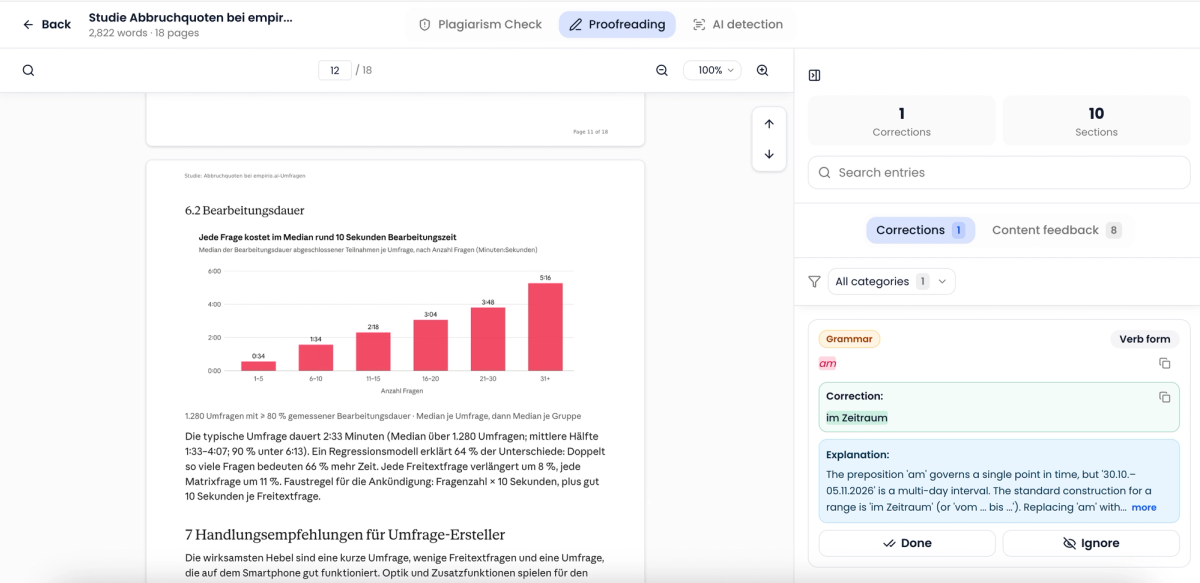
Traditional services tend to charge for these separately. Our guide to proofreading your thesis explains where proofreading ends and editing begins. AI proofreading gives you both together. It remains your work throughout: the tool points things out and proposes changes, and you do the rewriting.
What mistakes are usually left before submission?
Read the same text often enough and your brain fills in what ought to be there. Mistakes therefore slip through even when you have been careful. The most common ones are:
- Pronouns without a clear referent. A ‘this’ or ‘they’ that could mean two different things.
- Woolly wording. Phrases that gesture at a point without stating it.
- Grammar. Subject and verb that disagree, tenses that switch mid-paragraph.
- Punctuation, typos and capital letters. Minor individually, noticeable across 10,000 words.
- Abrupt transitions. Sections that follow one another without being linked.
Four of these five are language problems and the fifth is structural. A spell check on its own covers only part of the list.
Spelling, grammar, punctuation: why Word won't do
Spelling, grammar and punctuation hardly seem worth worrying about. Word and Google Docs underline mistakes as you type, so what could go wrong? Quite a lot, as it turns out.
In October 2026, GoThesis put this to the test. A 127-word academic sample containing 11 deliberate errors went through the standard checker in Microsoft Word, through Google Docs and through GoThesis's own AI proofreading. Word picked up 4 of the 11, Google Docs 10 and GoThesis all 11. Bear in mind that the sample was written in German, so the figures cannot simply be carried over to English. The underlying weakness is the same. GoThesis and empirio.ai are part of the same company.
| Tool | Errors found | Observation |
|---|---|---|
| Microsoft Word | 4 of 11 | grammar errors in agreement and case mostly went undetected |
| Google Docs | 10 of 11 | missed the referencing error |
| GoThesis AI proofreading | 11 of 11 | gave a reason for each correction and commented on the argument |
Source: test by GoThesis using a German sample text, October 2026. One short text is no proof for every dissertation, but it does show where the weak spots are.
Why does this happen? A word processor is good at spotting words that do not exist. Most mistakes in a dissertation are perfectly good words used wrongly.
Grammar
Take ‘The results of the survey shows a clear trend’. Every word is spelt correctly, yet the verb should be ‘show’ because the subject is ‘results’. Slips of this kind tend to appear when you rework a sentence and leave the verb behind.
Punctuation
‘However the sample was small’ needs a comma after ‘However’. In a short sentence you would spot it. Buried in a long paragraph you have read twenty times, you will not.
Spelling
‘Practice’ or ‘practise’, ‘dependent’ or ‘dependant’, ‘their’ or ‘there’: as long as both are real words, a basic checker has nothing to flag. Mixing ‘analyse’ and ‘analyze’ in one document goes unnoticed too. With its proofreading for academic theses, GoThesis checks grammar, punctuation and spelling together and reads every word within its sentence.
How does AI proofreading work in practice?
Once your file is uploaded, the language model reads the dissertation from the first page to the last. The report then contains three things:
- A rating for each chapter. GoThesis sets out what works in a section and what does not.
- Rewritten passages. You see the original sentence, a suggested alternative and the reason for the change.
- A check of language and logic. Style and grammar are covered, as are the consistency of your argument and academic conventions such as formatting.
What sets this apart from a word processor is the wider view. AI proofreading can hold a statement in your conclusion against the research question in your introduction. A spell checker never looks beyond the sentence in front of it.
Proofreading by GoThesis
GoThesis is the sister product of empirio.ai for dissertations and other academic work.
- For essays and dissertations
- Built for academic work
- Right in your browser
How far can you rely on AI proofreading?
It catches a great deal and settles nothing. Keep these three limits in mind:
- Your course rules are unknown to it. Module handbook, referencing style and the habits of your discipline are not part of the text. Compare the suggestions with them.
- Specialist vocabulary can trip it up. Now and then a rare but correct term is marked as wrong.
- Feedback is an opinion. Whether a chapter is too long or a point underdeveloped is ultimately for your supervisor to judge.
Handle each suggestion as you would a note from a careful course mate: read it, test it and then make your own decision. Remember, too, that the test above used a single short text. It is no promise that a 60-page dissertation will come back spotless.
How much does a human proofreader cost in the UK?
When a person proofreads your dissertation, you are paying for their time. For orientation, the Chartered Institute of Editing and Proofreading publishes suggested minimum rates, but these are recommendations and not a price list. Each service sets its own prices, generally based on length and deadline.
Scribbr is one example. For a dissertation of around 12,000 words, the price calculator on its UK site shows:
| Deadline | Proofreading and editing | with Structure Check and Clarity Check |
|---|---|---|
| 1 week | £174 | £306 |
| 72 hours | £252 | £450 |
| 24 hours | £330 | £594 |
Source: Scribbr price calculator, UK website, University / College level, accessed 24 November 2026.
Look at the right-hand column. The basic service deals with language only. Comments on structure and on logic and clarity are add-ons at Scribbr, each with its own price. Book everything and a 12,000-word dissertation costs at least £306 with a week's wait. At around 24,000 words the figure rises to £594.
GoThesis charges £22.90 for AI proofreading of around 12,000 words. Content feedback is part of it and the report arrives within minutes.
Time is the other factor. Suppose you notice three days before hand-in that no one has checked your work. A human proofreader then means the express rate, or nothing. AI proofreading may be the only check you can still fit in. It is no substitute for someone who knows your subject. Compared with submitting unchecked, though, it is a big improvement.
Is AI proofreading allowed at UK universities?
Most UK universities accept help with language, and many set out the limits in a proofreading policy. The common thread is that a third party, human or software, must not add content or rewrite passages for you. Which rules apply to you depends on your university, as our guide Proofreading Your Thesis: What UK Universities Allow explains in detail.
Comments on content follow the same principle. ‘Chapter 4 answers the research question only in part’ is the sort of remark a supervisor might make. Acting on it is your job. The line is crossed when someone else, or a tool, supplies the missing paragraphs.
Generative AI is a separate matter. Loughborough University, for example, treats a failure to acknowledge generative AI in assessed work as academic misconduct. Whether a check that changes nothing in your text has to be acknowledged is set out in your university's guidance. If it is unclear, ask your supervisor or your school office. You can read more about the rules in our guide to checking your dissertation for AI text.
Check your dissertation: AI proofreading from GoThesis
GoThesis specialises in checking academic work. Its AI proofreading for academic papers puts feedback and correction into a single report. Each chapter is rated with its strengths and weaknesses, the logic of your argument is reviewed and style and grammar are corrected with specific rewording.
The process has three steps:
- Upload the file. PDF or Word, up to 30 MB, with no sign-up.
- The AI analyses it. Style, grammar, argument, structure and academic conventions are checked across the full text.
- Read the report. GoThesis gives an average analysis time of under 3 minutes. Every section comes with suggestions.
| Service | Length | Price |
|---|---|---|
| AI proofreading | Essay or coursework | £14.90 |
| AI proofreading | Dissertation of around 12,000 words | £22.90 |
| AI proofreading | Dissertation of around 24,000 words | £28.90 |
| AI proofreading plus plagiarism check | Bundle | from £29.80 |
Correct as of November 2026 and subject to change.
GoThesis stores data in the EU, does not pass your text to third parties and deletes it automatically once the check is done. For a second check after your revisions, GoThesis Plus costs £39.90 a month and includes proofreading.
The full check: all sources of error covered at once
Language and content are not the whole story. No proofread will show you whether parts of your dissertation look copied or machine-written. GoThesis has a plagiarism check and an AI detector for that. Combine them with the proofreading and you receive detailed feedback on everything that can cost marks:
- Plagiarism. Your text is compared with academic sources, journals and websites, and each match is linked to its source.
- Referencing. Missing citations, an inconsistent citation style and errors in the bibliography.
- AI text. Each sentence is analysed and flagged passages are rated low, medium or high.
- Content. Comments on each chapter covering argument, research question and structure.
- Grammar and style. Every issue highlighted in the text with a suggested rewording.
This is a long way from a plain similarity report. A basic plagiarism checker lines your text up against existing sources and lists the overlaps. Whether your references are correct, whether a chapter addresses the research question and whether a paragraph sounds like AI are questions it leaves open. The full check answers them together.
The real benefit is knowing where you stand before hand-in. You are no longer guessing about any of these risks, and you can see what still needs attention. All three checks together are available from £26.70. Our comparison of AI detectors shows which tools find AI passages, and our GoThesis review looks at the platform as a whole.
Ready for the check?
Upload your dissertation. A few minutes later you will know which errors are left and how your text reads: Get your dissertation proofread now.
Making good use of the feedback
A proofread achieves little if you accept every change in a hurry on the evening before submission. Working in this order pays off:
- Start with the content. Go through the chapter comments and decide what to revise. Correcting commas in a paragraph you later delete is wasted effort.
- Move on to the corrections. Take the highlighted passages in turn. Adopt what is right and keep what is standard in your discipline.
- Watch for patterns. When one type of mistake keeps appearing, search the whole document for it.
- Finish with a read-through. Out loud or on paper, because every revision introduces fresh mistakes.
Set aside at least two days before the deadline. The check itself is quick. Acting on it takes longer.
Conclusion
Every dissertation contains mistakes, and enough of them will cost you marks. Your word processor finds some. A human proofreader soon costs more than £170 for 12,000 words and needs several days. AI proofreading sits in between: it corrects grammar, punctuation and spelling and tells you whether your argument, research question and structure stand up.
That makes online proofreading with AI from GoThesis a sensible final step for most dissertations. Language and content are checked together, and around 12,000 words cost £22.90. Add the plagiarism check and the AI detector if you want every risk covered. How you respond to the suggestions is your decision, and the work remains yours.