

You have spent months on your thesis, and a week before the deadline it still is not clean: a missing comma, a verb that no longer matches its subject, a chapter that drifts from your research question. Readers notice. The Honors College at the University of Maine lists minimal errors in grammar, spelling, mechanics, and punctuation among the criteria in its written thesis rubric.
AI proofreading reads your whole thesis in minutes. It flags grammar, punctuation, and spelling errors and also gives you feedback on argument, structure, and whether each chapter answers your research question. It costs a fraction of what a human editor charges for the same document. You decide which suggestions to accept.
📌 Key takeaways
- AI proofreading corrects your language and comments on your content.
- In a GoThesis test, Word caught only 4 of 11 errors.
- A human edit at Scribbr starts at $229 for 12,000 words.
- GoThesis AI proofreading costs $22.90 for about 12,000 words.
- Add a plagiarism check and AI detection for a full check.
We checked prices and features on the providers' websites on November 24, 2026.
Want to check right now? Upload your paper to GoThesis without signing up and start the AI proofreading for your thesis.
Proofreading by GoThesis
GoThesis is the sister product of empirio.ai for theses and other academic papers.
- For papers and theses
- Built for academic work
- Right in your browser
What is AI proofreading and what can it do?
AI proofreading is an automated review in which a language model reads your entire paper, marks errors, and gives you feedback on the text. Unlike the spell checker in your word processor, it does not look at single words. It reads sentences, paragraphs, and chapters in context.
A good AI proofread delivers two things in one pass:
- Feedback on content. Does a clear line of argument run through the paper? Does it answer the research question? Do the structure and organization of the chapters fit together?
- Corrections to the text. Grammar, punctuation, and spelling, each with the passage marked and a suggested fix.
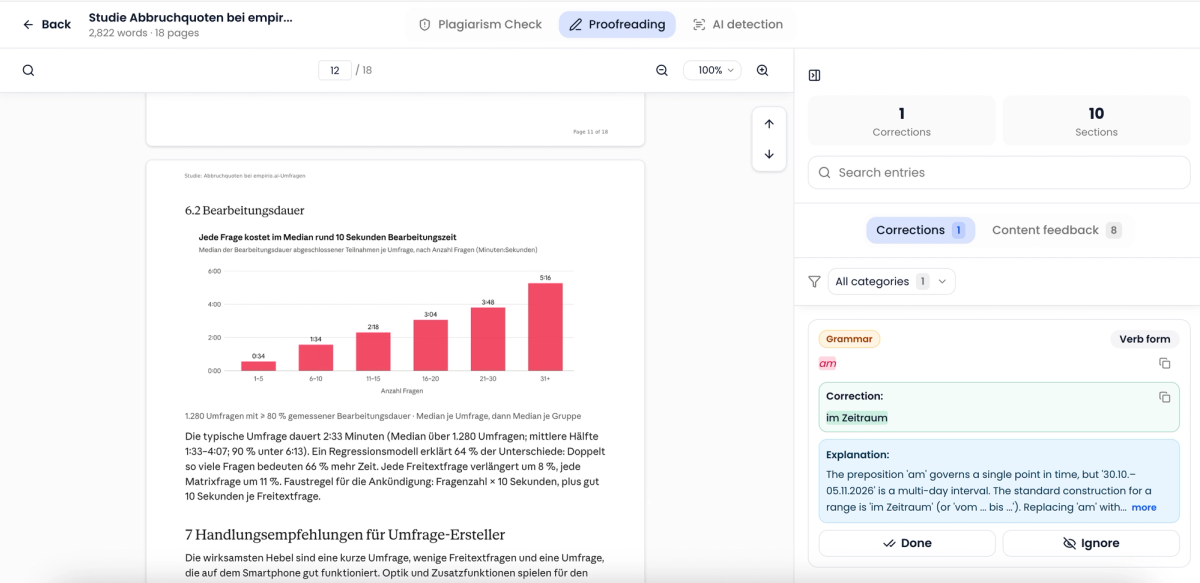
Human editing services usually sell these as separate services at separate prices. Where the line between proofreading and editing runs is covered in our guide to thesis proofreading. AI proofreading combines both. The writing and the decisions stay with you: the tool marks and suggests, it does not rewrite your thesis.
Which errors are still in your thesis before you submit?
After weeks with the same text, you stop reading what is on the page and start reading what you meant. That is why errors survive even in carefully written work. These are the usual suspects:
- Unclear references. A “this” or “it” with nothing obvious to point to.
- Vague terms. Wording that is roughly right but names nothing precisely.
- Grammar slips. Subject-verb agreement, tense shifts, dangling modifiers.
- Punctuation, typos, and capitalization. Small things that add up over 50 pages.
- Missing transitions. Paragraphs and chapters sit next to each other instead of building on each other.
Most of these are proofreading issues. The last one is about structure. That is exactly why checking spelling alone is not enough.
Grammar, punctuation, spelling: why Word is not enough
Grammar, punctuation, and spelling sound trivial. You write in Word or Google Docs, after all, and every mistake gets a red or blue underline. Unfortunately, that is only partly true.
GoThesis tested this in October 2026 with an academic sample text of 127 words and 11 planted errors, run through Microsoft Word's default checker, Google Docs, and its own AI proofreading. Word flagged 4 of the 11 errors, Google Docs 10, and GoThesis all 11. One caveat: the sample text was German, so the exact numbers do not transfer to English. The pattern does. GoThesis and empirio.ai belong to the same company.
| Tool | Errors found | What stood out |
|---|---|---|
| Microsoft Word | 4 of 11 | mostly missed grammar errors such as wrong agreement and wrong case |
| Google Docs | 10 of 11 | did not catch the citation error |
| GoThesis AI proofreading | 11 of 11 | explained every error and commented on the argument |
Source: GoThesis test with a German-language sample text, October 2026. A short text proves nothing about every paper, but it shows where the gaps are.
The reason is simple. A word processor mainly catches words that do not exist. The typical errors in a thesis are real words in the wrong place.
Grammar
“The number of studies have increased” consists entirely of correctly spelled words. The error is agreement: the number has increased. Mistakes like this creep in when you restructure a sentence and forget to adjust the verb.
Punctuation
“The sample was small, the results are not representative” joins two complete sentences with a comma. That comma splice is easy to miss in your own writing because you already know how the sentence is meant to sound.
Spelling
“Affect” and “effect,” “its” and “it's,” “principal” and “principle”: both spellings exist, so a simple checker stays silent. Add technical terms and proper names that are not in the dictionary. GoThesis covers all three areas in one pass with its proofreading for academic theses, which judges each word in the context of its sentence.
How does AI proofreading work?
You upload your paper as a file, the language model reads it from introduction to conclusion, and you get three kinds of results:
- Chapter-by-chapter feedback. GoThesis rates every section and names its strengths and weaknesses.
- Concrete rewrites. Instead of a vague “improve phrasing,” you get a before-and-after suggestion with the reasoning behind it.
- Language and logic checks. The report covers style and grammar, the logic of your argument, and academic conventions and formatting.
The difference from your word processor is context. AI proofreading can compare a claim in chapter 5 with the research question in chapter 1. A spell checker looks at one sentence at a time.
Proofreading by GoThesis
GoThesis is the sister product of empirio.ai for theses and other academic papers.
- For papers and theses
- Built for academic work
- Right in your browser
How reliable is AI proofreading?
AI proofreading finds a lot, but it decides nothing. Three limits are worth knowing:
- It does not know your requirements. Your program's guidelines, your department's citation style, and the conventions of your field are not in the text. Check the suggestions against them.
- It can get technical terms wrong. An unusual but correct term is sometimes flagged as an error.
- Feedback is an assessment. Whether a chapter really is too long or an argument is missing is your advisor's call in the end.
Treat every suggestion like a comment from an attentive classmate: take it seriously, check it, decide for yourself. The test above also rests on one short text and does not guarantee that 60 pages come back error-free.
What does a human editor cost in comparison?
Editing by a person is skilled manual work and priced accordingly. There is no fixed rate. The Editorial Freelancers Association publishes a rate chart for orientation, but it neither sets rates nor tells its members what to charge. Every service prices in its own way, usually by word count and turnaround.
Scribbr shows what that looks like in practice. For a thesis of about 12,000 words, its price calculator quotes these amounts:
| Turnaround | Proofreading and editing | with Structure Check and Clarity Check |
|---|---|---|
| 1 week | $229 | $409 |
| 72 hours | $331 | $601 |
| 24 hours | $433 | $793 |
Source: price calculator on Scribbr's website, University / College level, prices in US dollars, retrieved November 24, 2026.
The right-hand column is the one that matters. Plain proofreading and editing corrects the language. Feedback on structure and on logic and clarity are separate services at Scribbr and cost extra. If you want both, you pay at least $409 for 12,000 words and wait a week. For about 24,000 words, the same package comes to $793.
By comparison, AI proofreading from GoThesis costs $22.90 for about 12,000 words, already includes the content feedback, and is ready in minutes.
Then there is time. If you realize three days before the deadline that nobody has read your thesis, a human editor means paying the rush rate or going without. In that situation, AI proofreading is often the only check that still fits your schedule. It does not replace a person who knows your field. It is still far more than no proofreading at all.
Is AI proofreading allowed for your thesis?
Language correction is generally accepted at US colleges and universities. What matters is that nobody but you adds content or rewrites passages, neither a person nor a tool. Your school's academic integrity policy or honor code draws the line. How to read it is covered in our guide Thesis Proofreading: What US Universities Actually Allow.
The same logic applies to content feedback. A note like “Chapter 4 only partly answers the research question” is feedback you could also get from your advisor. You write the response yourself. It becomes a problem only when a tool or a person drafts the missing paragraphs for you.
Many schools now also require you to disclose AI tools. At Illinois State University, for example, all use of generative AI in a thesis must be disclosed. Whether that covers a pure check is spelled out in your program's rules. If in doubt, ask your advisor or the graduate school. More on the rules around AI is in our guide to checking your thesis for AI text.
Check your thesis: AI proofreading from GoThesis
GoThesis specializes in checking academic work. Its AI proofreading for academic papers combines content feedback and correction in one report: a rating for every chapter with strengths and weaknesses, a review of your argument's logic, and style and grammar corrections with concrete rewrites.
Here is how it works:
- Upload your thesis. As a PDF or Word file of up to 30 MB. No sign-up required.
- Let the AI read. It analyzes style, grammar, argument, structure, and academic conventions across the whole paper.
- Get your report. According to GoThesis, the analysis takes under 3 minutes on average. The report gives you suggestions for every section.
| Service | Scope | Price |
|---|---|---|
| AI proofreading | Term paper | $14.90 |
| AI proofreading | Thesis of about 12,000 words | $22.90 |
| AI proofreading | Thesis of about 24,000 words | $28.90 |
| AI proofreading and plagiarism check | Bundle price | from $29.80 |
As of November 2026, subject to change.
Your data is stored in the EU, never shared with third parties, and deleted automatically after the check. If you want to check again after revising, GoThesis Plus at $39.90 a month includes proofreading.
The full check: every source of error in one go
Language and content are only part of what you hand in. Proofreading does not tell you whether passages will be flagged as copied or as AI-generated. That is what the plagiarism check and the AI detector from GoThesis are for. Run all three and you get detailed feedback on every place a thesis can lose points:
- Plagiarism. Passages matched against academic sources, journals, and websites, each linked to its source.
- Citations. Missing citations, inconsistent citation styles, and errors in your bibliography.
- AI text. Sentence-level analysis with three confidence bands: low, medium, and high.
- Content. Feedback on every chapter: line of argument, research question, structure.
- Grammar and style. Each issue with the passage marked and a suggested rewrite.
That goes well beyond simple text matching. A basic plagiarism checker compares your text with existing sources and reports overlaps. It does not tell you whether your citations are right, whether a chapter answers the research question, or whether a paragraph reads like AI. The full check covers all of it.
What you gain is certainty before you submit. Instead of hoping at each of these points, you know where your thesis stands and what you still need to fix. The three checks together start at $26.70. Which tools find AI passages is covered in our comparison of AI detectors. How the platform does overall is in our GoThesis review.
Ready for the check?
Upload your thesis and see within minutes where errors remain and how your text holds up: Have your thesis proofread now.
How to work the feedback into your thesis
The best proofread is useless if you click through dozens of comments the night before the deadline. This order gets you the most out of it:
- Content first. Read the chapter feedback and decide what you still want to change. If you fix commas first and rewrite paragraphs later, you correct everything twice.
- Then the corrections. Go through the marked passages one by one. Accept what is right and leave what your field handles differently.
- Look for repeats. If the same type of error shows up several times, search the whole document for it.
- Read it once more at the end. Aloud or on paper. Revising creates new errors.
Plan at least two days before the deadline for this. The check takes minutes. Working in the feedback does not.
Conclusion
Errors in a thesis are normal, and they still cost you. The checker in your word processor catches only some of them. A human editor quickly costs more than $200 for 12,000 words and takes days. AI proofreading closes that gap: it corrects grammar, punctuation, and spelling and also tells you whether your argument, research question, and structure hold up.
For most theses, online proofreading with AI from GoThesis is the obvious last step before submission, because it delivers both in one pass and costs $22.90 for about 12,000 words. If you want certainty on every source of error, add the plagiarism check and the AI detector. What you do with the suggestions remains your decision and your work.