

Let's try a quick test: Who would you rather believe, your flatmate's gut feeling or a survey with a properly documented method? Probably the survey, and that puts you right at the heart of empirical research methods.
Empirical research methods are defined scientific procedures for collecting and analysing data systematically in order to answer a research question. They fall into two groups: quantitative methods, which work with numbers and large samples, and qualitative methods, which examine individual cases openly and in depth. By the end of this article, you will know which approach fits your project.
📌 Key takeaways
- Empirical research draws conclusions from systematically collected data.
- Quantitative methods measure in numbers and need large samples.
- Qualitative methods examine few cases openly and in depth.
- Surveys, observation, content analysis and experiments are the four basic forms.
- Your research question determines the right method.
Create a survey for free
With empirio.ai you can create a modern online survey in minutes — with hosting in the EU.
- AI-built survey
- Adjust by drag & drop
- Real-time analysis
What does empirical mean?
Empirical describes knowledge that is based on systematically collected and analysed experience, meaning observations, surveys, experiments or content analyses, rather than on pure theory, everyday assumptions or personal impressions. The term goes back to the ancient Greek word “empeiria”, which translates as “experience”.
Our everyday opinions and assumptions, by contrast, rest on subjective and often patchy impressions, which is why they easily lead to false conclusions. Empirical research is designed to prevent exactly that: It defines before the study how data will be collected, analysed and interpreted, so that others can retrace and verify every step. How well this succeeds is measured against the quality criteria of objectivity, reliability and validity.
Theoretical groundwork still matters! It is where research questions and hypotheses come from, which you then test with a suitable method. For a thorough introduction to the whole process, see our guide to the fundamentals of empirical research.
Empirical does not mean complicated. It means verifiable: evidence instead of assertion.
Types of empirical research methods
Empirical research methods fall into two large groups: quantitative methods, which measure phenomena in numbers, and qualitative methods, which examine individual cases openly and in detail. Both approaches are equally scientific; they simply answer different kinds of questions.
The four basic forms of data collection, namely surveys, observation, content analysis and experiments, exist in both variants. A survey can take the shape of a standardised questionnaire with fixed answer options (= quantitative) or of an open interview (= qualitative). What matters is therefore less the form of data collection than its degree of standardisation.
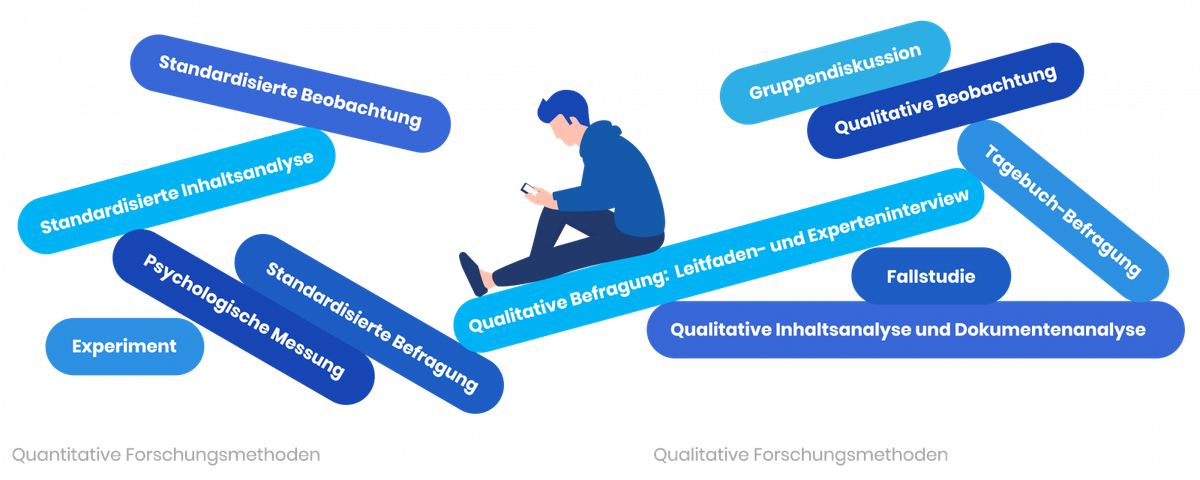
Quantitative empirical research methods
Quantitative research methods capture characteristics in numbers so that phenomena can be measured, compared and analysed statistically. Originally developed in the natural and social sciences, they are used in almost every discipline today. Their strength lies in large, standardised data sets: If the sample was drawn at random and matches the composition of the population (= the group you want to make a statement about), the results can be generalised.
Quantitative methods include:
- Standardised surveys: online questionnaires and interviews with a fixed set of questions.
- Standardised observation: behaviour is counted according to a fixed scheme.
- Standardised content analysis: texts and media are coded into fixed categories.
- Experiments: one condition is deliberately changed and the effect is measured.
Standardised online surveys are especially popular in dissertations and theses because they reach many participants in a short time. Well-known tools for this include Google Forms, SurveyMonkey and empirio.ai, an online survey tool from Germany.
Example: Visitors to a website are asked to rate the design of different sections on a scale from 1 to 5. From the measurable answers, the team works out which sections to redesign first.
Qualitative empirical research methods
Qualitative research methods examine a small number of cases openly and in depth in order to understand motives, interpretations and connections that cannot meaningfully be expressed in numbers. They were developed mainly in the social and cultural sciences. Instead of fixed answer options, there are open questions and room for the unexpected, and the analysis interprets texts, statements or observations rather than running statistics.
Qualitative methods include:
- Guided and expert interviews: open conversations along rough guiding questions.
- Qualitative observation: behaviour is described openly rather than counted.
- Qualitative content analysis: texts are analysed interpretively.
- Group discussions: several people discuss a topic and the dynamics are analysed.
- Case studies and document analysis: a single case is examined comprehensively.
Example: A bank wants to understand why part of its customer base refuses to use online banking. In open interviews, customers talk about their concerns, and the conversations produce hypotheses that can then be tested quantitatively.
Quantitative or qualitative: choosing the right method
The choice of the right research method depends on your research question: If you want to measure frequencies and generalise findings, you need quantitative data. If you want to understand motives and discover something new, qualitative interviews or observations will get you further.
| Aspect | Quantitative research | Qualitative research |
|---|---|---|
| Goal | measure, compare, generalise | understand, explore, form hypotheses |
| Data | numbers and fixed categories | texts, statements, observations |
| Sample | large, ideally drawn at random | small, deliberately selected |
| Questions | closed, standardised | open, flexible |
| Analysis | statistical | interpretive |
| Typical logic | deductive, testing hypotheses | inductive, developing hypotheses |
You do not have to keep the two worlds strictly apart, by the way. Many studies combine them as mixed methods: Open interviews deliver possible explanations first, then a standardised survey tests whether they hold for a larger group. You can read more in our comparison of qualitative vs. quantitative, and the underlying logic is covered in the article on deductive and inductive research.
💡 Tip
Write your research question in a single sentence and look at the question word. “How many” and “how often” almost always lead to a quantitative method, “why” and “how do people experience” to a qualitative one.
Common mistakes with empirical research methods
Most problems in empirical projects do not arise during the analysis but much earlier: when the method is chosen and planned. Working carefully at this stage saves a lot of trouble later.
Three mistakes come up again and again. All three can be avoided if you derive the method strictly from your research question and know the limits of your data.
Mistake 1: Choosing the method before the research question
Many people commit to an online survey before their research question is settled, because the method feels familiar and convenient. The result is data that only half answers the actual question. Better the other way round: Formulate the question first, then check which method delivers the data you need.
Mistake 2: Generalising from small samples
Twelve interviews tell you something about twelve people, not about “students in the UK”. Anyone who treats qualitative results like representative figures draws conclusions the data cannot support. Qualitative findings should therefore be phrased as hypotheses or tendencies, not as percentages.
Mistake 3: Confusing sample size with representativeness
A large sample makes a study more precise, but not automatically representative. A study becomes representative only if participants were selected at random and match the composition of the population. A thousand answers from a single degree programme remain a statement about exactly that programme.
Create a survey for free
With empirio.ai you can create a modern online survey in minutes — with hosting in the EU.
- AI-built survey
- Adjust by drag & drop
- Real-time analysis
Conclusion
Empirical research methods are not an end in themselves but the path from assumption to verifiable statement. As a rule of thumb: Let your research question decide whether you measure or interpret, and document every step so that others can retrace it. Then your study stands on solid methodological ground.
Where to go next
- Want to plan the full course of your study? Empirical research process: procedure and example
- Data collected and waiting to be analysed? Evaluation methods in empirical research
- Planning a survey as your method? Online survey: definition, advantages and disadvantages
Just starting your empirical project?
Our guide walks you through every step from research question to finished analysis: Fundamentals of empirical research