

Time for a quick test. “All swans are white. Snowmen are white. So snowmen are swans.” The sentence sounds like logic, but logic is exactly what it is not.
Deductive reasoning means starting from a general rule or theory and drawing a conclusion about one specific case. If the premises are true and the argument is built correctly, the conclusion has to be true as well. No new knowledge appears, existing knowledge is simply made visible. By the end of this article you will spot in seconds whether an argument in your own work holds up.
📌 The key points at a glance
- Deductive means going from a general theory to a single case.
- A deductive argument carries truth forward but adds no new knowledge.
- Valid and true are two different things in an argument.
- A supported hypothesis proves no theory, it survives one test.
- Inductive reasoning runs the other way, from cases to rules.
Create a survey for free
With empirio.ai you can create a modern online survey in minutes — with hosting in the EU.
- AI-built survey
- Adjust by drag & drop
- Real-time analysis
What does deductive mean? The definition
Deductive describes a logical procedure in which one specific case is derived, with necessity, from a general statement such as a theory, a law or a regularity. The word goes back to the Latin “deducere”, meaning to lead down or to derive.
A deductive argument classically has three parts: two premises and a conclusion. The form goes back to the syllogism of Aristotle and works the same way in everyday life as it does in research. The best known example is the argument about Socrates: all humans are mortal, Socrates is a human, so Socrates is mortal.
- Premise 1, the general rule. Every GP surgery in the UK closes on a Wednesday afternoon.
- Premise 2, the single case. Today is a Wednesday afternoon.
- Conclusion, the necessary result. My own GP surgery is not open for appointments right now.
The GP surgery argument is formally faultless, and the first premise still deserves a second look. The claim covers every single surgery in the country, and the argument itself offers no evidence for it. A neatly built argument is therefore no guarantee of a correct result.
The direction is what makes a deduction a deduction: from the general to the particular. Strictly speaking, that is also why a deduction produces nothing new. In technical terms, deduction transfers truth but does not extend content. The conclusion already sits inside the premises and is only made visible. In empirical research that is not a weakness but the point: testing a theory needs a derivation that leaves no room for manoeuvre.
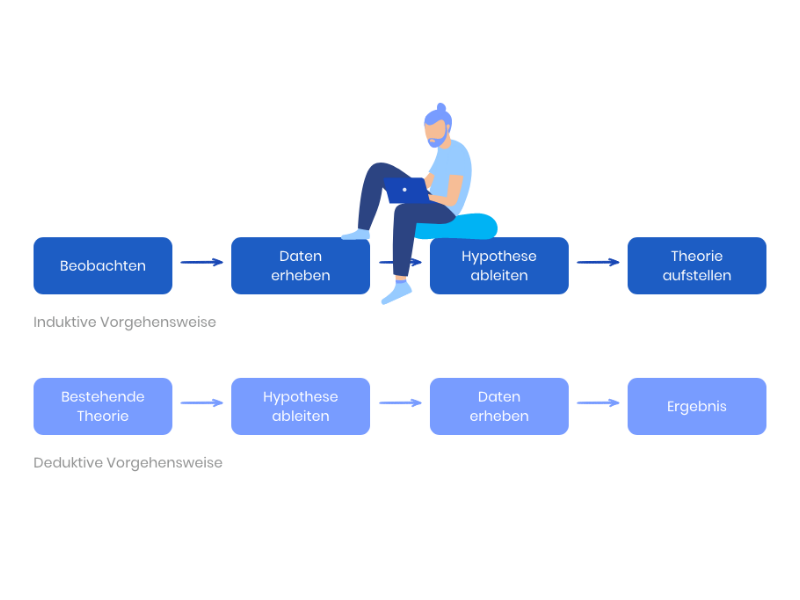
Deductive reasoning as a diagram: the theory comes first, the single case comes last.
Deductive and inductive: the difference
Deductive and inductive reasoning differ in the direction of the argument: deductive reasoning goes from an existing theory to the single case, inductive reasoning goes from observed cases to a general rule. One route tests a theory, the other builds one.
The choice between deductive and inductive has practical consequences for your own project. A deductive design needs a theory that already exists and is well documented, and it usually works with standardised data. An inductive design starts without a finished explanation and needs open material that gets organised later.
| Feature | Deductive | Inductive |
|---|---|---|
| Direction of the argument | from theory to single case | from single case to theory |
| Role of the theory | comes first, gets tested | comes last, gets built |
| Certainty of the conclusion | necessary if the premises hold | only ever probable |
| Typical data collection | standardised survey, experiment | open interview, observation |
In practice, deduction and induction are rarely cleanly separated. Methods guides usually treat the two as ideal types rather than as designs that ever appear in pure form, because the premises of a deduction come from empirical work at some point, and no observation is made without prior theoretical knowledge. Anyone running both routes one after the other in a research design will find the detail in deductive and inductive research.
The deductive approach: four steps
The deductive approach runs in four steps: choose a theory, derive a hypothesis, collect data, test the hypothesis. Theoretical thinking always comes first, never the data collection.
Because the hypothesis is fixed in advance, the result that would refute it has to be fixed in advance too. Committing to that before collection is the real difference from inductive work, and the reason deductive designs usually run on a quantitative research method.
- Choose a theory. An existing theory supplies the general statement you work against.
- Derive a hypothesis. From the theory you formulate a testable if-then statement about your case.
- Collect data. The data collection is built so that it can also let the hypothesis fail.
- Test the hypothesis. The result either refutes the hypothesis or supports it provisionally.
An example from media studies shows the sequence. A theory describes the link between smartphone ownership and messenger use among teenagers. From it you derive the hypothesis: if 16-year-olds own a smartphone, at least a third of them use a messenger every day. You then survey 200 teenagers who own a smartphone. A result clearly below that mark refutes the hypothesis. A result above it does not prove the theory, it only leaves the theory unrefuted.
💡 Tip
Write every hypothesis so that you can name, before data collection starts, one concrete result that would knock it over. If no such result comes to mind, the hypothesis is not testable and the design is not really deductive. The question takes two minutes and saves a lot of argument in the methods chapter.
Valid or true: what a deductive argument delivers
A deductive argument is valid when the conclusion follows necessarily from the premises. The same argument is true only if the premises themselves hold as well. Validity concerns the form of the argument, truth concerns the content, and both can go wrong independently of each other.
The split between validity and truth is the most common blind spot on this topic. The Open University puts it plainly in its free course material on judicial reasoning: the logic of a syllogism is flawless when applied correctly, yet the syllogism itself says nothing about the truth of the premises, so a flawed premise makes the conclusion fallible too. Logic checks whether an argument is neatly built. Whether the world plays along with the premise is not something logic checks.
| Example argument | Valid? | True? |
|---|---|---|
| Socrates is mortal | ✓ | ✓ both premises hold |
| GP surgery closed on Wednesday | ✓ | ✕ the first premise is unchecked |
| Snowmen are swans | ✕ | ✕ the argument is built wrongly |
The snowman argument deserves a second look, because guidebooks occasionally present it as an example of deduction. “All swans are white. Snowmen are white. So snowmen are swans.” Both premises name the same property, and no membership of a group follows from that. The argument is invalid, however true the individual sentences may be.
A deductive argument can be perfectly built and still be false. Logic checks the form, not the world.
Create a survey for free
With empirio.ai you can create a modern online survey in minutes — with hosting in the EU.
- AI-built survey
- Adjust by drag & drop
- Real-time analysis
Common mistakes in deductive arguments
Three mistakes turn up again and again in deductive arguments, and all three cost marks in the methods chapter of a dissertation. What the three have in common is a text that looks formally correct while the error sits one level below the surface.
Anyone who knows these three mistakes will find them in a few minutes while proofreading their own work. The quickest route is to write the argument out of your text and cut it down to three lines: premise, premise, conclusion.
Mistake 1: two true sentences, one false conclusion
Two statements that name the same feature do not yet establish a connection. The swan example does exactly this: “white” appears in both premises but does not link the two groups. Logicians call this an undistributed middle term. In a text you can spot it because the conclusion asserts an equivalence that was never set up anywhere.
Mistake 2: a supported hypothesis is read as proof
A hypothesis that holds up in your own data does not prove the theory behind it. The hypothesis has merely survived one opportunity to be refuted. The Stanford Encyclopedia of Philosophy sums up the position of Karl Popper on this point: when the conclusions derived from a theory are shown to be true, the theory is corroborated, but never verified. Write “the hypothesis could not be refuted” rather than “the theory was confirmed”.
Mistake 3: the premise is never checked
Taking a theory from the literature does not mean the theory holds for your case. Many theories were developed with one particular group, in one particular country or in one particular decade. Leaving that unsaid in the theory chapter means building a valid argument on a premise that does not fit your own sample.
⚠️ Watch out
A larger sample makes a deductive result more precise, but not automatically representative. A survey becomes representative only when the selection of participants matches the composition of the group you want to make a statement about. The guide to the representative survey explains how that works.
Working deductively in your dissertation
Deductive work makes sense in a dissertation when your topic already has a worked-out theory you can lean on. The order never changes: theory chapter first, hypotheses at the end of the theory chapter, data collection after that.
One word deserves care, because the labels differ between countries. At most UK universities the final project on an undergraduate or master’s degree is called a dissertation, and “thesis” is reserved for doctoral research. Newcastle University sets out exactly that split in its academic skills material. American usage runs the other way round, and the writing guidance of the University of Oxford uses the terms in that inverted sense too, so a quick look at your own department handbook is worth the two minutes.
For the data collection itself, students mostly use an online survey tool, for example Google Forms, SurveyMonkey or empirio.ai, an online survey tool from Germany. Timing matters more than the tool: the questionnaire is written after the hypotheses, not before. Every question should map onto a hypothesis, otherwise you collect data that nobody needs in the results chapter.
Checklist for your methods chapter
- The theory is named, with source and year.
- Every hypothesis can be derived from the theory.
- Every hypothesis has a result that would refute it.
- Every question in the questionnaire belongs to a hypothesis.
- The limits of the theory are named, not hidden.
Turning a research question into clean hypotheses is covered step by step in formulating research questions and setting up hypotheses. For the data collection itself, the guide to the survey for a bachelor’s or master’s dissertation helps.
Conclusion
Deductive work is the calmer of the two research directions: you test what others have thought through, and your own contribution lies in the clean derivation. The difference between a good dissertation and a mediocre one rarely sits in the amount of data, it sits in whether the premises are laid open and the limits are named. Anyone writing that a hypothesis could not be refuted has understood more about method than anyone declaring a theory proven.
Where to go next
- Curious about the opposite direction? What does inductive mean?
- Want both terms side by side? Induction and deduction at a glance
- Planning your data collection? The empirical research process
- Need the basics first? Empirical research: definition and methods
Hypotheses ready, questionnaire still missing?
With empirio.ai you can build an online survey for free, collect the answers from your sample and export them for analysis.