

Your survey is running and the first responses are coming in. Then someone from the Phoenix warehouse gets in touch: half the crew is not filling it out, because it only exists in English. Now you have to choose between a second survey and a proper multilingual version.
You create a multilingual survey by finishing the questionnaire in your source language first, activating the target languages in your survey tool, having all the text translated, and then clicking through every language version once from start to finish, including the one in the language you do not speak yourself. How much work this turns into depends on the order.
📌 Key takeaways
- Finish the questionnaire first, then have it translated.
- One survey with language versions saves you the merging.
- In the US, the second language is almost always Spanish.
- With empirio.ai the AI translates the whole questionnaire in one go.
- Later changes are applied across all languages automatically.
Create a survey for free
With empirio.ai you can create a modern online survey in minutes — free to start.
- AI-built survey
- Adjust by drag & drop
- Real-time analysis
What makes a survey multilingual
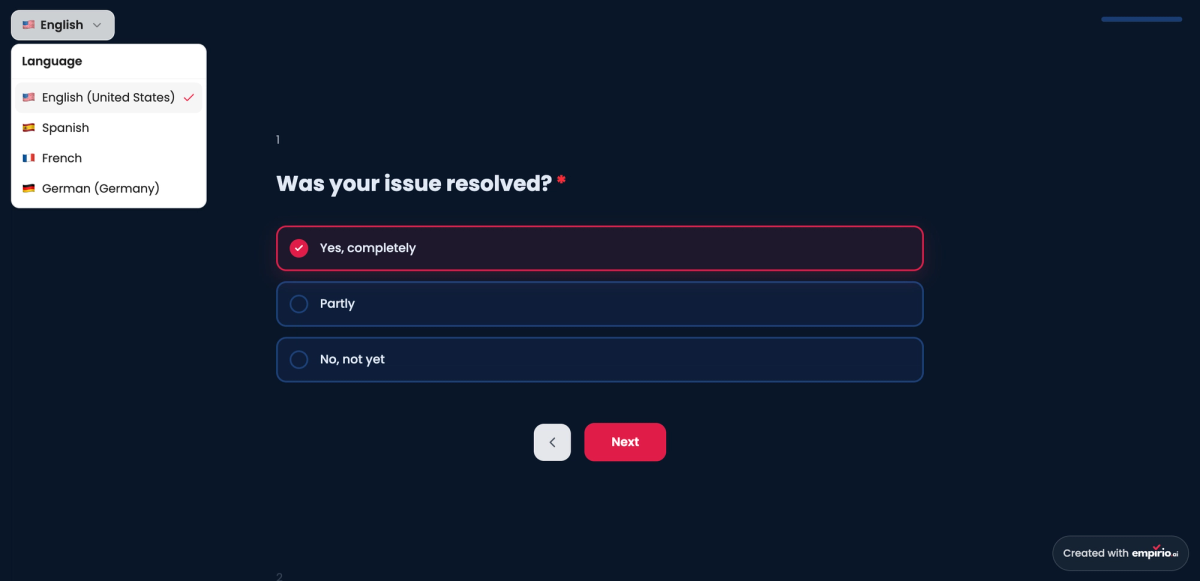
A multilingual survey is a survey that offers the same questionnaire in several languages and still collects the answers in one shared dataset. Respondents either pick their language themselves or are assigned it automatically.
The point where most guides get vague is that a questionnaire has two layers. The interface is one: next buttons, required-field notices, error messages. In many tools those follow the language of the person answering, without you doing anything. Your own text is the other: title, questions, answer options, closing message. That is where the work sits, and that is what people mean when they say multilingual survey.
The second distinction decides how your analysis will go. A proper multilingual survey is one survey with several language versions: one link, one analysis, one column for the language. Set up a separate survey per language and you end up with three separate tables to merge by hand. Both get you there. Only the work afterward is different.
Translating costs you an hour. Merging two tables by hand afterward costs you an afternoon.
Which languages you actually need
Not every survey needs several languages. The question is not where your respondents sit, but which language they answer honestly in. For a technical survey among developers, English usually does the job. For anything that asks about opinion, satisfaction or feeling, it does not.
In the United States that question has a fairly predictable answer, and the federal government has already done the counting for you.
Spanish first, then look at your own list
The Census Bureau groups languages spoken at home into four categories, and Spanish is the only single language that gets a category of its own. The other three are Other Indo-European languages, Asian and Pacific Island languages, and all other languages. For most surveys in the US that makes the decision simple: English plus Spanish covers the largest share, and everything beyond that depends on where your respondents actually are.
The Census Bureau collects this through the American Community Survey, which asks three questions: whether a person speaks a language other than English at home, which language that is, and how well they speak English. That third question uses a four-point scale, and the wording is worth stealing: very well, well, not well, not at all.
If you survey for a program that receives federal funds
Language access is not always a courtesy question. In 2000, an executive order required federal agencies to identify the need for services for people with limited English proficiency and to provide meaningful access to language assistance. Agencies use the Census language data to decide where and how to do that.
If your survey runs for a public program, a school district or an organization on federal funding, the language question therefore belongs in the planning phase and not at the end. What counts in your specific case is decided by the agency funding the program, not by a guide like this one.
Three cases where the native language pays off
- The employee survey in a workforce spread across several states or countries. Anyone asked to rate a manager in a second language answers more cautiously and more briefly.
- The customer survey across several markets. Open text answers are the most valuable part. Hardly anyone writes those in a language they feel unsure in.
- The thesis with an international sample. Here the language often decides whether you reach the sample size you need at all. How to get enough people in the first place is covered in how to find participants for your survey.
There is a cost on the other side, and it matters just as much: every language is a version you carry along with every change. Two to four languages cover almost any project. Anyone who adds seven because they can ends up maintaining seven questionnaires.
Four steps to a multilingual survey
The order matters more than the tool. Anyone who translates first and then changes questions does the work twice, once in every language.
That is why the source version comes first and sending it out comes last.
Step 1: Finish the source version
Build the questionnaire in the language you are most confident in, and build it completely: every question, every answer option, the branching logic, the introduction and the closing text. Only once you have nothing left to change does the translation begin. How a solid questionnaire is put together is covered in our guide on how to create a questionnaire.
Step 2: Decide on the target languages
Only take the languages you actually have respondents in, and check beforehand whether your tool offers them at all. That decision belongs before the translation, not after. Every language you add later means another pass through the whole questionnaire and another round of proofreading.
Step 3: Translate and have it read back
The translation itself takes seconds these days, the proofreading is the actual work. Every translated question goes past the eyes of someone who genuinely speaks the language. For twenty questions that takes ten minutes, and it heads off exactly the misunderstandings that make your groups impossible to compare later.
Step 4: Click through every version once
Open each language version in a browser and fill it out completely, including the one whose language you do not speak. You are not checking the wording here, you are checking the mechanics: does the logic jump correctly, are all answer options there, is nothing cut off. Longer languages such as Spanish happily break a layout that the English text still held together.
Translating questions is more than swapping words
A translated question has to measure the same thing as the original, not just mean the same thing. No translation solves this part on its own, because it depends on the country rather than the language.
Three places go wrong most often. All three only show up when you analyze the results:
- Scales are not the same everywhere. A letter-grade logic running from A to F triggers a different expectation outside the US school system. Agreement scales are the safer route, because the Likert scale works comparably across countries.
- Levels of formality change answering behavior. Spanish distinguishes between tú and usted, and English does not. Pick one and keep it, or you end up comparing two different surveys.
- Categories often do not fit. Education levels, job groups and regions are cut differently in every country, and a literal translation produces options that do not exist there. Race and ethnicity categories in particular follow US federal standards that have no equivalent elsewhere.
When it has to be precise, back translation helps: a second person translates the finished version back into the source language without knowing the original. If the result drifts, you have found your problem spot. Which question types suit that at all is covered in our overview of question types in surveys.
Create a survey for free
With empirio.ai you can create a modern online survey in minutes — free to start.
- AI-built survey
- Adjust by drag & drop
- Real-time analysis
Creating a multilingual survey with empirio.ai
With empirio.ai, an online survey tool from Germany, one button handles the whole third step. You build the survey in your own language as usual, activate the multi-language setting and have the entire questionnaire translated. There is nothing to build a second time.
Getting there is three clicks in the settings. After that you carry on working exactly as before.
Activating multiple languages
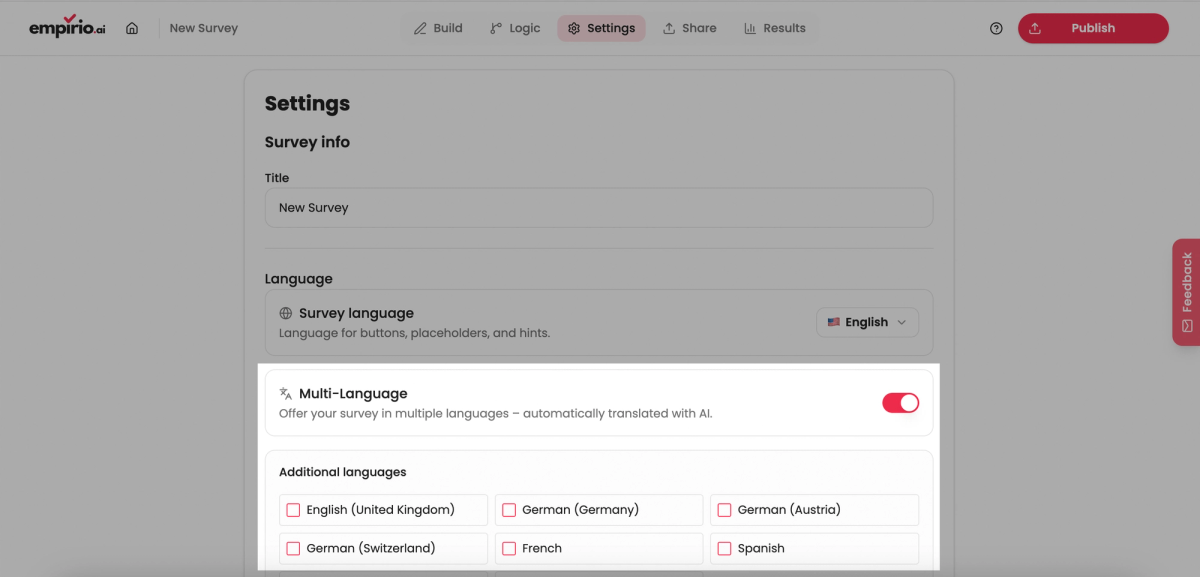
Open the finished survey, go to Settings and then Language. The switch activates multiple languages and lets you choose from six: German, English, French, Spanish, Italian and Dutch. The AI then translates the entire questionnaire, meaning questions, answer options and text, in a single pass.
Switching between language versions
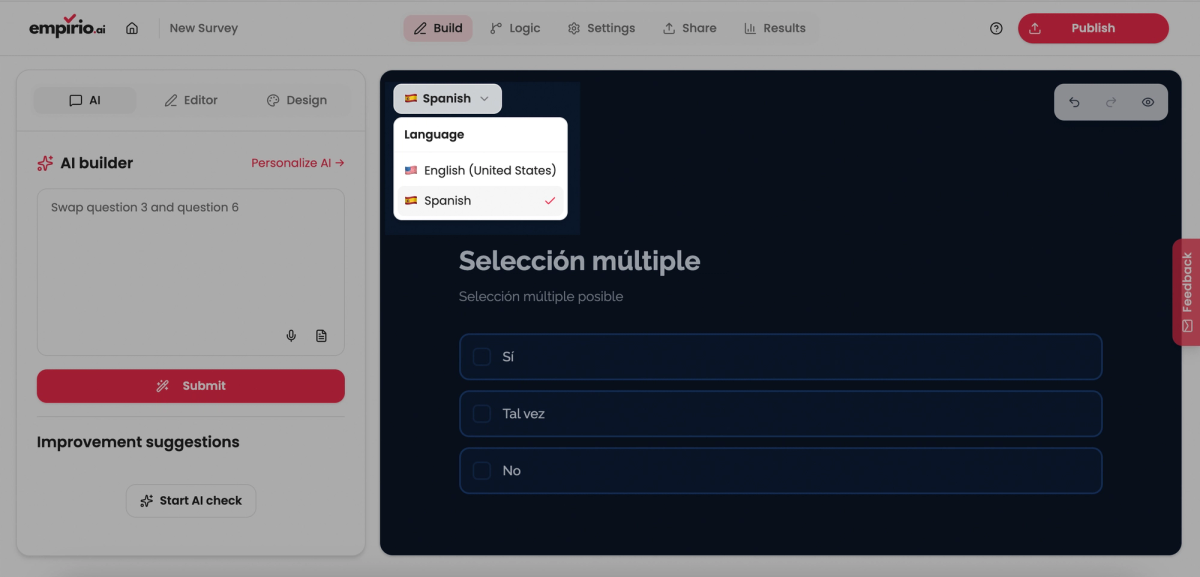
Under Edit you then get a dropdown that switches between the language versions. You see every translation in the same place where you edit the original, and you can adjust individual wordings directly. This is exactly where the eyes of someone who speaks the language belong.
Adding questions afterward
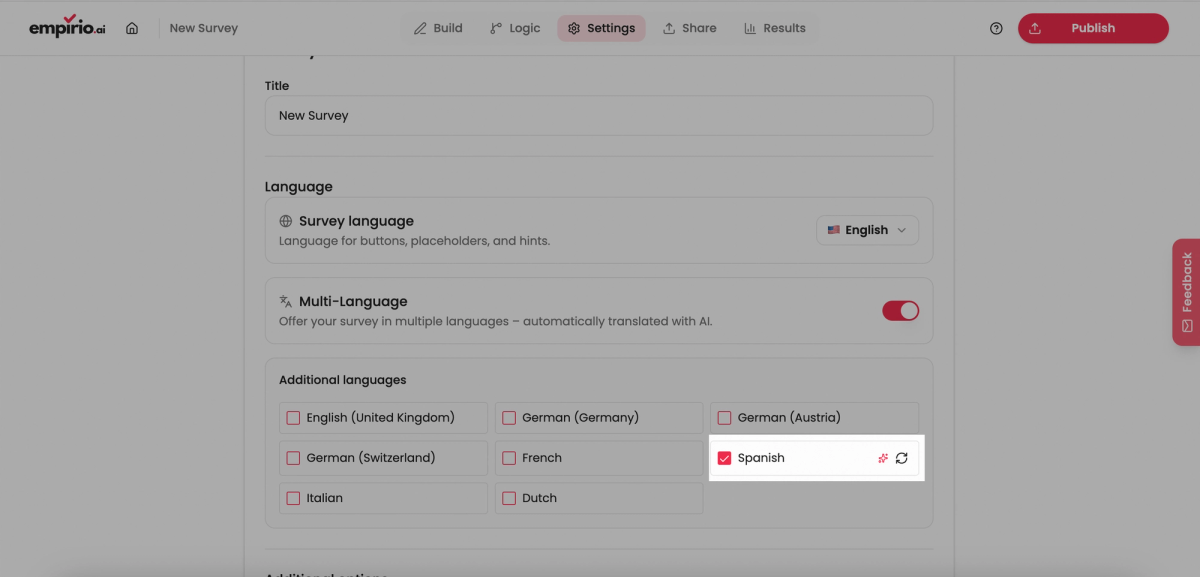
The real advantage only shows up later. Add a question or change a setting and it happens across all languages automatically. The new elements can then be translated again at the push of a button, without touching the rest. So you keep maintaining one survey rather than six.
Two honest limits belong here. Multilingual surveys and automatic translation are part of the Pro plan at empirio.ai, not of the free one (as of September 2026). And those six languages are the set: anyone who needs Polish, Vietnamese or Tagalog needs a different tool. For English and Spanish they are enough, beyond that it depends. What the plans cost is covered in our guide to the cost of a survey.
Typical mistakes with multilingual surveys
Three mistakes come up again and again in multilingual surveys. All three only surface once the survey is live. By then the correction is expensive.
The pattern behind them is always the same. Treat the language versions as separate projects and you lose the very advantage you set them up for.
Translating too early
Start the translation before the source version is settled and you pay for every later change multiplied by the number of languages. One extra question in four languages is four entries, four checks and four chances to forget one of them. Finish first, then translate.
Not recording the language
If you cannot tell afterward which answer came from which language version, you cannot see differences between groups. Make sure the language ends up in the dataset. If the column is missing, a question about language belongs at the start of the questionnaire, not at the end. The American Community Survey wording is a ready-made model: how well does this person speak English, answered on four steps from very well to not at all.
Translating only the questions
Invitation text, subject line, reminder and thank-you page get forgotten regularly. Send a Spanish survey with an English invitation email and you lose respondents before the first question. The translation does not end at the questionnaire, it ends at the last piece of text someone reads from you.
Conclusion
Running a survey in several languages is no longer a question of budget, it is a question of order. Finish the source version, decide the target languages, have it translated, click through every version once. In the US that second step is usually shorter than people expect, because English plus Spanish already covers most of the ground. The time you save there is better spent on proofreading.
What to read next
- Still looking for the right tool? The 5 best survey tools compared
- Want to know what it costs? How much does a survey cost?
- Writing the questionnaire right now? Survey templates and examples
One survey, several languages?
Build your survey with empirio.ai in your own language and have the questionnaire translated. Create a survey online