

In January 2002 the Pew Research Center asked half its sample whether the president should focus more on domestic policy or foreign policy. Domestic policy won comfortably. For the other half the same answer category was labeled “the war on terrorism” instead of “foreign policy,” and the majority flipped.
Closed-ended questions are questions in a survey or interview where every answer choice is supplied in advance: the respondent picks from a fixed list, marks a point on a scale or chooses between two alternatives instead of writing the answer themselves. We will show you which types exist and how to spot when your answer list is shaping the result.
📌 The key points
- Closed-ended questions supply every answer choice in advance.
- The answer list changes the result, not just the format.
- Answer categories must be exhaustive and mutually exclusive.
- Krosnick and Presser recommend five to seven scale points.
- Pew generally avoids select-all-that-apply lists.
Create a survey for free
With empirio.ai you can create a modern online survey in minutes — with 100% data protection from Germany.
Start for freeWhat are closed-ended questions?
A closed-ended question is a question in a survey where every answer choice is supplied in advance. The respondent selects from the given categories and does not phrase the answer in their own words.
Survey methodologists separate closed-ended questions into two quite different groups, and the split matters more than it sounds. Some carry a rating scale, where the categories follow a gradation from one end of a dimension to the other. Others carry only a list, where the choices sit side by side with no order at all.
The split between scale and list is practical, not academic. A rating scale comes with its own rules on the number of points and the middle category; an answer list comes with rules on completeness and order. Treat them as one thing and you apply the wrong rules, then puzzle over the distribution.
| Answer format | What is supplied | Example |
|---|---|---|
| Open-ended question | nothing, just a text box | What was missing from the class? |
| Closed-ended question with rating scale | graded categories on one dimension | very satisfied to very dissatisfied |
| Closed-ended question without a scale | a list with no gradation | Which degree are you working toward? |
Every question format and its subtypes appear in the overview of question types in a survey. If you would rather work out which of the two basic forms suits your project, the direct comparison of open-ended and closed-ended questions is the place to start.
Types of closed-ended questions
Closed-ended questions sort along two features: how many answers the respondent may give, and whether the categories stand in a rank order. That produces five forms which turn up in almost every survey.
The labels for these five forms differ by tool. Sometimes the two most common are called multiple choice and checkboxes, sometimes single answer and multiple answer. The underlying format is the same.
| Question type | How many answers | Example |
|---|---|---|
| Dichotomous question | exactly one of two | Have you ever taken a survey? |
| Single-choice question | exactly one of several | Which degree are you working toward? |
| Multiple-choice question | any number from a list | Which languages do you speak? |
| Rating scale | one point on a gradation | How satisfied were you with the advising? |
| Ranking question | all items, placed in order | Rank five criteria by importance |
One stubborn misunderstanding surrounds the dichotomous question. You will often read that it can also carry four graded answers from “strongly support” to “strongly oppose.” A question like that is no longer dichotomous: dichotomous means split in two, so exactly two categories. Four graded points make a rating scale, and different rules apply there.
Multiple-choice questions: several answers at once
In a multiple-choice question the respondent may mark several answer choices at the same time. That makes sense whenever the categories do not exclude one another, such as languages spoken or devices used. The cost shows up in the analysis: the percentages no longer add up to 100, because each person is counted more than once.
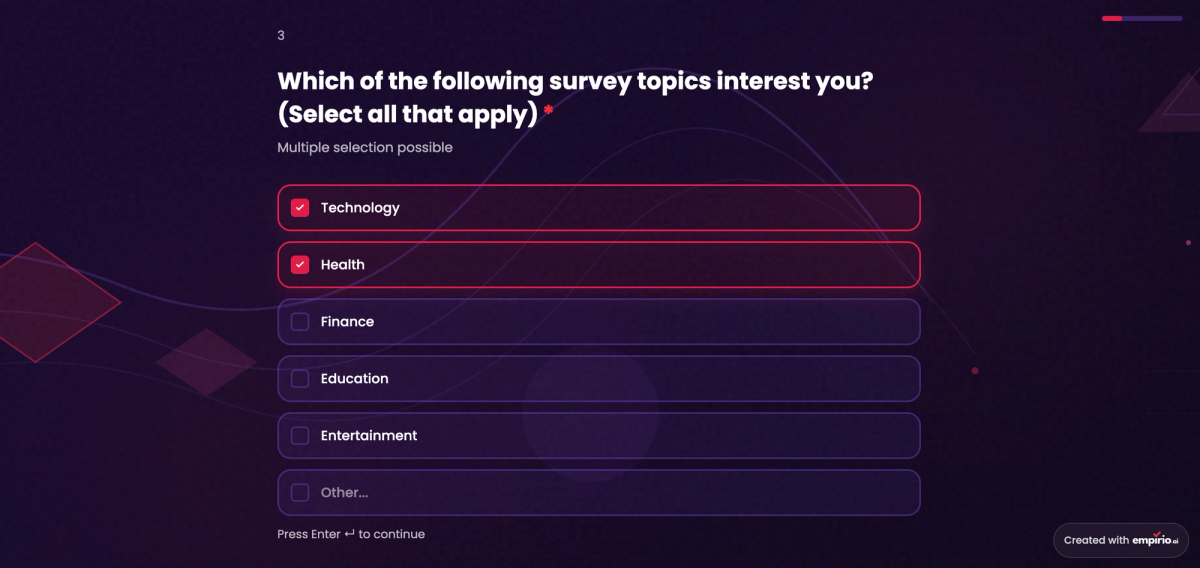
How to build these questions and which traps wait at the analysis stage is covered in detail in the article on multiple-choice questions.
Single-choice questions: exactly one answer
In a single-choice question the respondent settles on exactly one answer choice. This form assumes the categories genuinely exclude one another, otherwise the respondent faces two equally correct answers and picks at random. In return the analysis is as simple as it gets, because the shares divide cleanly into 100 percent.
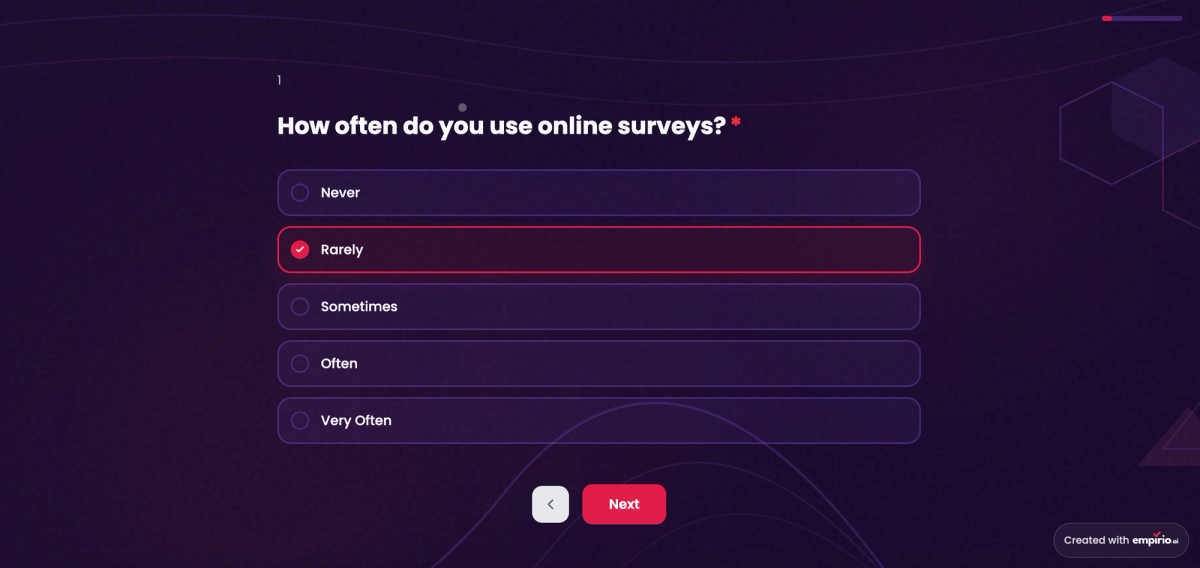
The boundary with related forms and further examples are set out in the article on single-choice questions.
Advantages and disadvantages of closed-ended questions
The biggest advantage of closed-ended questions is fast, objective analysis; the biggest disadvantage is the limit set by whatever someone thought of in advance. The two are the same thing: the very list that makes analysis easy cuts off everything not on it.
What closed-ended questions deliver
- Closed-ended questions cost respondents very little time.
- The answers can be analyzed statistically with no preparation.
- Every respondent sees the same categories, which makes answers comparable.
- Misunderstandings are rarer, because the choices show what is meant.
- The analysis gives the same result whoever runs it.
What you give up in return
- Answers outside the supplied list are lost entirely.
- Anyone who finds nothing suitable marks something anyway.
- The wording of the categories can skew the result.
- The respondent’s own choice of words stays invisible.
How strongly the categories work is clear from an experiment by the Pew Research Center in January 2002. Half the sample chose between “domestic policy” and “foreign policy,” and 52 percent picked domestic policy against 34 percent for foreign policy. For the other half the second category read “the war on terrorism,” and the ratio reversed to 33 against 52 percent. The question was identical; only one answer category was drawn more narrowly.
The answer list is not the packaging around the question. It is part of the question.
The counterweight sits in the article on open-ended questions: they capture exactly what a fixed list cuts away, but every single answer costs coding time afterward.
Create a survey for free
With empirio.ai you can create a modern online survey in minutes — with 100% data protection from Germany.
Start for freeBuilding answer choices that hold up
Answer choices for a closed-ended question have to meet two formal conditions: they must be exhaustive, covering every possible reply, and mutually exclusive, so that each reply falls into exactly one category. Pew Research Center names both conditions in its own guidance on writing survey questions.
Both conditions sound obvious and go wrong constantly, usually unnoticed until the analysis. Four checks catch the common cases, and they take minutes before the survey goes out.
Every possible answer has to appear on the list
When an obvious category is missing, one of two things happens: the question is skipped, or something gets marked at random. Both damage the data, the second one invisibly. Where the full set of cases cannot sensibly be listed, add an “other” category, ideally with a small text box beside it.
Two answer categories must not overlap
Numeric bands are the classic failure. With the choices “between 6:00 and 6:30” and “between 6:30 and 7:00,” someone who gets up at 6:30 faces two correct answers. Unambiguous limits fix it: “6:00 to 6:29” and “6:30 to 6:59.” The same applies to age bands and income brackets.
The answer categories have to match the question
A common break appears when the question text asks for something the answer list does not offer. “Were you an active member of a club in the past twelve months?” calls for a yes or no, yet it is often paired with “often, sometimes, rarely, never.” Either rewrite the question as a frequency question, or cut the categories back to yes and no.
Long category lists are fine when the answer is a fact
Pew Research Center keeps most answer lists to four or five choices, but deliberately breaks that rule for factual questions. Its standard religion question runs to more than twelve categories, beginning with the most common affiliations, and respondents handle it without trouble because they expect to find their own group on the list. The same logic applies to race, ethnicity and state of residence: inclusiveness beats brevity whenever the respondent is looking something up rather than forming a judgment.
⚠️ Watch out
Test your answer lists against an invented person who fits them badly. Someone with no fixed waking time, who never uses an ATM or who falls into none of your age bands will expose the gap in seconds.
How many answer choices make sense?
For rating scales Krosnick and Presser (2010) conclude that five to seven points measure best; for plain answer lists the Pew Research Center suggests four, or five at most, especially by phone. The two numbers do not contradict each other, they apply to two different formats.
Both recommendations rest on the same reasoning. Too few categories stop showing differences; too many become unclear, because nobody can say what separates point four from point five. Pew adds a second argument for short lists: psychological research indicates that people struggle to hold more than four or five choices in mind at once when the options are read aloud.
| Format | Recommended number | Source |
|---|---|---|
| Rating scale | 5 to 7 points | Krosnick and Presser (2010) |
| Answer list, especially by phone | 4, at most 5 | Pew Research Center |
| Factual question such as religion | many more are fine | Pew Research Center |
A second point matters almost more than the number itself: label every point, not just the two ends. Fully labeled scales raise reliability and validity, are preferred by respondents and help people with less formal education in particular. Read how that looks on the best known scale format in the article on the Likert scale.
A middle category on a rating scale: include it or leave it out?
You will often read the advice to use an even number of points so that respondents have to take a side. The research does not really support that. Middle categories do attract people who are simply saving effort. Even so, Krosnick and Presser (2010) recommend offering one, because people who genuinely sit in the middle otherwise shift systematically to a neighboring category and skew the distribution.
When a “don’t know” category belongs in the question
A “don’t know” category is not a matter of right or wrong but of content, mode and audience. If you can be sure every respondent has an answer, you can leave it out. For knowledge questions and attitudes on remote topics that is rarely the case, and without the option people pick a substantive category at random.
💡 Tip
Set “don’t know” and “prefer not to answer” visibly apart from the rest of the scale, for instance with a blank line. Otherwise the visual midpoint of the scale shifts and respondents anchor on the wrong place.
Common mistakes with closed-ended questions
Most mistakes with closed-ended questions sit in the answer choices rather than the question text. Four of them turn up especially often, and all four can be fixed in minutes before the survey goes out.
What these four have in common is that they stay invisible in the data. A skewed distribution looks like a finding rather than a fault, which is exactly why the check belongs beforehand.
Putting everything on an agree-disagree scale
Scales running from “strongly agree” to “strongly disagree” are convenient because they fit any statement. Pew Research Center warns that they also produce acquiescence bias: less educated and less informed respondents agree more readily regardless of content, and the effect is stronger when an interviewer is present. The better practice is to offer a choice between two alternative statements, or to ask directly about the dimension itself.
Using select all that apply instead of a decision per item
Checkbox lists are the default in online surveys and still the weaker option. Pew Research Center generally avoids them after its own 2019 study, which found that forced-choice questions yield more accurate responses, particularly on sensitive topics. A list of eight checkboxes becomes eight short yes-no questions instead.
Ignoring the order of the answer list
Where an answer sits in the list affects how often it is picked, and the direction depends on how the question is delivered. In telephone surveys respondents more often choose items heard later, the recency effect. In self-administered surveys they tend to choose items at the top, the primacy effect. Pew randomizes most answer lists for exactly this reason, but leaves ordinal scales in order, because the sequence itself carries information the respondent needs.
Assuming a regularity that is not there
Answer categories such as “once a month,” “every two weeks” or “every week” assume the behavior follows a rhythm at all. Plenty of people take out cash when they need it rather than by the calendar. Asking for a count within a fixed period avoids the assumption: “How often did you take money out of an ATM last month?” with the choices not at all, once, two or three times, four times or more.
Create a survey for free
With empirio.ai you can create a modern online survey in minutes — with 100% data protection from Germany.
Start for freeAnalyzing closed-ended questions
Closed-ended questions are analyzed by counting how often each answer category was chosen and converting the counts into percentages. Which further calculations are valid is decided not by the question format but by the level of measurement of the answer categories.
Clean answer choices pay off at exactly this step. Mutually exclusive categories can be counted straight off; overlapping ones cannot. And a category nobody chose is a finding too: it was either unnecessary or unclearly worded.
- Count the frequencies. How often each category was chosen, in absolute numbers and percent.
- Fix the base. With multiple answers the percentages exceed 100, and that needs stating.
- Report missing values separately. A skipped question and a “don’t know” are not the same thing.
- Compare subgroups. A cross-tabulation shows whether two groups really differ.
At the subgroup stage the level of measurement decides. For nominal categories such as major a mean is meaningless, so you count frequencies. For ordinal categories such as letter grades the median is the sound figure. Whether a mean may be taken from a rating scale is disputed in the methods literature, because it assumes equal distances between the points. It is reported anyway in many studies, and when it is, a sentence explaining why that is defensible belongs with it. Which level applies to your data is settled in the article on levels of measurement.
Conclusion
Closed-ended questions are not the easy option but the demanding one: all the thinking sits at the front, in the answer categories, and cannot be repaired later. Work exhaustively and exclusively, choose the number of points deliberately and keep an eye on the order, and you get data you can analyze the same day.
Where to go next
- Want to weigh up both question forms? Open-ended and closed-ended questions compared
- Need the other side in detail? Open-ended questions and how to code them
- Looking for further question formats? Question types in a survey
- Building your questionnaire right now? How to create a questionnaire
The guidance quoted here is published by the Pew Research Center, and the European counterpart with the same recommendations is the GESIS Survey Guidelines.
Want to try closed-ended questions right away?
With empirio.ai, an online survey tool from Germany, you can set up single-choice, multiple-choice and scale questions in a few clicks and see the frequencies directly in the results. Create a survey for free
Frequently asked questions
Create a survey for free
With empirio.ai you can create a modern online survey in minutes — with 100% data protection from Germany.
Start for free