
Plagiarism software is everywhere, and pretty much every provider calls itself the best. An honest overall winner that suits every piece of work doesn't exist, though. What's perfectly fine for your twelve-page term paper can fall short for a master's thesis with hundreds of sources. This comparison saves you the legwork: you'll learn what makes a good tool, how the three providers that matter most for students differ in technology and price, and which one fits your project. In a few minutes, you'll know where to check your work best.
📌 The essentials at a glance:
- There's no single overall winner. Whether a tool is any good comes down to the size of its source database, how well it detects paraphrasing, the quality of the report, data protection and price.
- Three names matter most for students in practice: GoThesis (affordable, AI-powered, results in a clickable portal), Scribbr (works with Turnitin, so it's close to what your university checks) and BachelorPrint (worth it if you want checking and printing in one place).
- As a student, you normally can't book Turnitin yourself. Ouriginal, formerly known as Urkund or PlagScan, has been history since 2026.
Create a survey for free
With empirio.ai you can create a modern online survey in minutes — with hosting in the EU.
- AI-built survey
- Adjust by drag & drop
- Real-time analysis
Why there's no such thing as the perfect plagiarism checker
"Best" always depends on what you need it for. If you just want a rough idea of whether other people's words have crept into your text, your needs are completely different from someone who wants to predict their university's final result as closely as possible. Both approaches are valid, just with different tools.
That's why bold claims like "100% detection rate" or ready-made top lists won't get you far. There's no independent test that can credibly crown one provider the winner across every piece of work: the databases differ too much, and the result always depends on the actual text. It's far more useful to judge each tool against a few clear criteria and then pick whichever one matches your work, your budget and how much certainty you need.
💡 Tip if you want to get started right away:
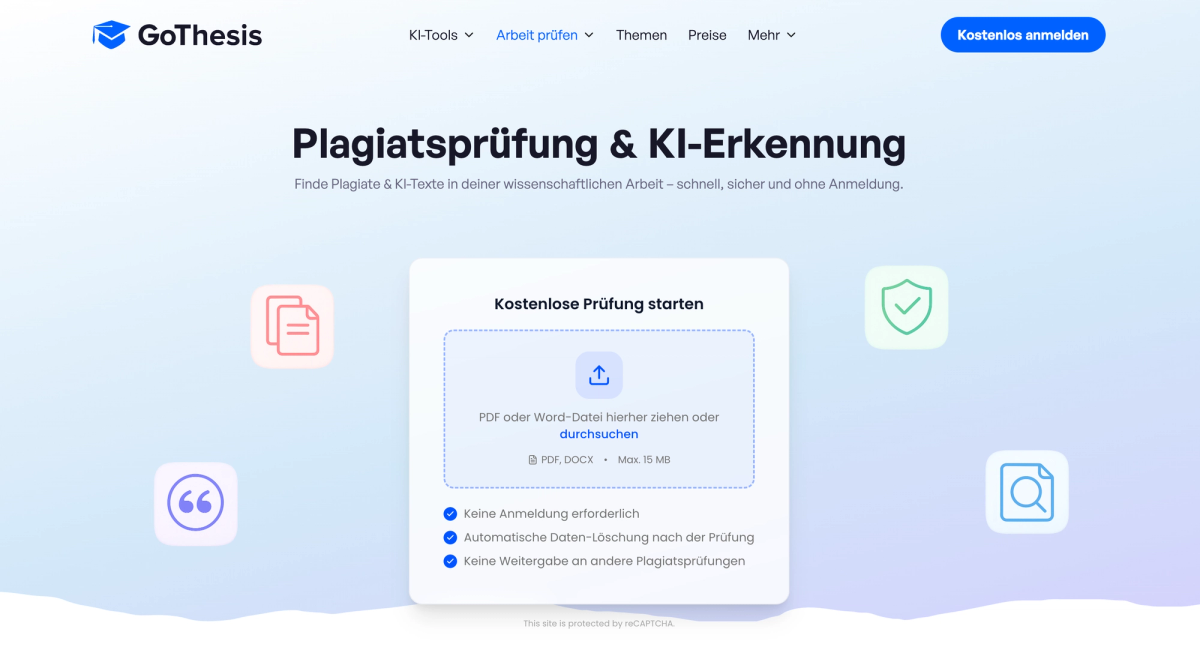
If you don't want to weigh things up for ages and just want to see where your work stands quickly, GoThesis's plagiarism check lets you upload your document for free, without registering, and gives you a first impression within minutes via the initial check.
Six features that reveal a strong tool
Rather than trusting someone else's ranking, it's better to check for yourself. The following six questions quickly reveal whether there's real quality behind the marketing promises.
How large is the source database?
A comparison is only as good as what it's compared against. A tool that covers plenty of websites, books and academic publications finds more than a provider with a thin database, which misses passages and gives you a false sense of security.
Does it catch rewritten passages too?
Only looking for word-for-word copies isn't enough these days. What matters is whether the software detects paraphrasing, meaning passages where the wording has been changed but the idea has been lifted. Because so many texts are now written with AI, an additional AI text detector is a clear bonus.
How useful is the report, really?
A bare percentage doesn't tell you much. A report only becomes useful once it highlights every flagged passage in the text, links the matching source and breaks down the similarity for each one. Only then can you see where you actually need to make changes.
What happens to your document?
This point is easy to overlook, yet it's the trickiest one. If your work ends up in a public, searchable database, it could later show up as an apparent "source" when your university runs its own check, so you'd effectively be plagiarising yourself. Make sure it's clearly stated where your data is stored and that it's automatically deleted after the check.
Pay once or subscribe?
For a single piece of work, a one-off payment per document is usually fairer than a subscription that quietly keeps running after your first check. What matters most is that the price is transparent and there are no hidden costs.
How fast is it, and how well does it handle your language?
Speed matters most right before a deadline. A result within minutes is a must, and so is reliable handling of texts in your own language, including special characters, technical vocabulary and the citation styles common in your studies.
💡 Tip:
Turn these six questions into your personal checklist and work through each provider's site with it. If an answer is missing, especially around data protection, treat that as a warning sign. A provider that's open about how it works, as GoThesis is with its plagiarism check, usually has nothing to hide.
GoThesis, Scribbr and BachelorPrint head to head
In everyday student life, most paths lead to the same three providers. What they have in common is that they charge per document rather than by subscription and deliver results within minutes. Where they differ is in technology, presentation and price.
GoThesis: the affordable AI approach
Because GoThesis runs its checks with AI, the price is lower than with many traditional providers. Your result appears in an interactive portal: suspicious passages are highlighted in colour, the original source is linked, and you can tick off or dismiss each match individually. Alongside word-for-word copying, it also picks up paraphrasing and citation errors, and a separate step checks for AI-generated sections. Getting started is easy thanks to a free initial check that shows you, without registering, how many flagged passages to expect in a section of your work. You only unlock the full report once you're convinced it's worth it.
Beyond the plagiarism check, it's also worth knowing you can add an AI proofreading service. That gives you feedback on the content of your work and helps you spot grammar and spelling mistakes that word processors like Word tend to miss.
You'll find a detailed rundown of all the features and prices in our GoThesis review.
Scribbr: closest to your university's check
Scribbr checks your work using Turnitin's technology. That's also the main reason for its popularity: since many universities also rely on Turnitin behind the scenes, your Scribbr result is often fairly close to what your university later finds. You pay a somewhat higher price for that closeness (worth noting: even Scribbr points out that universities often use their own databases, so results can still differ from your university's software). A free initial check is available here too.

BachelorPrint: strong if you're printing too
BachelorPrint offers a solid check for a one-off payment and really scores when you also want to have your finished work printed and bound by the same provider. Checking and printing from a single source is a genuine convenience for many people just before a deadline.

Prices and key features at a glance
| Provider | Price (one-off payment) | Key feature |
|---|---|---|
| GoThesis | €14.90 to €28.90 depending on word count, free initial check | AI-based, interactive online portal, citation-error and AI-text detection, optional AI proofreading add-on |
| Scribbr | €17.95 to €39.95 depending on word count, free initial check | Turnitin-based check, similar to many universities, including AI-text detection |
| BachelorPrint | €16.90 to €36.90 depending on word count | A good option if you're having your work printed afterwards, including AI-text detection |
All prices are one-off payments with no subscription. As of July 2026, subject to change.
Two prominent names are deliberately missing from this recommendation. Turnitin is the benchmark at many universities, but it's licensed through the institution and normally isn't available for individual students to book directly; you'll find the background in our guide to Turnitin for students. And Ouriginal, which operated for a long time under the names Urkund and PlagScan, was shut down in 2026 and is no longer available as a standalone solution.
Which tool is worth it for whom
A single winner won't get you far, but matching a tool to your goal gives you instant clarity. See which description fits you best:
- Check cheaply while still covering paraphrasing and citation errors: This is where GoThesis plays to its strengths. The interactive portal walks you through every flagged passage, and the free initial check lowers the barrier to trying it out.
- Get as close as possible to your university's eventual result: There's barely any way round Scribbr and its Turnitin basis.
- Have your work printed and bound afterwards: In this case, BachelorPrint is handy, since checking and printing come from the same place.
One more tip from practice: many people deliberately check twice, once early on to catch bigger issues such as paragraphs that stick too closely to the original, and a second time shortly before submission as a final check. A provider with a free initial check or a multi-check package pays off especially well for this approach. Our guides show you the best way to go about it depending on the type of work: plagiarism-checking a term paper, plagiarism-checking a dissertation, and plagiarism-checking a master's thesis.
Create a survey for free
With empirio.ai you can create a modern online survey in minutes — with hosting in the EU.
- AI-built survey
- Adjust by drag & drop
- Real-time analysis
Free checkers: where they help, and where they don't
Free plagiarism-check tools are easy to find, and they're fine for a first impression. But as soon as a final dissertation or thesis is involved, they almost always hit their limits, and exactly at the features covered above: a small source database, word-count restrictions, weak paraphrase detection. Some free services even fund themselves by reusing uploaded texts. That's an unnecessary risk to take with the single most important document of your studies.
The middle ground is a free initial check: you find out, at no cost, whether and how many suspicious passages are in a section of your work, then decide at your leisure whether the full report is worth it for you. That way you can try it risk-free and still get the depth you need once things get serious.
Pitfalls worth avoiding
The same four mistakes keep cropping up when people choose a tool. Knowing them will save you some hassle:
- Fixating on the percentage. Whether the report says 6% or 16% doesn't tell you anything on its own. All that matters is whether every idea you've borrowed is properly backed up with a source.
- Ignoring data protection. Upload your work to an opaque provider and you risk your text being stored and later counting against you as a supposed "source". Always check that there's no public storage and that deletion happens automatically.
- Leaving it too late. If you only check on submission day, you have no buffer left to rework any flagged passages properly. Checking early gives you breathing room.
- Accidentally sliding into a subscription. Nobody needs a monthly subscription for a single piece of work. Unless you deliberately want to check multiple times, a one-off payment is the clearer choice.
In short: finding the right plagiarism check for you
The best plagiarism software isn't the one with the loudest promises, it's the one that fits your work. Apply the five yardsticks of source volume, paraphrase detection, report quality, data protection and price, and it quickly becomes clear which tool will actually help you.
For most students, GoThesis is an affordable and capable option, with an interactive report and a free initial check. If you want to get as close as possible to your own university's result, look at Scribbr's Turnitin-based check, and if you're having your work printed anyway, BachelorPrint has you covered. Whichever you choose, it's better to check a little too early than too late, so you can go into your submission feeling relaxed.
Ready for the check?
Upload your work to the plagiarism check and see within minutes which passages you might still want to revise.