

“The lecture was qualitatively excellent.” “Quantitatively, far more people showed up than expected.” Two sentences about the same event, and yet they say completely different things.
Qualitative describes what something is like, quantitative describes how much of it there is. In empirical research that word difference becomes a methodological one: qualitative methods collect data openly and interpret meaning, while quantitative methods collect data in a standardized way and analyze it statistically. By the end of this article you will be able to decide which of the two routes fits your own research question.
📌 The key points at a glance
- Qualitative concerns the nature of something, quantitative the amount.
- Qualitative research interprets meaning, quantitative research measures and calculates.
- Standardization is the dividing line, not the number of cases.
- Qualitative says nothing about how good a study is.
- Mixed methods combine both approaches in one project.
Create a survey for free
With empirio.ai you can create a modern online survey in minutes — with 100% data protection from Germany.
Start for freeWhat do qualitative and quantitative mean in everyday English?
Qualitative refers to the nature, character or quality of something, while quantitative refers to amount, size and number. Both words describe the same object from two different angles, which is why they show up side by side so often.
The origin of the two words makes the difference easier to hold on to. Quality comes from the Latin qualitas, formed from qualis (“of what kind”). Quantity comes from the Latin quantitas, formed from quantus (“how great, how much”). Remember the two Latin question words and you already have the distinction: qualis asks “what kind?”, quantus asks “how much?”.
Everyday English has picked up a shortcut that causes confusion in research. Calling a product “quality” means it is good. That meaning does not carry over into “qualitative research”: there the term says only that a study looks at what a case is like, not at how many cases there are.
Qualitative does not mean good. Qualitative means: this is about kind, not about count.
What does qualitative mean in research?
Qualitative research is an umbrella term for methods that examine a subject openly and without standardization, in order to reconstruct meaning and generate hypotheses rather than test hypotheses that already exist.
Qualitative research relies on an interpretive approach aimed at understanding. Qualitative methods look at a few cases, or even a single one, in as much depth as possible, in order to open up a field about which little reliable knowledge exists so far. In a thesis or capstone project, this is usually the point at which your advisor asks you to justify your choice of method. The article on qualitative research walks through the process step by step.
How qualitative data is collected
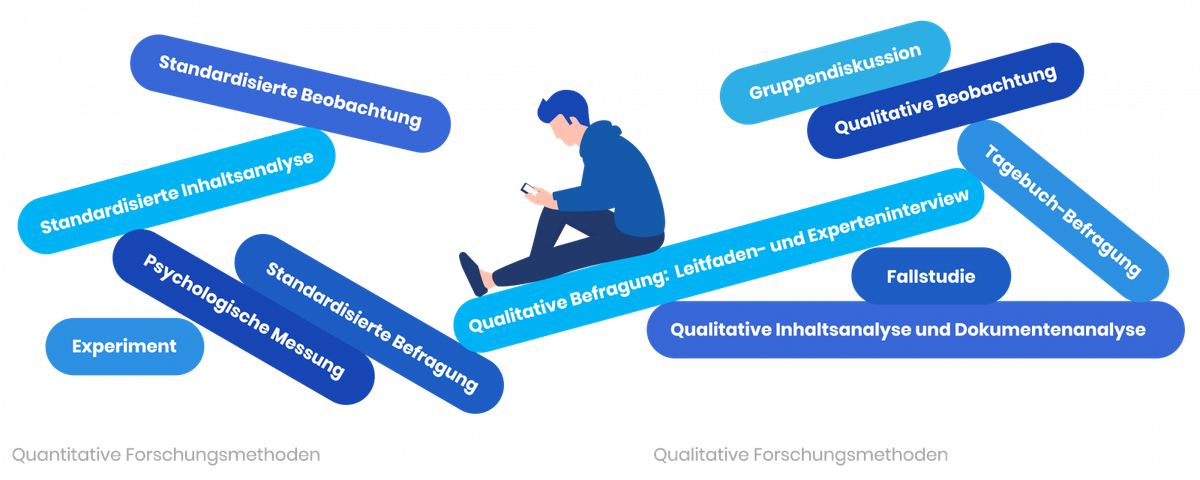
- Semi-structured and expert interviews
- Narrative interviews
- Focus groups and group discussions
- Diary studies
- Qualitative observation
- Qualitative content analysis
- Document analysis and case studies
Possible research question: What effect does frequently watching reality TV have on the way people see the world?
For a question like this, a small number of people are interviewed at length about their reasons and motives, using open-ended questions and no fixed answer options. The content analysis that follows sorts the answers into categories and works out patterns. The result is not a percentage but a well-founded account of how the connection actually works.
What does quantitative mean in research?
Quantitative research is an umbrella term for methods that measure characteristics in a standardized way and analyze them statistically, in order to test hypotheses formulated in advance and support statements about larger groups.
Quantitative methods give every respondent the same questions in the same order with the same answer options. That standardization is exactly what makes answers comparable and allows them to be counted, averaged and related to one another. Official statistics, such as those published by the U.S. Census Bureau, are built on the same principle. The article on quantitative research describes the full process.
How quantitative data is collected
- Standardized surveys, for example as an online survey
- Written, in-person or telephone interviews with a fixed questionnaire
- Standardized observation
- Standardized content analysis
- Experiments with a treatment and a control group
Possible research question: Is frequent television consumption associated with poorer mental well-being?
For a question like this, both characteristics, viewing time and mental well-being, are measured with a standardized questionnaire in a carefully drawn sample. The analysis uses statistical procedures and shows whether the two characteristics occur together and how strong that association is.
⚠️ Careful
A statistical association is not a cause. A survey can show that two characteristics occur together, but not that one produces the other. Anyone who wants to demonstrate causation needs an experiment or measurements taken at several points in time.
Create a survey for free
With empirio.ai you can create a modern online survey in minutes — with 100% data protection from Germany.
Start for freeQualitative vs. quantitative: the difference at a glance
The difference between qualitative and quantitative shows up in five places: the aim of the study, the type of data, the degree of standardization, the form of analysis and the reach of the results.
The table below puts both approaches side by side. It describes the normal case rather than a rigid rule, because in practice there are studies that combine individual features from both columns.
| Feature | Qualitative | Quantitative |
|---|---|---|
| Aim | understand meaning, build hypotheses | test hypotheses, measure frequencies |
| Guiding question | How and why? | How much and how often? |
| Data | text, image, audio | numbers and measurements |
| Collection | open, not standardized | standardized, identical for all |
| Analysis | interpretive, category-building | statistical, calculating |
| Result | types, patterns, new theories | distributions, associations, key figures |
One thing is missing from the table on purpose: the number of cases. Small samples are common in qualitative research, but they are a consequence of how demanding the method is, not its defining feature.
Three misconceptions about qualitative and quantitative
The three most common misconceptions about qualitative and quantitative concern the number of cases, an assumed claim to quality and the belief that you have to choose one of the two routes.
All three are persistent because the contrast “a few cases in depth against many cases in breadth” is so easy to remember. As a rule of thumb it holds. It still misses the point, and anyone who knows these three misconceptions will argue far more confidently in the methods section of a thesis.
Misconception 1: qualitative means few cases, quantitative means many
The number of cases is a side effect, not a distinguishing feature. What decides the label is whether data collection is standardized or reconstructs the individual case. Some methodologists therefore argue that the more useful contrast would be standardized against reconstructive procedures. A semi-structured interview stays qualitative even when 60 people take part.
Misconception 2: qualitative data is of higher quality
Qualitative data is neither better nor worse than quantitative data, it simply answers different questions. The word stem is misleading here, because “quality” in everyday English stands for “good”. Whether a study is any good is decided by its quality criteria and not by the type of data. The article on objectivity, reliability and validity explains what those criteria are.
Misconception 3: you have to choose one of the two approaches
Qualitative and quantitative methods can be combined within one project, and quite often that is the stronger solution. Under the name mixed methods, both routes are used one after the other or in parallel, for example open-ended interviews first for orientation and a standardized survey afterward for confirmation. The only requirement is that the combination is justified rather than a sign of indecision.
Qualitative or quantitative: which fits your question?
Whether you work qualitatively or quantitatively is not a matter of taste but of how much is already known about your topic and what kind of research question you are asking. Questions about why lead to qualitative methods, questions about how much lead to quantitative ones.
As a general rule, the less that is known about a topic, the more open the approach should be. If a clear and testable assumption already exists, the standardized route is the faster one. The table below sorts the most common starting points.
| Starting point | Suitable approach | Typical method |
|---|---|---|
| Topic barely researched | qualitative | semi-structured interview |
| Testable hypothesis in place | quantitative | standardized online survey |
| Statement about a large group needed | quantitative | survey with a random sample |
| Numbers exist, explanation missing | quantitative first, then qualitative | survey, then interviews |
| New questionnaire being developed | qualitative first, then quantitative | interviews, then a pilot test |
Taking both routes is rarer in student work, simply because it costs time. For a bachelor thesis, one well-justified approach carried through consistently is usually enough.
💡 Tip
In an online survey the question type decides the type of data. Rating scales, single choice and multiple choice produce quantitative data, open text fields produce qualitative data. A survey with ten closed questions and one open-ended question at the end stays quantitative, but that single open question often supplies the most valuable quotes for the discussion section.
Whether a planned survey counts as qualitative or quantitative therefore comes down to the question types in the questionnaire. The article on the qualitative and quantitative survey goes into that distinction in detail.
Conclusion
Qualitative and quantitative are not levels of quality but two directions of attention: one toward the nature of something, the other toward its amount. Read your own research question honestly and the answer is usually already there. A why in the question makes the study qualitative, a how much makes it quantitative.
What decides whether a study is qualitative or quantitative is not the number of participants but the standardization of the data collection.
Where to go from here
- Want to see a study from start to finish? Empirical research: definition, methods and guide
- Looking for the pros and cons of both routes? Qualitative and quantitative research methods
- Not sure whether your survey is qualitative or quantitative? Qualitative vs. quantitative survey compared
- Wondering whether you are working deductively or inductively? Induction and deduction: definition and difference
And what does the questionnaire look like?
The quantitative part needs rating scales and closed questions, the qualitative part needs open text fields. Both can sit in the same questionnaire, for example with empirio.ai, an online survey tool from Germany. See questionnaire templates
Frequently asked questions
Create a survey for free
With empirio.ai you can create a modern online survey in minutes — with 100% data protection from Germany.
Start for free