

Two conclusions, both of which sound logical: “All deciduous trees shed their leaves in winter, so the linden tree outside city hall will shed its leaves too.” And: “My three neighbors are always late, so neighbors are unpunctual.” Only one of those two sentences is compelling.
Induction and deduction differ in the direction of the reasoning: with induction you move from individual observations to a general rule, with deduction from a general rule to the individual case. Induction produces new knowledge and stays uncertain, deduction tests existing knowledge and is compelling in return. By the end of this article you will recognize which of the two directions sits behind any argument you read.
📌 The key points at a glance
- Induction reasons from the single case to the general rule.
- Deduction reasons from the general rule to the single case.
- A deductive conclusion is compelling, an inductive one only probable.
- Abduction is the third and usually forgotten form of reasoning.
- Research uses both directions, usually one after the other.
Create a survey for free
With empirio.ai you can create a modern online survey in minutes — free to start.
- AI-built survey
- Adjust by drag & drop
- Real-time analysis
Induction and deduction: the difference at a glance
Induction and deduction differ in three respects: the direction of the reasoning, the strength of the conclusion and the role each plays in the research process. The direction is the core, everything else follows from it.
Induction works from the bottom up, from many individual observations toward a rule that is meant to hold for unobserved cases as well. Deduction runs the other way, from a rule that has already been formulated to a statement about a concrete case. Because induction claims more than the observations contain, it can create new knowledge and accepts uncertainty as the price. Deduction never claims more than was already contained in its premises, which makes it safe but not new.
| Feature | Induction | Deduction |
|---|---|---|
| Direction | from the single case to the general rule | from the general rule to the single case |
| Strength | only probable, never compelling | compelling if the premises hold |
| Result | a new, provisional theory | a tested statement about the single case |
| Starting point | observation without a finished theory | an existing theory or regularity |
| Typical method | qualitative, such as guided interviews | quantitative, such as a standardized survey |
| Word origin | Latin inducere, “to lead in” | Latin deducere, “to derive” |
In research practice the two paths never appear as neatly separated as this table suggests. Neither works without the other: no observation is made without prior theoretical knowledge, and no theory emerges without contact with empirical material. A study is therefore rarely purely inductive or purely deductive, but predominantly one or the other. Closely related but not identical is the question of whether your work is qualitative or quantitative: that concerns the data, this concerns the direction of the reasoning.
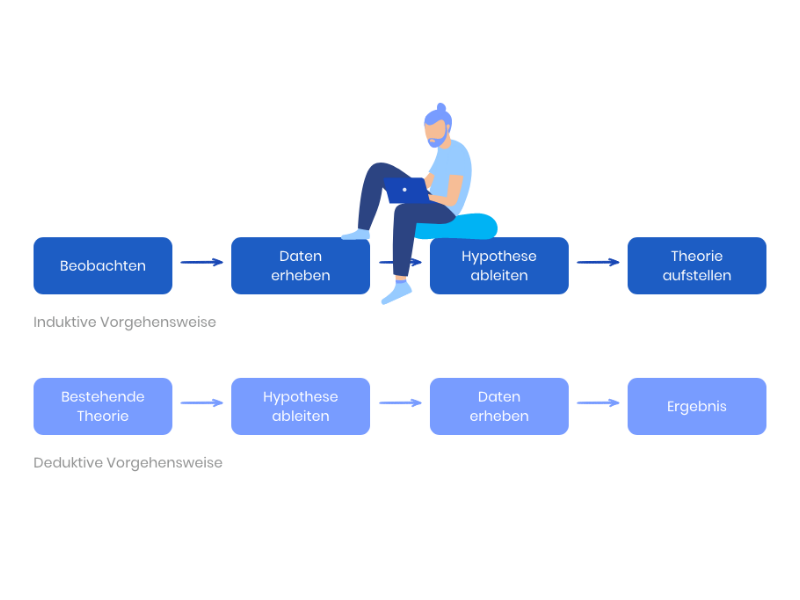
Induction: from observation to rule
Induction is the inference from individual observations to a general rule or theory that is meant to hold for unobserved cases as well. Researchers start from a specific case and derive generalized statements about similar cases, situations and regularities from it.
Inductive reasoning in everyday life: if someone turns up late several times, their friends assume that the person will be unpunctual in the future too. Nobody has ever tested this, and yet the conclusion covers every future arrangement.
In research this everyday logic is not enough. An inductive argument has to set out the probable connection between the premise (= the repeated lateness) and the conclusion (= future lateness) and support it with an empirical method, such as a guided interview. That always includes stating how many cases the conclusion rests on and how probable it therefore is.
Induction counts in empirical research as a good strategy for gaining new insights, which is why it is usually paired with a qualitative approach. If there is no usable theoretical basis for your research question, or if you want to develop a theory of your own, an inductive approach is the right choice. The article What does inductive mean? walks through the route from material to theory step by step.
Deduction: from rule to single case
Deduction is the inference from a general rule to a concrete single case. Researchers derive a logical statement about exactly the case they are interested in from a regularity that is taken to hold generally.
Deductive reasoning in everyday life: because all deciduous trees shed their leaves in winter and linden trees are deciduous, the linden tree outside city hall will shed its leaves in winter as well. Anyone who has never seen that tree can still make the statement.
In research a deductive argument has to be built so that the premise (= all deciduous trees shed their leaves in winter) transfers to the conclusion without any gap. That is then checked with an empirical method, for instance a quantitative observation in a mixed forest or a standardized survey.
Deduction counts as a good strategy for testing the validity of existing theories systematically, which is why it is typically paired with a quantitative approach. If the literature already offers a theory from which a hypothesis for your case can be derived, a deductive approach is the right choice. The article What does deductive mean? goes through the four steps in detail.
Strength: why only one of the two conclusions is compelling
A deductive conclusion is compelling, an inductive one never is: if a deduction is logically valid and its premises are true, the conclusion must be true as well. Induction, by contrast, always claims more than the observations deliver and therefore remains a statement about probability.
Both forms of reasoning pay for their strength with a weakness. Deduction is safe but creates no new knowledge: the statement about the linden tree was already contained in the general rule about deciduous trees. Induction creates new knowledge but can be overturned at any time by a single case. The sentence “all swans are white” was regarded as settled in Europe for centuries and fell with the first sighting of black swans in Australia.
The catch with deduction lies in the premises. Take the argument: all birds can fly, a penguin is a bird, therefore a penguin can fly. The form is logically flawless and the result is still wrong, because the first premise is false. Valid and true are two different things, and a valid argument built on a shaky rule is one of the most common weaknesses in a methods section.
The weakness of induction has a name of its own in the philosophy of science: the problem of induction. The Scottish philosopher David Hume showed in the eighteenth century that past observations yield no logical certainty about future cases. Karl Popper concluded from this, in his book “The Logic of Scientific Discovery” published in German in 1934, that theories can never be proved, only refuted.
Deduction can tell you nothing new. Induction can tell you nothing for certain. That is why research needs both.
Create a survey for free
With empirio.ai you can create a modern online survey in minutes — free to start.
- AI-built survey
- Adjust by drag & drop
- Real-time analysis
Abduction: the third form of reasoning that usually goes missing
Abduction is the inference from a surprising result to the most likely explanation for it. The term was introduced by the American philosopher and logician Charles Sanders Peirce (1839 to 1914), who described abduction as the process by which an explanatory hypothesis is formed.
Peirce explained all three forms of reasoning using a bag of beans, and the example makes the difference clearer than any definition. The same three building blocks are always involved: the rule, the case and the result. All that changes is which two of them are known.
- Deduction: rule and case are known. All beans in this bag are white, these beans come from the bag, so they are white.
- Induction: case and result are known. These beans come from the bag and they are white, so all beans in the bag are probably white.
- Abduction: rule and result are known. All beans in the bag are white, here are some white beans, so they probably come from this bag.
For your own work abduction matters wherever a finding does not fit the picture. It supplies the conjecture that then has to be tested, which places it at the start of an investigation rather than at its end. Peirce explicitly tied abduction to a subsequent deductive check, precisely because any finding invites plenty of invented explanations. How such a conjecture becomes a testable hypothesis is covered in Formulating a research question and hypotheses.
Induction or deduction: which suits your own work?
Whether you work inductively or deductively is decided by the state of research on your topic, not by taste. If a theory exists that fits your question, you test it deductively. If none exists, you develop one of your own inductively.
Many theses combine the two, and that is entirely acceptable. One common pattern: a handful of open interviews first explore inductively which factors play a part at all, then the resulting conjecture is tested deductively in a standardized survey. The only requirement is that your methods section says which step follows which logic.
| Your starting point | Suitable route | Typical data collection |
|---|---|---|
| A theory exists that you want to test | deduction | standardized online survey |
| There is barely any literature on the topic | induction | guided interviews |
| You want to explore first, then test | induction first, then deduction | interviews, then a survey |
| A finding surprises you | abduction as an interim step | form a hypothesis, then test it |
For the deductive part you will usually need standardized data. With empirio.ai, an online survey tool from Germany, you can create such a survey free of charge and export the responses for analysis. How a survey fits into a thesis is set out in the guide to surveys for a bachelor or master thesis. How both directions shape an entire research design is explained in deductive and inductive research.
Three mix-ups that keep coming up
Three mistakes appear again and again around induction and deduction, and all three come from an equation that looks plausible at first sight. In the methods section of a thesis they stand out immediately, because they undercut the justification of the method.
The quickest way to find them when proofreading is to ask one question of every methodological claim: am I really talking about the direction of the reasoning here, or about something else that merely sounds similar?
Mathematical induction is a deductive procedure
Mathematical induction carries the name but means something else. It is a proof technique that establishes a statement for all natural numbers with certainty, via a base case and an induction step. That certainty is exactly what induction in the philosophical sense can never reach. The German term was coined by the mathematician Richard Dedekind in 1888 in his work “Was sind und was sollen die Zahlen?”.
Inductive is not the same as qualitative
Inductive work and qualitative methods often appear together, but they mean two different things. Inductive and deductive describe the direction of the reasoning, qualitative and quantitative describe the data. Patterns that lead to a new hypothesis can be read off quantitative data as well, and a guided interview can perfectly well serve to test an existing theory.
A large number of cases does not make an inductive conclusion compelling
A large sample raises the probability of an inductive conclusion but does not turn it into a proof. Even after a thousand consistent observations it remains open to refutation. What a large sample actually delivers is something else: it makes the statement more precise, and only a suitable composition of participants makes a study representative.
⚠️ Careful
Never write in your methods section that a theory has been proved inductively. Inductive findings are presented as provisional and then tested. Phrasings such as “the analysis suggests” or “the data support the assumption” are accurate and cost you no points.
Conclusion
Induction and deduction are not rival camps but two halves of the same movement: one brings a theory into existence, the other puts it to the test. For your own work it matters less which of the two routes you take than whether you can name it and justify it. Anyone who writes clearly in the methods section why their starting point calls for exactly this route has already dealt with the hardest part of the methods discussion!
Where to go next
- Want the route from single case to rule in detail? What does inductive mean?
- Want to follow the opposite direction? What does deductive mean?
- Planning your research design? Deductive and inductive research
- Need the process from start to finish? The empirical research process
The theory is ready, the data are missing?
With empirio.ai you can create an online survey free of charge, collect the responses from your sample and export them for analysis.