

Ask two people what a multiple choice question is and you get two different answers. Anyone who has just taken an exam pictures four options with exactly one correct. Anyone building a questionnaire pictures a column of checkboxes where several can apply at once.
A multiple choice question is a closed question with a fixed list of answer options. In a survey the term means respondents may check more than one box, while on an exam it usually means one option is correct and the rest are deliberately built wrong answers called distractors. We will show you both versions, with examples and with the rules for reading the results.
📌 The key points
- Multiple choice questions offer a fixed list of options.
- In surveys several answers may apply at once.
- On exams the wrong options are called distractors.
- Pew Research Center avoids select-all lists entirely.
- Multiple response percentages add up past 100.
Create a survey for free
With empirio.ai you can create a modern online survey in minutes — free to start.
- AI-built survey
- Adjust by drag & drop
- Real-time analysis
What are multiple choice questions?
A multiple choice question is a closed question where every answer option is written out in advance and the respondent may pick more than one of them. Survey software often labels the same format multiple response or check-all, and all three names describe the identical thing.
Survey research and testing part ways at exactly this point, which is why two people can talk past each other using one word. In a survey there is no correct answer, only categories that either apply to someone or do not. On an exam there certainly is a correct answer, and the remaining options exist specifically to sound plausible while being wrong.
| Setting | How many answers count | Role of the other options |
|---|---|---|
| Online survey | every one that applies | equally valid categories |
| Exam with one key | exactly one | distractors, the wrong answers |
| Exam with several keys | more than one | part correct, part distractor |
Methodologically the multiple choice question belongs to closed questions without a rating scale. Timo Lenzner and Natalja Menold distinguish three response formats in the GESIS Survey Guidelines on question wording (2015): open questions, closed questions with a rating scale, and closed questions without one. The multiple choice question sits in the third group, because its options stand side by side and follow no gradation.
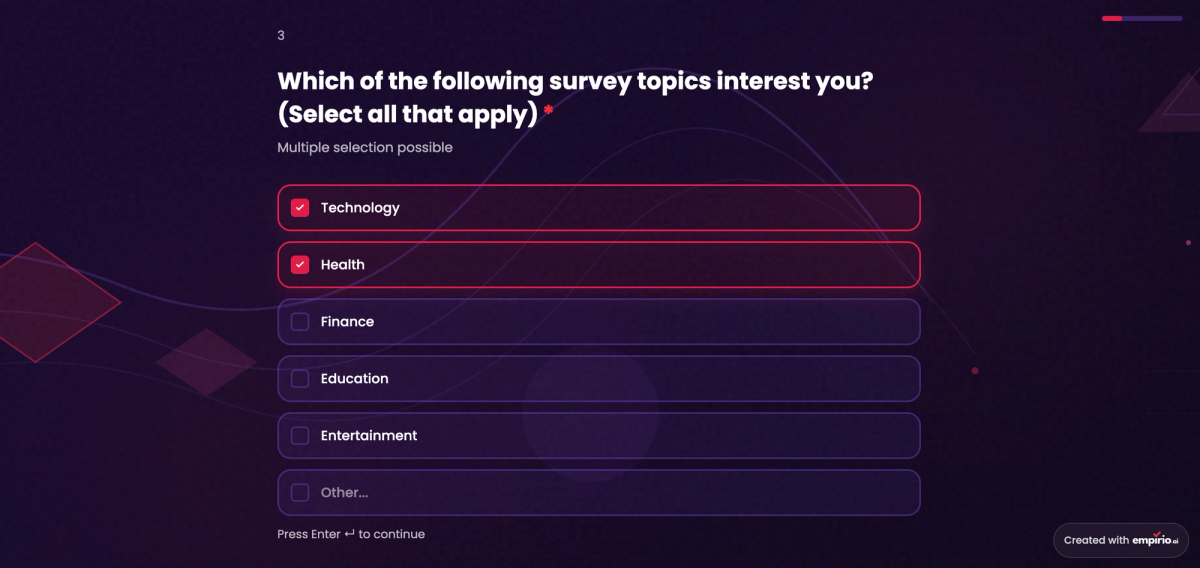
One detail gets misreported often, and it comes back to bite at the analysis stage. A multiple choice question does not create one variable with several values in your dataset. It creates as many yes-no variables as there are options, so twelve checkboxes give you twelve columns, each holding checked or not checked. Which calculations that allows is covered in the article on levels of measurement.
Multiple choice question examples
A multiple choice question fits whenever the answer options do not rule each other out. Languages spoken, devices used, events attended or reasons behind a decision are the standard cases, because one and the same person can honestly check several of them and a single pick would flatten the picture.
The counter-test takes seconds and saves a lot of grief later. Picture one real respondent and walk the list: if more than one box would honestly need checking, multiple choice is right. If it can only ever be one, the item belongs in the questionnaire as a single choice question.
Multiple choice examples from surveys and questionnaires
In a survey the permission to check several boxes belongs in the question itself, not in a footnote and not in the layout alone. A short note such as “Select all that apply” is enough. Without any such hint some respondents treat the item as a single choice and check only the most important answer, and the distribution ends up systematically too narrow.
- Which social networks do you use at least once a week? Select all that apply.
- What reasons led you to choose this major? Select all that apply.
- Which campus library services have you used this semester?
- Which languages do you speak well enough to hold a conversation?
None of these four asks for an opinion, and that is the point. Multiple response suits things a person can list, so usage, ownership, experience or reasons. For attitudes and judgments a rating scale is the right format, because it shows how strongly someone holds a view rather than only that they hold it.
Multiple choice examples from exams and tests
On an exam the same form splits into two parts. The Poorvu Center for Teaching and Learning at Yale University describes multiple choice questions as typically composed of a question stem and several choices, including distractors and one correct option.
Stem: A glass is filled with water and floating ice cubes. The ice cubes melt. What happens to the water level in the glass?
- The water level stays the same.
- The water level in the glass rises.
- The water level in the glass falls.
The three options are similar in length, similar in build and all three sound possible at first pass. Someone who does not know the physics cannot work out the answer from the shape of the options, and that is the whole test of a well built exam item.
Building the answer list
The answer list of a multiple choice question has to meet two formal conditions: it must be exhaustive, covering every realistic answer, and free of overlap, so no two options describe the same thing. Both conditions decide whether your frequencies mean anything at the end or are simply an artifact of the list.
The GESIS Survey Guidelines state both for closed questions in general, but on a check-all question they bite harder. On a one-answer question an overlap forces an arbitrary decision, and that often leaves no visible trace in the data. On a multiple response question the respondent simply checks both boxes, and the same fact gets counted twice.
An escape category belongs on almost every list
Few lists can be made genuinely complete, so the GESIS Survey Guidelines recommend an “Other” category, ideally with a small free text field beside it. On a multiple response question a second escape category is easy to forget: “None of these”. Without it there is no way to tell later whether someone skipped the question or whether nothing on the list applied.
Where an option sits changes how often it is picked
Position in the list affects selection. In self-administered surveys respondents tend to pick items near the top, the primacy effect, and both GESIS and Pew Research Center describe it. Pew programs many of its own response lists to be randomized so that no single item sits early or late for everyone, which spreads the bias across the sample instead of concentrating it on one option.
Long lists invite fast checking
Pew Research Center advises keeping the number of answer choices to a relatively small number, just four or perhaps five at most, because people have a hard time holding more than that in mind at one time. For factual questions such as field of study or religious affiliation, more categories are explicitly encouraged, and Pew's own religion questions run past twelve. What decides is not the count alone but whether the list asks respondents to deliberate or to recognize.
💡 Tip
Read your options aloud as complete sentences, stem plus option each time. Wording that looked elegant in the layout reliably turns out to be skewed or ambiguous once it has to be spoken.
Check-all lists or yes-no per item
A check-all list is not the only way to capture several answers, and by the research it is not the most accurate. The alternative is to have each option answered separately with yes or no, known as the forced choice format. A list of eight checkboxes then becomes eight short individual questions.
Pew Research Center is unusually blunt about this. After a study of its own in 2019 it found that forced choice questions tend to yield more accurate responses, especially for sensitive questions, and it has generally avoided select-all-that-apply questions ever since. The GESIS Survey Guidelines reach the same recommendation from the other direction, proposing the yes-no format as the way to remove order effects.
What the check-all list gives you
- Respondents finish noticeably faster.
- Long option lists look less daunting on screen.
- Every survey tool supports the format without extra work.
- Analysis needs no additional calculation steps.
What you take on in exchange
- Lower items get checked systematically less often.
- An empty box stays ambiguous between no and overlooked.
- Answers on sensitive topics come back less accurate.
- Anyone clicking quickly checks only the obvious.
The rule of thumb follows from that. The more weight a single option carries in your analysis, the more the yes-no format is worth its extra clicks. An opening question about channels used can stay a quick check-all list. The central question of a thesis, the one an entire chapter of results hangs on, deserves the slower format.
Create a survey for free
With empirio.ai you can create a modern online survey in minutes — free to start.
- AI-built survey
- Adjust by drag & drop
- Real-time analysis
Multiple choice questions on exams and tests
On an exam the quality of the wrong answers decides whether a multiple choice question measures anything at all. Those wrong answers are the distractors, and they should sound plausible enough that only real understanding rules them out. An item with weak distractors tests how well someone reads test questions, nothing more.
The Poorvu Center for Teaching and Learning at Yale University puts the standard in one sentence in its guide to designing assessment questions: good distractors target major student misconceptions, remain clear by avoiding overlapping content and awkward grammar, and avoid catch-all answers like all of the above or none of the above. On the number of choices the same guide points to prior research supporting a minimum of three.
How students find the answer without knowing the material
Guessing is the structural weakness of the format, and students are good at it. The rules of thumb that circulate among test takers are the most useful fault list an instructor can have, because each one points at a specific construction error. Clear all four and most of the guessing advantage disappears.
| Student rule of thumb | The fault behind it | What you do about it |
|---|---|---|
| The longest answer is the right one | key written out more fully | keep all options similar in length |
| Answers with “always” or “never” are wrong | absolutes only in distractors | cut absolute wording entirely |
| The most technical answer is right | jargon only in the key | spread technical terms evenly |
| Option c is usually right | key rarely placed first | vary where the key sits |
Why catch-all options rarely earn their place
Options such as none of the above or all of the above are named directly in the Yale guidance as things to avoid, and the reason is that instructors reach for them when a fourth distractor will not come. Students learn to read them as filler and cross them out without thinking about the subject at all. The same logic applies to obviously silly distractors: an option nobody ever picks turns a four-option item into a three-option one.
One point sits outside item writing and still gets missed regularly. Course policies and university testing centers often govern more than the exam sheet shows, including the passing threshold, whether guessing is penalized and whether partial credit applies when several answers are correct. What binds you is your own institution's policy rather than common practice, and this article does not replace reading it.
Analyzing multiple choice questions
You analyze a multiple choice question by counting each answer option separately and then converting the counts into percentages. Unlike a single choice question those percentages do not add up to 100, because every respondent enters the calculation more than once and is counted again with each box they check.
That leads to the one decision that really matters here: what are you taking the percentage of? There are two legitimate bases, they produce different numbers from the same data, and both numbers are correct. It only goes wrong when the report fails to say which of the two is meant.
| Base | How it is calculated | What it is good for |
|---|---|---|
| Percent of cases | selections divided by respondents | how widespread an option is |
| Percent of responses | selections divided by all selections | share of the total response volume |
A small worked example makes the difference concrete. With 200 respondents and 500 selections in total, 150 selections fall on the option “Instagram”. Taken over cases, 75 percent of respondents use Instagram; taken over responses, Instagram accounts for 30 percent of the response volume. For the question “how widespread is Instagram” the first figure is the right one.
⚠️ Careful
Write the base directly onto the table or chart, for example “figures as a percentage of 200 respondents, multiple answers permitted”. Without that line a reviewer reads a distribution summing to 250 percent as an arithmetic error.
Comparing two groups needs a cross-tabulation per option, since each option is its own yes-no variable. Means are meaningless here, because the numbers 1 to 12 in an option list are labels without rank order. Which statistics suit which type of data is set out in the article on methods of analysis.
Common mistakes with multiple choice questions
Most mistakes in multiple choice questions come from assembling the options rather than from writing the stem. Four of them turn up especially often, and all four can be cleared in a few minutes before you send anything out, provided you read the finished list through in one go.
They share one unpleasant property: they do not produce an error message, they produce a distribution. A skewed distribution looks exactly like a finding, which is why the fault usually surfaces long after fielding has closed.
The instruction to check several boxes is missing
Without a note such as “Select all that apply”, some respondents treat the item as a single choice and check only the answer that matters most to them. The effect does not hit everyone equally, it hits the people moving quickly through the form. Every option then appears too rarely in the results, and by differing amounts.
Two options mean the same thing
Put “Instagram” and “Instagram Stories” side by side and the same person checks both, so a single behavior is counted twice. These duplicates almost always creep in when a list is extended later and someone adds a supposedly missing option without rereading the existing ones. On a one-answer question the same fault would surface sooner, because the respondent visibly stalls between two equally correct answers.
The list runs longer than the attention span
At fifteen options hardly anyone reads to the end, and the lower entries lose out to the upper ones. Grouping by theme and splitting one long list into two shorter questions works better. Where length is unavoidable, as with a list of states or majors, alphabetical order helps, because respondents then search rather than read.
Multiple response sits where only one answer is possible
Questions about the degree someone is working toward, their year of birth or their current state allow only one answer as a matter of fact. They still appear as check-all items surprisingly often, because whoever created them accepted the default question type. The result is records with two degrees checked that can never be resolved afterward, since nobody knows which one was meant.
How these four points fit into the wider process, from first draft to pretest, is covered in the guide to designing a questionnaire.
Conclusion
The multiple choice question is the format where the work sits before you send, not after. Build options that do not overlap, add the instruction to check several boxes and offer an escape category, and you get data you can analyze the same day. Anyone writing for an exam should spend most of the time not on the question but on the distractors.
A multiple choice question is only ever as good as the options nobody checked.
Where to go next
- Want the contrast with one-answer items? Single choice questions explained
- Looking for the rules covering every closed format? Closed questions and their answer categories
- Wondering what other question types exist? Question types in a questionnaire
- Weighing a fixed list against a text box? Open and closed questions compared
The survey rules used here come from the Pew Research Center guidance on writing survey questions and the GESIS Survey Guidelines by Lenzner and Menold (2015), the exam rules from the Poorvu Center for Teaching and Learning at Yale University.
Want to try a multiple choice question right away?
With empirio.ai, an online survey tool from Germany, you set up multiple choice, single choice and rating scales in a few clicks and see the counts per answer option directly in the results. Create a survey for free