

Count for a moment: how many surveys have you filled out this semester? What you just did was a measurement on an absolute scale, the highest level of measurement that statistics knows.
An absolute scale is a metric level of measurement where both the zero point and the unit are given by the thing itself: you count in whole items, and fewer than zero items does not exist. It is the only scale whose values cannot be converted into another unit. By the end of this article you will recognize absolutely scaled variables in your own survey and know which analyses they allow.
📌 The key points
- An absolute scale has a natural zero point and a natural unit.
- Absolutely scaled variables almost always come from counting.
- The absolute scale is a special case of the ratio scale.
- Values on an absolute scale cannot be converted into another unit.
- Every calculation and every statistical measure is permitted.
Create a survey for free
With empirio.ai you can create a modern online survey in minutes — free to start.
- AI-built survey
- Adjust by drag & drop
- Real-time analysis
What is an absolute scale?
An absolute scale is a metric level of measurement on which values are expressed as numbers, a natural zero point exists and the unit of measurement is given by the thing itself, in the broadest sense the unit of one item.
A natural zero point means the zero describes a real state rather than a convention set by people. Zero residents means nobody is there. A natural unit means there is only one sensible counting unit for the possible values. One person is one person, and half a person appears in no population statistic.
The natural unit is what separates the absolute scale from the other metric scales. A level of measurement describes how much information a measurement carries, and the absolute scale sits at the top of that order.
| Level of measurement | Zero point | Unit |
|---|---|---|
| Interval scale | set by convention | freely chosen |
| Ratio scale | natural | freely chosen |
| Absolute scale | natural | naturally given |
Most textbooks stop at four levels and treat count data as a special case of the ratio scale, because arithmetically the absolute scale adds nothing new. The hierarchy itself goes back to the psychologist S. S. Stevens, who set it out in Science in 1946.
Absolute scale or ratio scale: how to tell them apart
One question settles it: can the variable be expressed in a different unit without losing its meaning? With body weight you can, with the number of siblings you cannot.
Body weight can be given in pounds, in ounces or in kilograms. All three describe the same person, and the ratios between two values stay the same. That is the core of the ratio scale: a natural zero point, but a freely chosen unit. On an interval scale even the zero point is a convention, which is why temperatures in Fahrenheit can go below it.
With a count, that choice disappears. Three siblings are three siblings. No second unit exists to convert them into, and that is exactly what makes an absolute scale.
Four chairs remain four chairs. For counts there is no second unit of measurement.
Because the absolute scale carries every property of the ratio scale and adds one more condition, it is a special case of it. Both belong to the metric scales, which many textbooks group together as the cardinal scale.
Examples of an absolute scale in a survey
Absolutely scaled variables are easy to recognize in a survey: the question starts with how many or how often, and the answer is a count. Anything that can be counted sits on an absolute scale.
In a quantitative survey these questions appear more often than most people notice. They usually sit quietly in the demographic section at the end, where household size, semesters completed or frequencies are asked about.
- How many semesters have you completed so far?
- How many credit hours are you taking this semester?
- How many people live in your household?
- How many responses have you collected for your thesis?
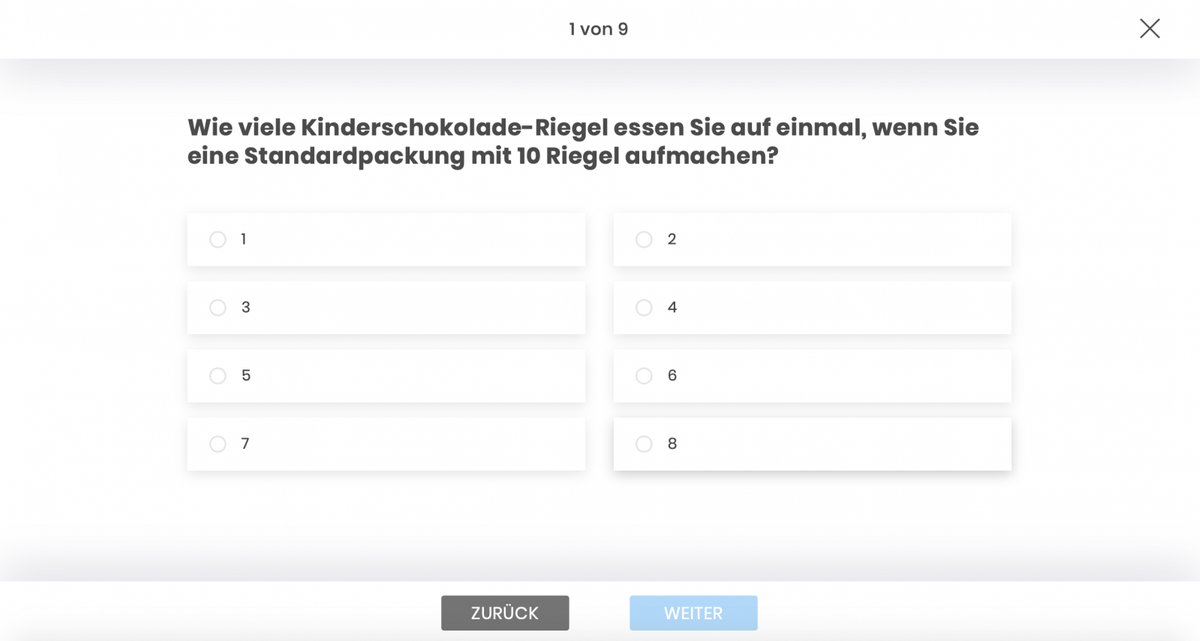
Outside the survey the absolute scale works the same way. The population of a country is absolutely scaled, which is how the US Census Bureau reports it for the United States. The number of people at an event and the number of cylinders in an engine belong in the same group.
Counts are not the only case, though. Ingo Klein of the chair of statistics at the University of Erlangen-Nuremberg assigns not only counts but also ranks and proportions to the absolute scale, because each of them allows exactly one measurement rule. A percentage, on that reading, is as absolutely scaled as a number of items. The argument is set out in the German-language discussion paper Skalentypen und Statistik (2004).
What you can calculate on an absolute scale
Every arithmetic operation is permitted on an absolute scale: addition, subtraction, multiplication and division. That also opens up every statistical measure, from mode and median through mean and standard deviation to the geometric mean.
This works because the absolute scale holds the highest level of measurement and contains the ones below it: whatever is permitted on a ratio, interval or ordinal scale is permitted on an absolute scale too. In practice that means you never have to check whether a method matches the level of measurement when you are working with counts.
Scale transformations, on the other hand, are not permitted on an absolute scale, because the identity mapping is the only transformation left. A ratio scale can be rescaled by a fixed factor, pounds into kilograms for instance. For a count no such factor exists, and that small difference goes unnoticed by almost everyone.
Absolutely scaled data are therefore the raw material everything else is derived from: counts become frequencies, frequencies become proportions, and both stay sound arithmetically. For your analysis that is the most comfortable starting point you can get!
Create a survey for free
With empirio.ai you can create a modern online survey in minutes — free to start.
- AI-built survey
- Adjust by drag & drop
- Real-time analysis
The most common mistake: asking for counts in ranges
The most common mistake with absolutely scaled variables happens while the survey is being built: the count is not asked for as a number but in given ranges such as 1 to 2, 3 to 5 and 6 or more. The high level of measurement is gone at that point.
Predefined ranges turn a count into ordered categories, and those sit on an ordinal scale. The mean can no longer be calculated cleanly, only estimated from class midpoints, and the top category is open ended. Anyone who later wants to analyze that question as metric data has to run the survey again.
The fix is an open input field for a number instead of a list of ranges. Whether you build your survey with Google Forms, SurveyMonkey or empirio.ai, an online survey tool from Germany, makes no difference to the level of measurement: the question format decides, not the tool. Which other question types fit depends on the variable, but for counts an open numeric question is almost always a better choice than a list of closed answer options.
⚠️ Watch out
Ranges are not always wrong. With income many researchers choose categories on purpose, because more people drop out of an open question. Decide before you send the survey whether you really need the mean, and only use ranges if you can do without it.
Conclusion
The absolute scale is not an advanced special case. It is the level of measurement most numbers in your survey land on as soon as you ask about counts. The name matters less than the consequence: asking for counts openly keeps every analysis option, squeezing them into ranges gives those options away.
Where to go next
- Want the full overview of scales? Levels of measurement explained
- Need the level below? Ratio scale with examples
- Looking for the right question format? Question types in a survey
- Planning the analysis? Quantitative surveys explained
Ready to collect the numbers yourself?
Our guide on how to create a questionnaire shows you how to build one that stays analyzable from the very first question.